
Certain financial indicators have historically been linked to Bitcoin’s performance, such as the global money supply (M2). But then, why isn’t the significant increase currently being recorded in M2 leading to an automatic rise in BTC?
Global Money Supply (M2) and Bitcoin: Is the Decoupling Confirmed?
The reality of the cryptocurrency market is evolving, and with it, the metrics historically used to analyze it in order to provide a solid assessment of the current situation and/or make reliable forecasts. For example, one need only look at how Ether’s performance has largely decoupled from that of Bitcoin since last year, to the point where it is no longer possible to anticipate delayed increases in ETH.
This situation also affects other indicators that are generally quite reliable, such as the curve of the global money supply, also known as M2. This metric is used to estimate the liquidity circulating in the financial system and its previously fairly direct impact on the price of BTC.
Indeed, the greater the available global liquidity, the faster investments in risky assets like cryptocurrencies accelerate. However, while this money supply curve shows a significant increase, BTC is currently plummeting below the $85,000 mark.
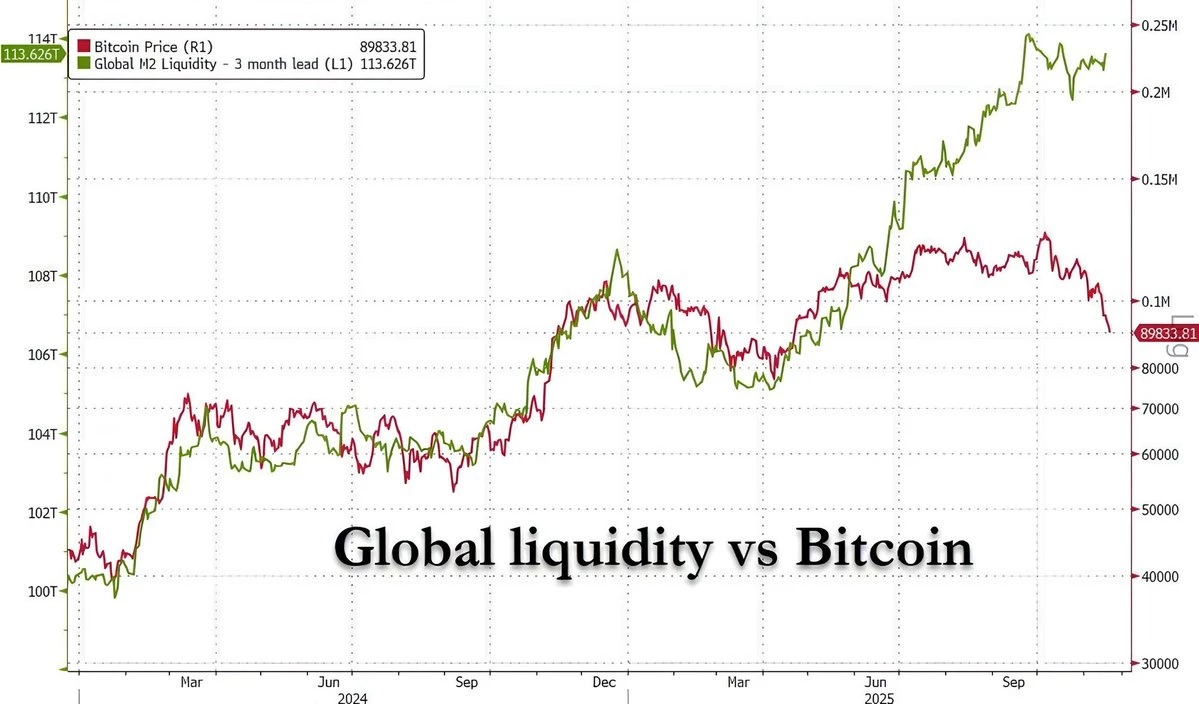
Significant decoupling between global money supply and the Bitcoin price
This observation was made by the analytics firm Finneko in a post on the X network that attempts to explain this discrepancy, which may “give the impression of an anomaly.” However, it makes perfect sense “once you look at what actually makes up this ‘global liquidity’—and, more importantly, where the increase is coming from.”
This is where it all comes down to: Global M2 is rising, but the liquidity that matters to the markets (that of the United States and Europe—the liquidity that flows into risky assets, credit, ETFs, and hedge funds) isn’t really improving.
Finneko
A liquidity trap made in China
According to Finneko analysts, the current situation hinges on China. Indeed, a very significant portion of the acceleration in global liquidity stems from the Chinese government’s attempt to stabilize its financial system, which is plagued by “the real estate crisis, local government debt, and an economy under deflationary pressure.”
This opening of China’s monetary floodgates inevitably triggers a rise in the Global M2 indicator, since “China alone accounts for nearly 30% of global liquidity.” The problem? This seemingly abundant capital is not flowing into the real economy, let alone into the global market for risky assets.
The money remains within the banking system, used to roll over debt, recapitalize, and plug holes. In short, we are in a kind of liquidity trap with a much less positive dynamic.
Finneko
A situation exacerbated by the restrictive monetary policy implemented in the United States. This is all the more true given that Bitcoin has historically been much more strongly correlated with the realities of the U.S. market—retail and institutional investors, ETFs, and dollar-denominated flows—than with Chinese policy decisions in this area.