
While the cryptocurrency market appears to be entering a pullback phase, stablecoin trading volumes are skyrocketing. Crypto investors are shifting into “extreme fear” as the market plunges once again
Since its last all-time high, Bitcoin has been unable to break free from the pull of the symbolic $100,000 level. This situation has triggered new massive liquidations, while some established cryptocurrencies are surging upward.
Crypto investors shift to “extreme fear”
Just one month ago, Bitcoin hit a new all-time high of $126,000. This record would be followed by a market collapse a few days later, with liquidations exceeding $20 billion.
Since then, the cryptocurrency market has been trying to recover, without much success. Except perhaps for certain established tokens like Zcash (ZEC), driven by the unlikely enthusiasm of those who see it as a quantum alternative to BTC.
And the situation doesn’t seem likely to improve anytime soon, given the latest market decline that has triggered $1.37 billion in liquidations over the past 24 hours. This has prompted the Fear & Greed Index to show “extreme fear” among investors, who are weary of the market’s lackluster performance.
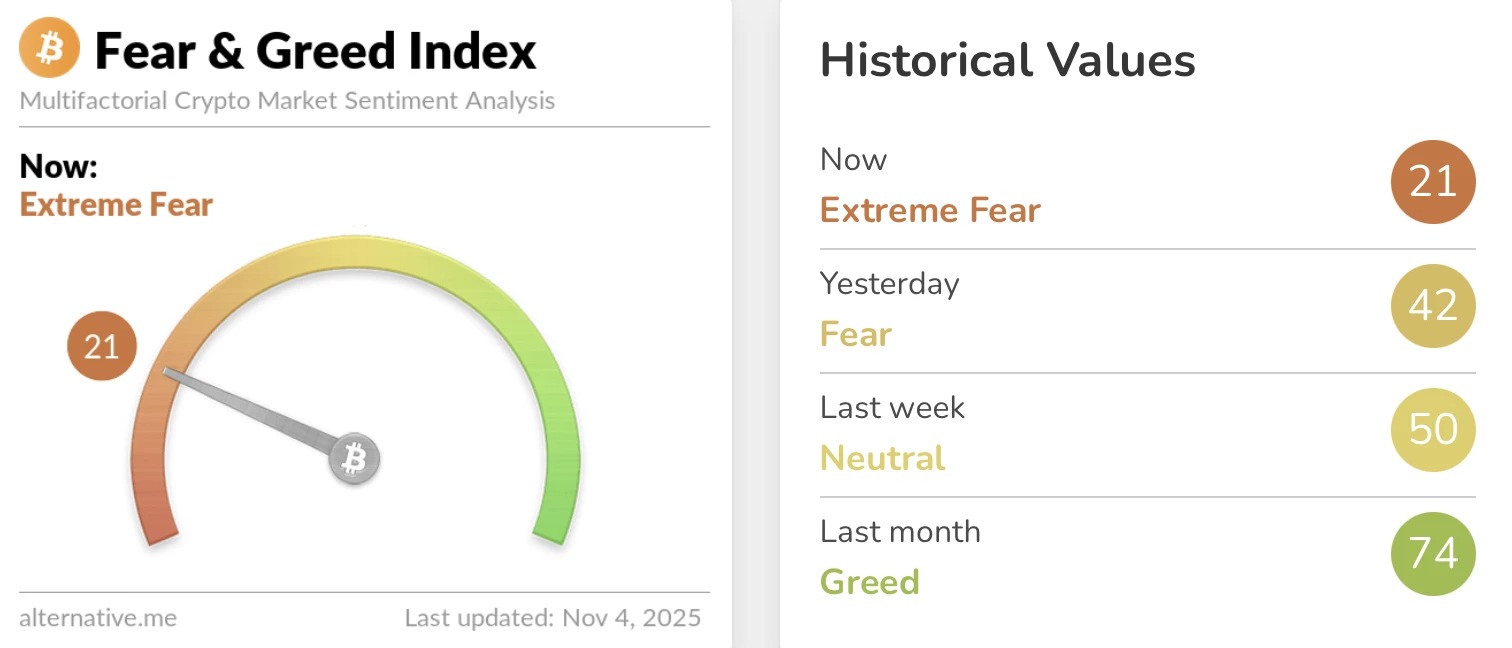
Crypto investors shift to ‘extreme fear’
The U.S. spot Bitcoin ETF market is in the red
At the same time, BTC is posting one of its worst October performances since 2014, with a decline of nearly 4% at the monthly close.
This situation is directly impacting the U.S. spot Bitcoin ETF market, with four consecutive days of net outflows totaling over $1.3 billion.
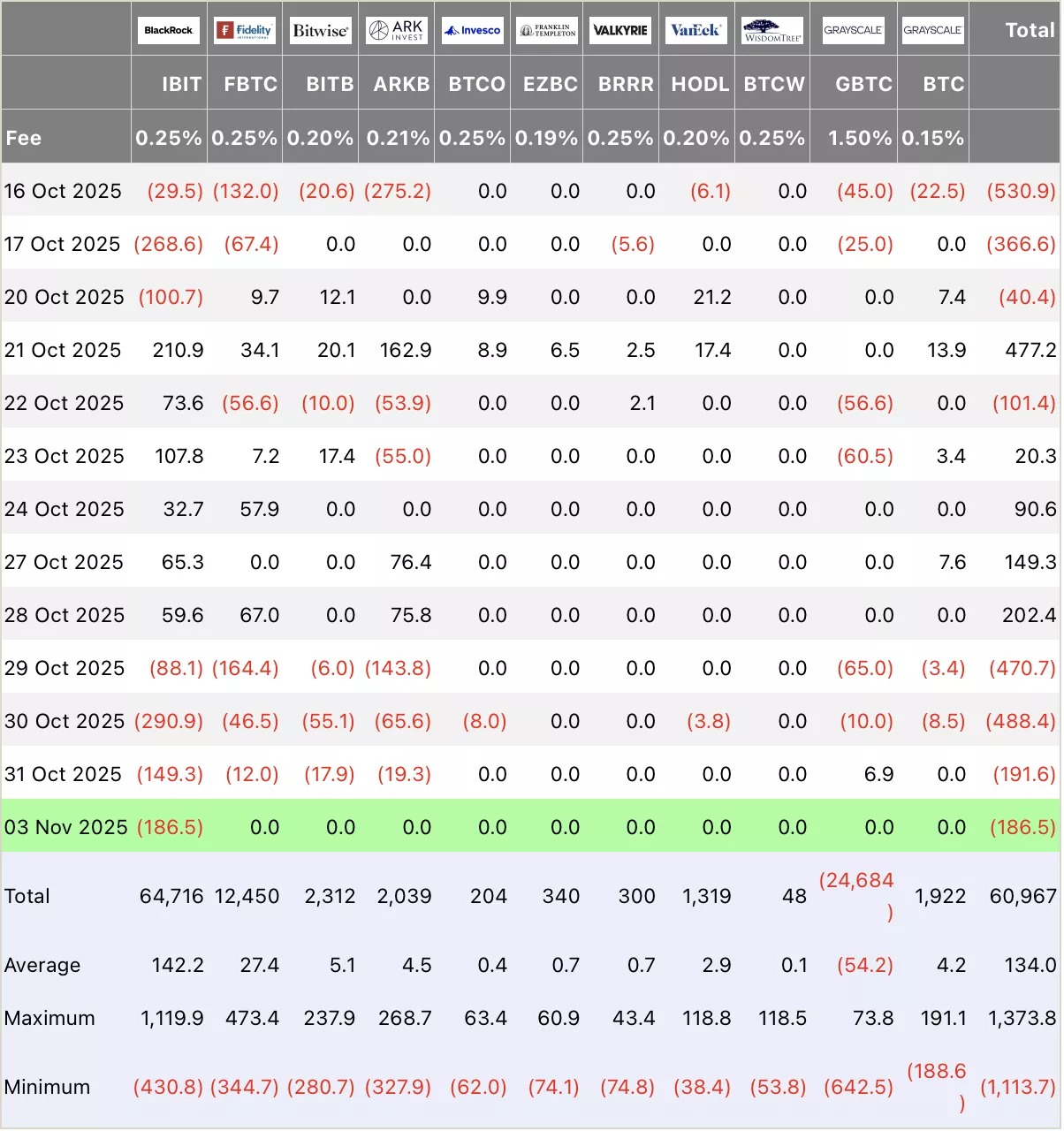
The spot Bitcoin ETF market is seeing significant outflows
Only Solana is bucking the trend, with over $260 million in net inflows recorded since the launch of Bitwise’s BSOL fund on October 28, and $65.2 million on November 3 alone.
Notably, the stock market clearly benefited from a genuine “Uptober” effect, reaching “a record $148 trillion in market capitalization.” However, this rise was largely driven by the performance of the seven major U.S. tech giants (the Magnificent 7), whose market share on the S&P 500 has risen from 12.3% in 2015 to 36.6% today.
“Wild surges in old, abandoned shitcoins”
A complicated landscape in which a few cryptocurrencies are still managing to stand out. Indeed, Zcash’s counter-trend rise seems to be inspiring others in what analyst Adam Cochran sums up as “wild surges in old, abandoned shitcoins.”
The most worrying thing is the wild surges of old, abandoned “shitcoins.” Seeing things like DCR or DASH explode is really just end-of-cycle nonsense.
Adam Cochran
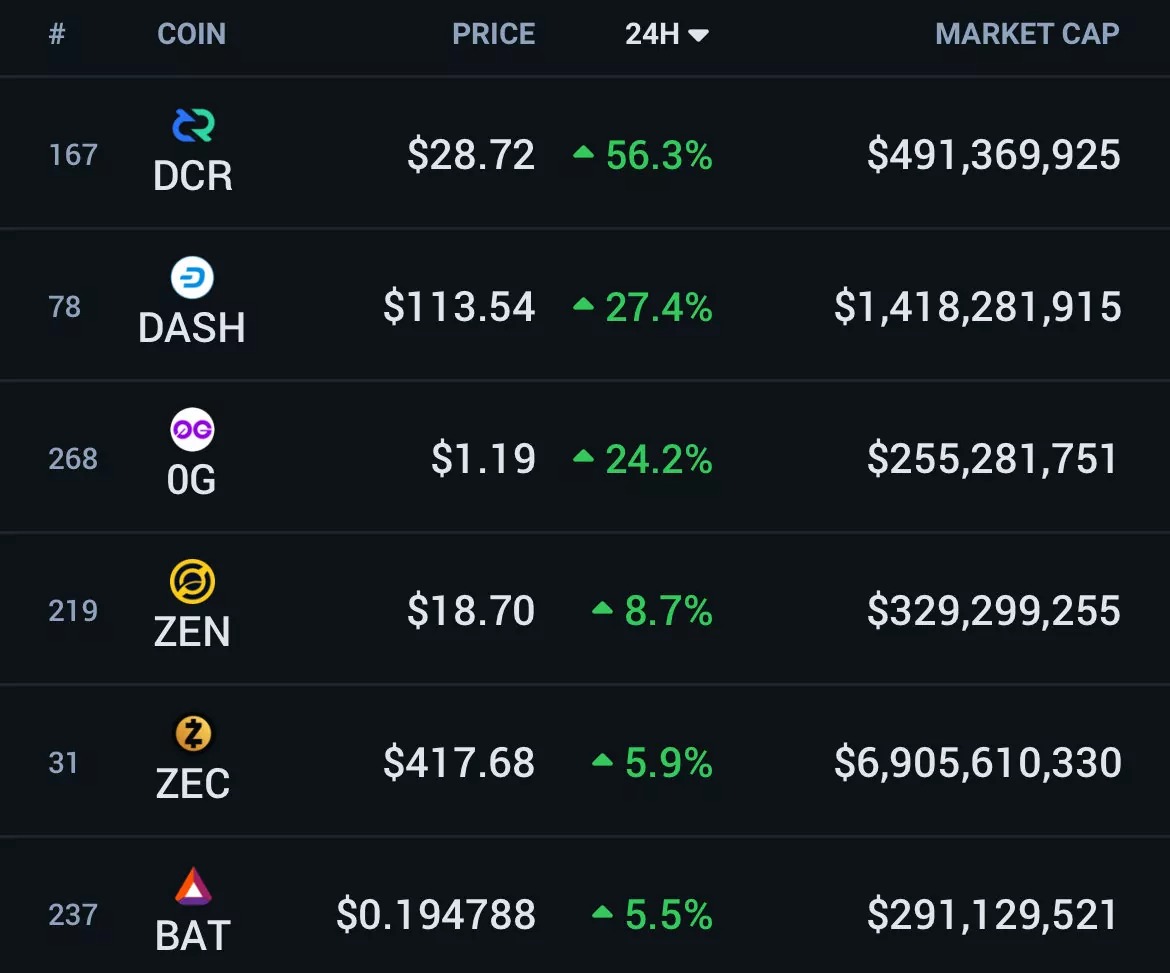
The ‘crazy surges of old, abandoned shitcoins’ mentioned by Adam Cochran
Because while ZEC has risen 200% over the last 30 days, DASH has surged 300% over the same period and DCR has risen 200% over the last 7 days. This trend also includes BAT and ZEN, with respective increases of 30% and 70% over the last 7 days.
At the time of writing, the BTC price is once again testing support around $103,000. A confirmed break on the daily timeframe could quickly push it below the symbolic $100,000 threshold. The situation is similar for the rest of the crypto market, with TOTAL2 hovering precariously around the $1.34 trillion mark.
sse. Let’s take a look at the various statistics specific to each to try to understand the current state of the market.
Are stablecoins benefiting from the decline in cryptocurrencies?
On Saturday, we reviewed Bitcoin’s (BTC) performance, which missed its “Uptober” for the third time in history. Nevertheless, not all sectors of the cryptocurrency market are in the same boat, starting with stablecoins, which achieved record trading volumes on Ethereum (ETH) during the month of October.
In fact, this asset class generated 2.82 billion in trading volume, marking a new all-time high (ATH) for the fourth consecutive month. In this case, USDC leads the pack, accounting for 57.45% of that volume in October:
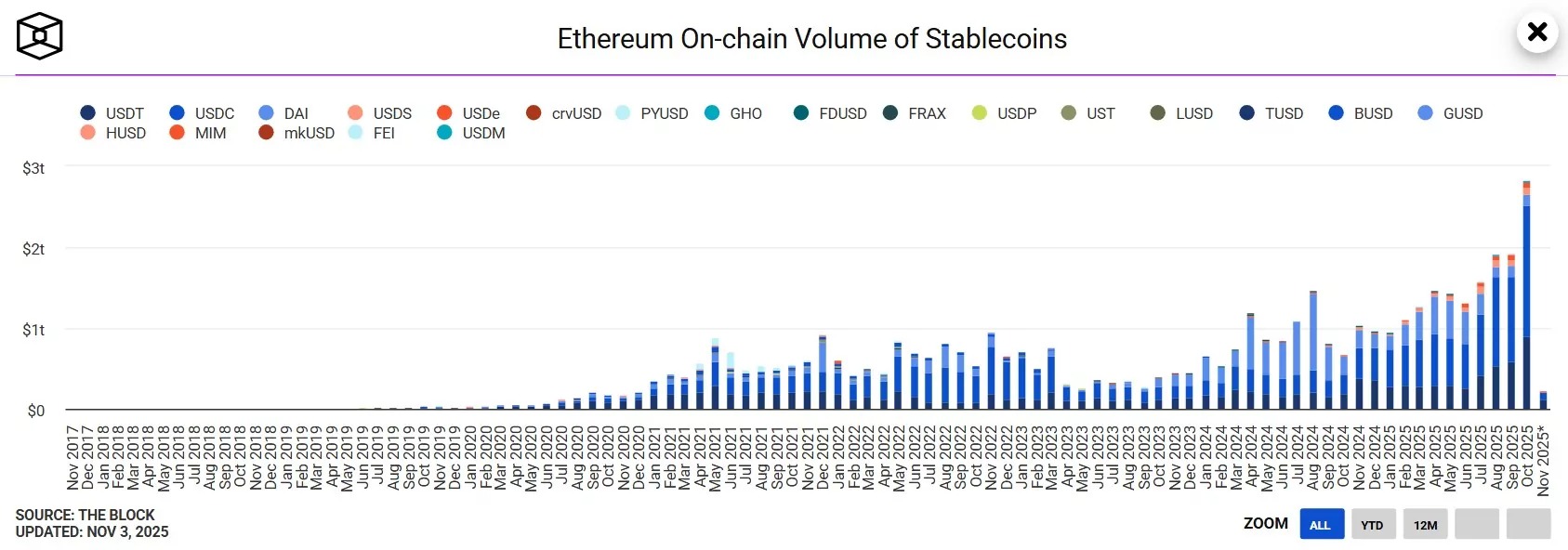
Stablecoin volumes on Ethereum
Despite these volumes, it is worth noting that stablecoin market capitalization has tended to stagnate in recent weeks. For USDT, for example, market capitalization has plateaued around $183 billion for the past ten days. Regarding USDC, we also observe that the growth in market capitalization has slowed since last month:
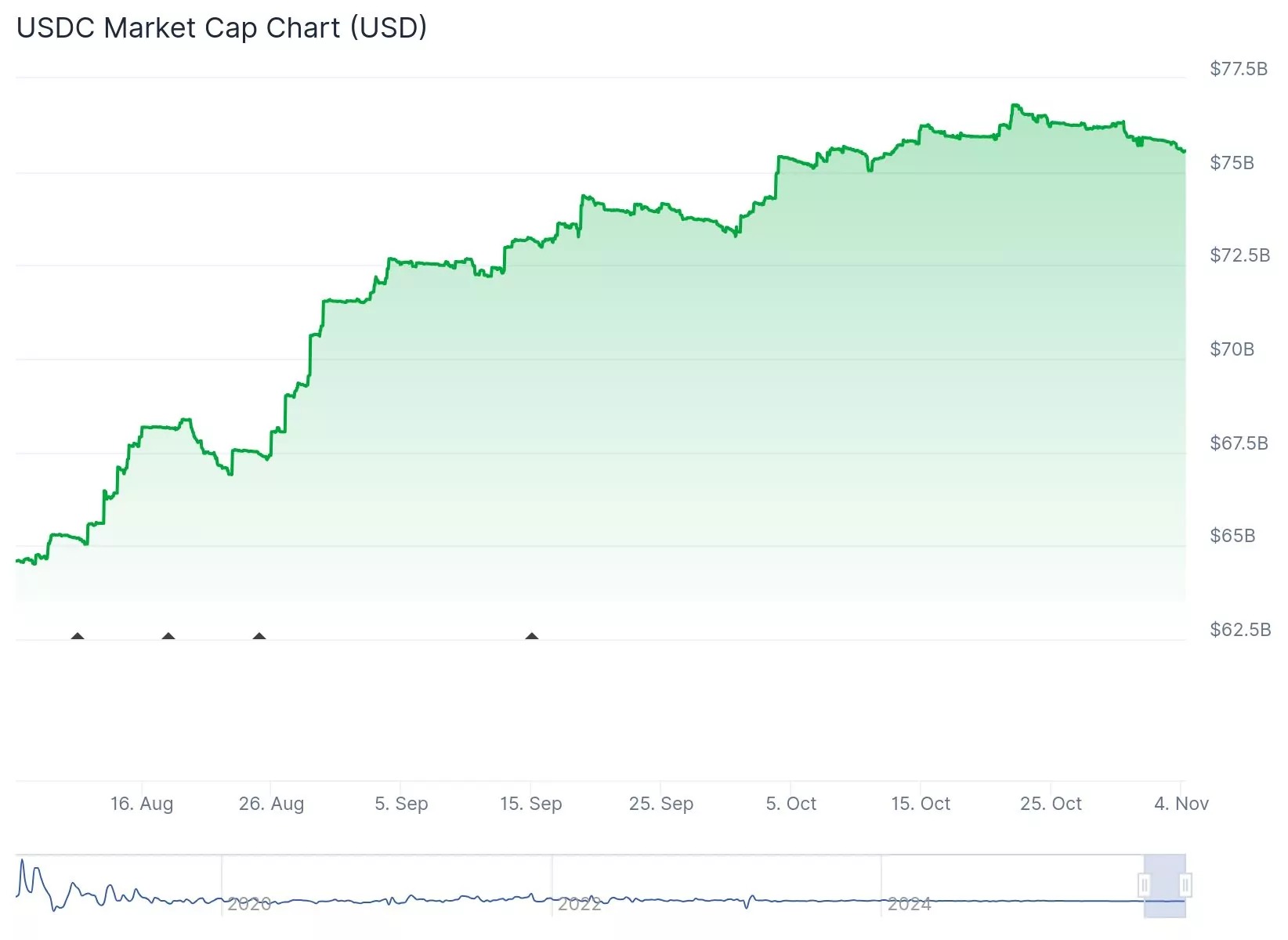
USDC market cap over 3 months
For now, however, Circle and Tether remain at the top of the list of applications generating the most revenue, according to data from DefiLlama:
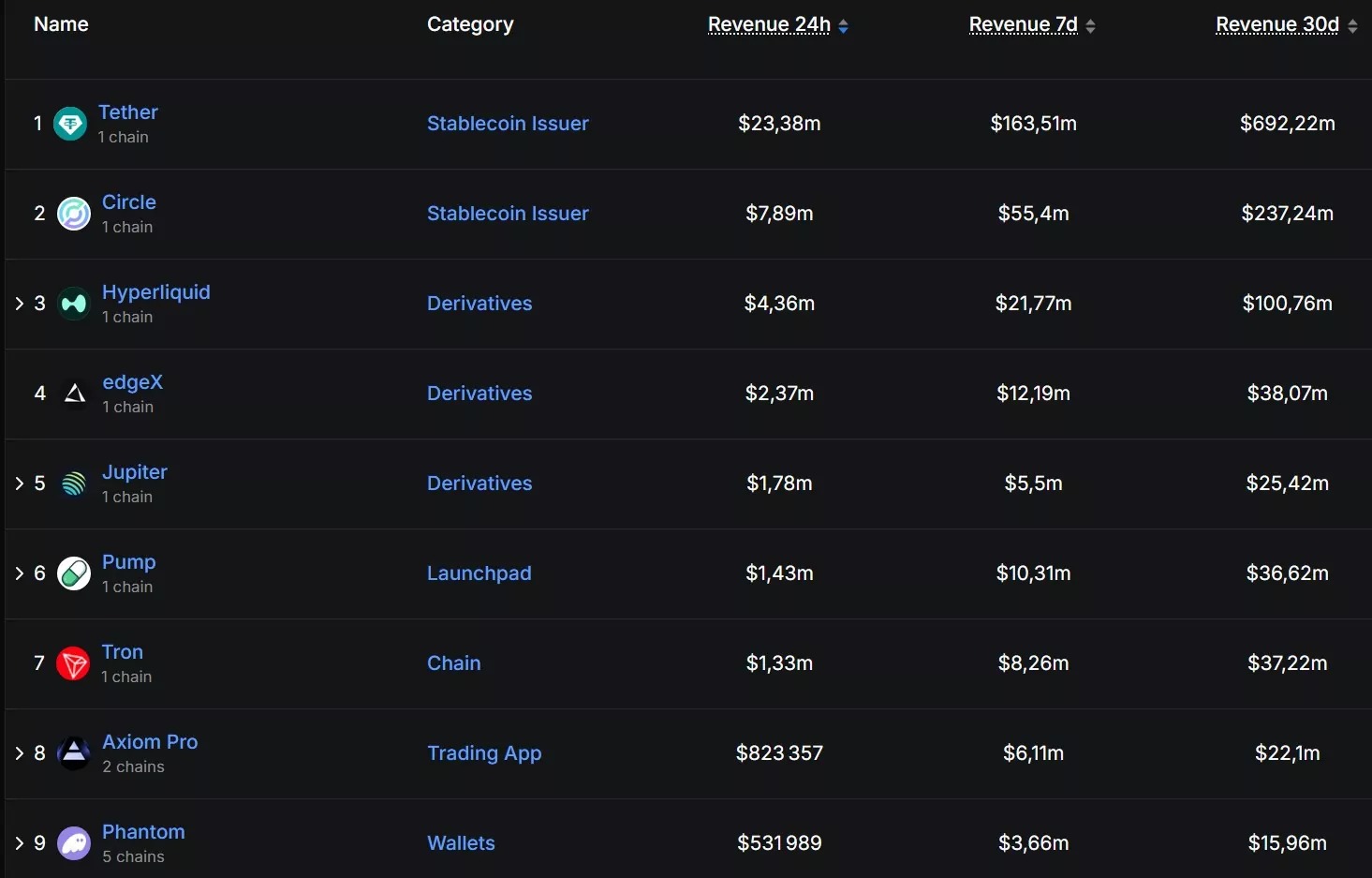
Top revenue-generating applications
Echoing the volumes mentioned earlier, this dominance is also evident in Ethereum’s on-chain data, as over the past 24 hours, the USDT and USDC smart contracts ranked as the 2nd and 5th smart contracts, respectively, through which the most gas was spent. Over 24 hours, this represents 11.28% of the gas spent on Ethereum, or 38.63 ETH.
Regarding the transactions generated by these same smart contracts, we can note, however, that while the USDC contract is close to its ATH—with over 133,000 transactions generated on Monday—the USDT contract has not yet surpassed its record of 316,442 transactions set on June 23, 2020:
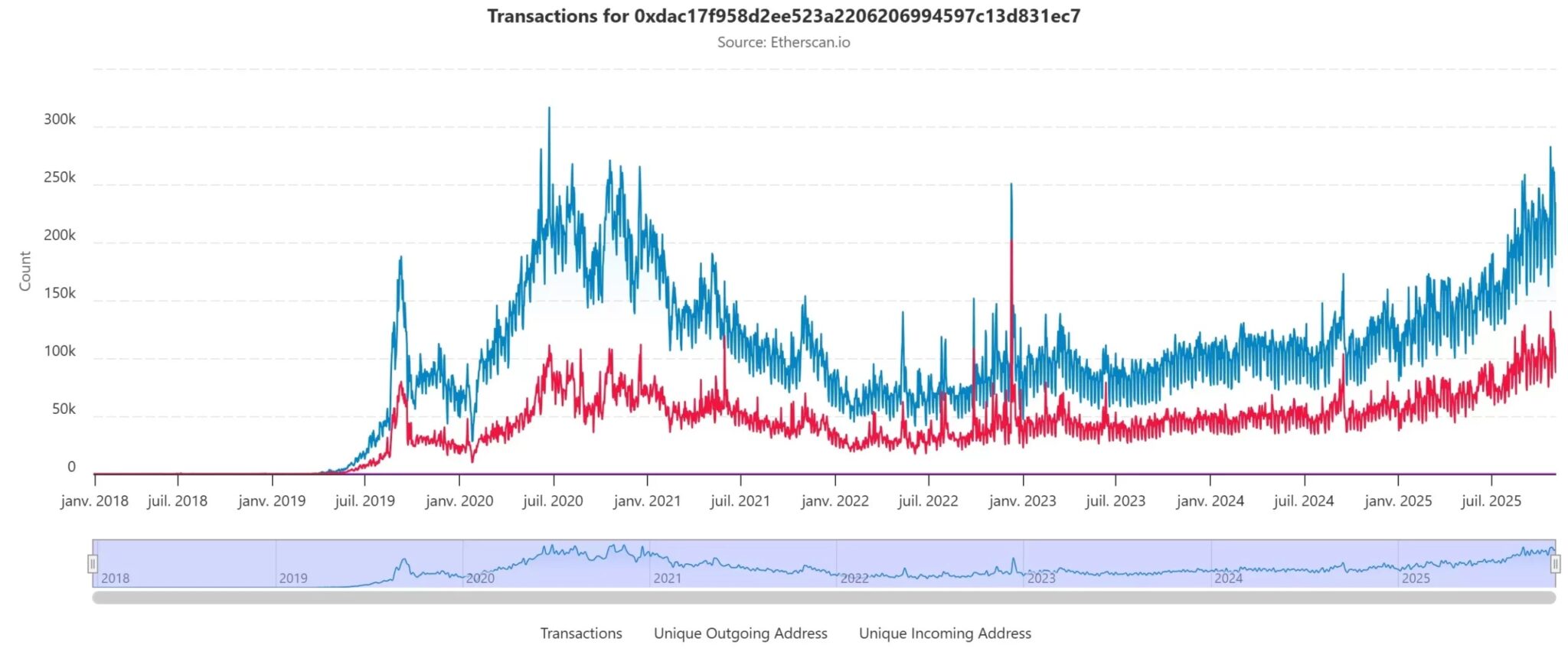
Daily transactions on the USDT smart contract
With November just beginning, the analysis can be repeated at the end of the month to see how the trend evolves. Beyond all adoption factors—whether related to U.S. regulation or initiatives by traditional finance players—market conditions can also be put into perspective.
And for good reason: despite a new ATH in early October, the price of BTC now appears to be entering a phase of uncertainty, and profit-taking may have fueled volumes on stablecoins. When the cryptocurrency market is unsure which direction to take, investors may turn to these stablecoins to generate other forms of returns, particularly through lending.