
The conflict between Bitcoin Core and Bitcoin Knots is intensifying around OP_RETURN: Core wants to lift their limit, Knots advocates anti-spam filters. What impact do these debates have on users?
The battle between Core and Knots continues
At the beginning of the year, the Bitcoin community split into two camps in an ideological and technological clash reminiscent of 2017 and the “blocksize war” debates. This divide pitted those who wanted to double the size of Bitcoin blocks, giving rise to Bitcoin Cash (BCH), against those who refused, arguing that this would lead to centralization of the blockchain. This new split focuses primarily on the non-monetary use of Bitcoin. Exchanges between developers and Bitcoin enthusiasts are now degenerating into personal attacks. Developers associated with Bitcoin Core refer to Knots supporters as “Knotzis,” while others launch religious memes targeting Luke Dashjr, the main maintainer of the Knots client.
At the heart of the conflict was a debate over lifting the OP_RETURN limit in version 0.30 of Bitcoin Core, scheduled for October. With this change, the 80-byte limit would be lifted, leaving only the 4MB block size limit. Bitcoin Core supporters believe that maintaining the current limit encourages users to circumvent transaction rules, sometimes in opaque ways, using practices that can saturate the bandwidth and storage of blockchain nodes.
On the other hand, Bitcoin Knots supporters see this as trivializing the non-monetary use of Bitcoin and fear that it will further encourage the publication of “spam” on the blockchain. As such, they are instead implementing filters and refusing to relay transactions containing OP_RETURN.
How does this OP_RETURN war affect users?
Even if you don’t have a particular opinion on the matter, these debates have no direct impact on your daily use of Bitcoin. In fact, they tend to improve and strengthen Bitcoin by diversifying the clients used, which, in a sense, contributes to its decentralization.
Indeed, before this debate, only 1-2% of nodes on the Bitcoin network used alternative clients, whereas now that figure exceeds 12%, or more than 11,000 nodes.
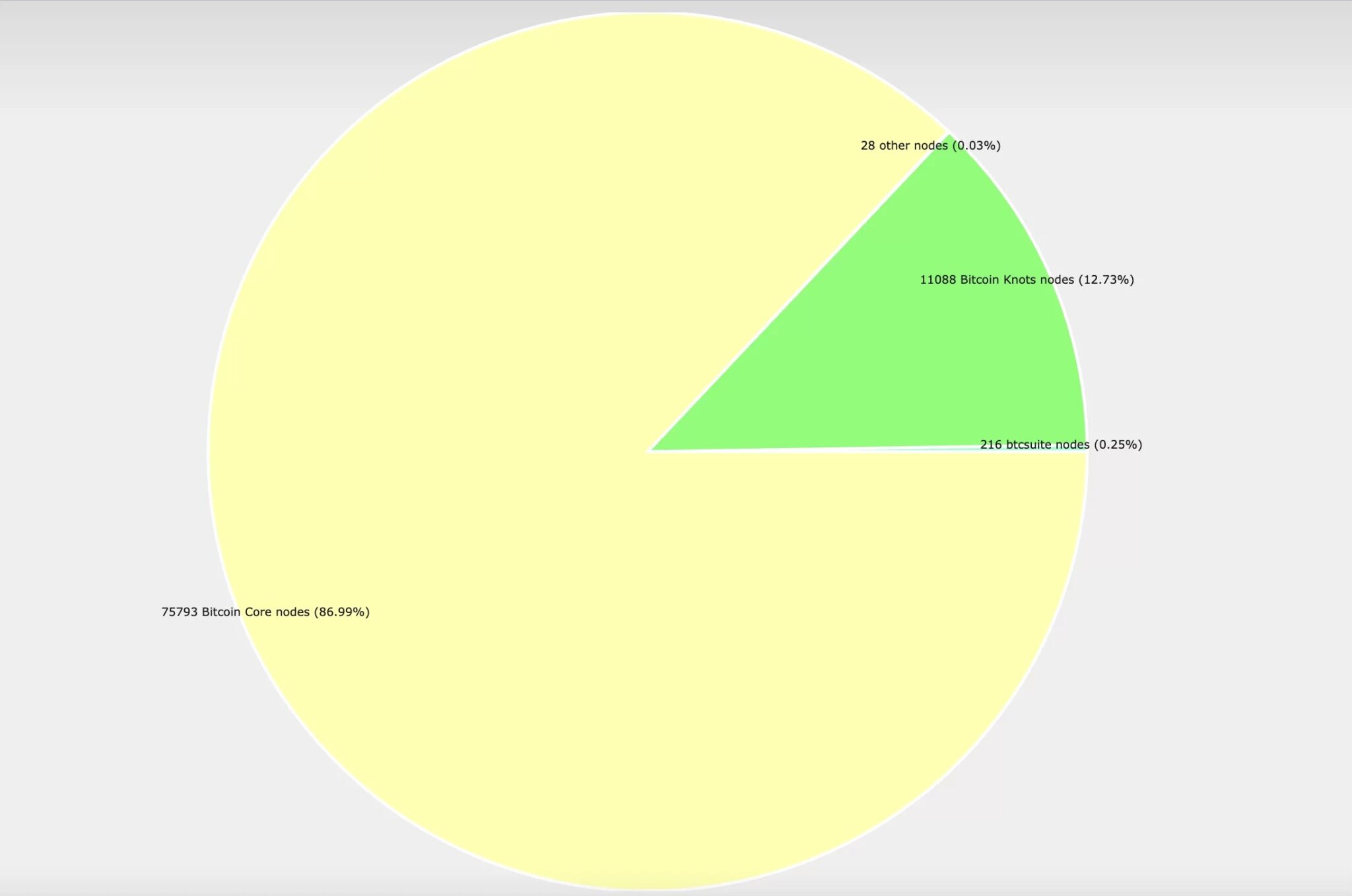
By way of comparison, version 0.29 of Bitcoin Core accounted for around 15% of nodes, and today there are nearly 100,000 Bitcoin nodes on the network, 87% of which use Bitcoin Core 0.29 or one of its earlier versions.
However, it could also be argued that this situation actually corresponds to a centralization of Bitcoin clients, insofar as Bitcoin Knots is almost entirely controlled by Luke Dashjr. If the latter were compromised, malicious code could be introduced, causing financial losses to those who use this client.
As for the OP_RETURN modification, it should be integrated into Bitcoin Core v0.30 in October 2025, after passing all the necessary verification steps.