
Since Thursday evening, Bitcoin (BTC) and the rest of the crypto market have been experiencing a price decline. What are some possible explanations for this drop?
The crypto market sees red
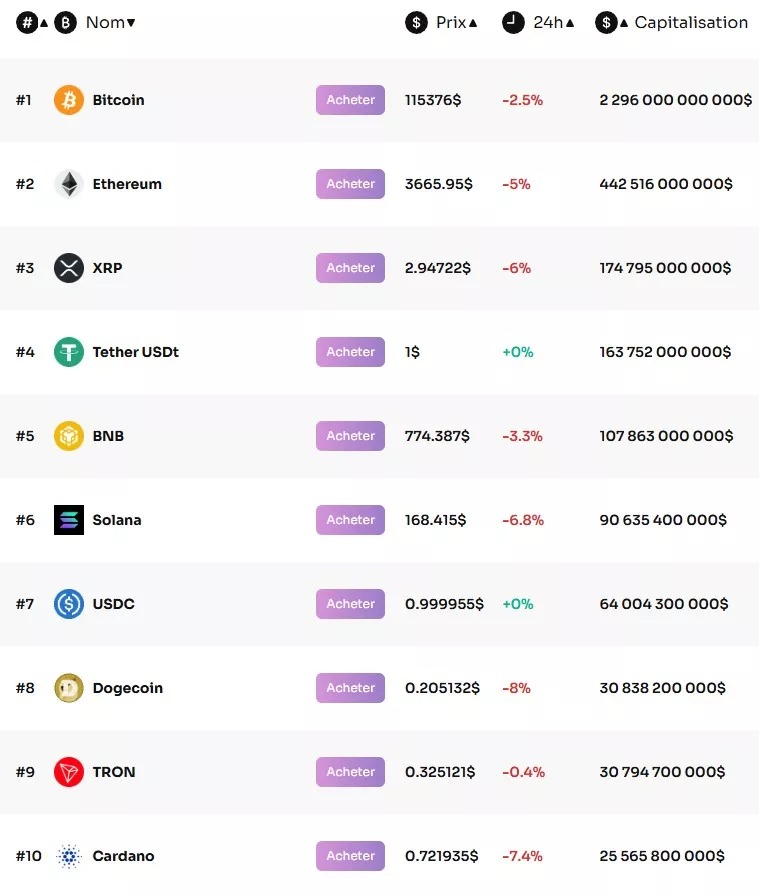
Over the past 24 hours, total crypto capitalization has fallen by 7.2%, according to data from CoinGecko, and now stands at just over $3.8 trillion.
While the decline in Bitcoin (BTC) remains fairly moderate, at around 2.5% over 24 hours, other assets are suffering more severely, such as XRP, SOL and DOGE, for example:
As for liquidations on centralized derivatives platforms, although significant, they are still limited to $645 million over 24 hours, with long positions accounting for nearly 93%.
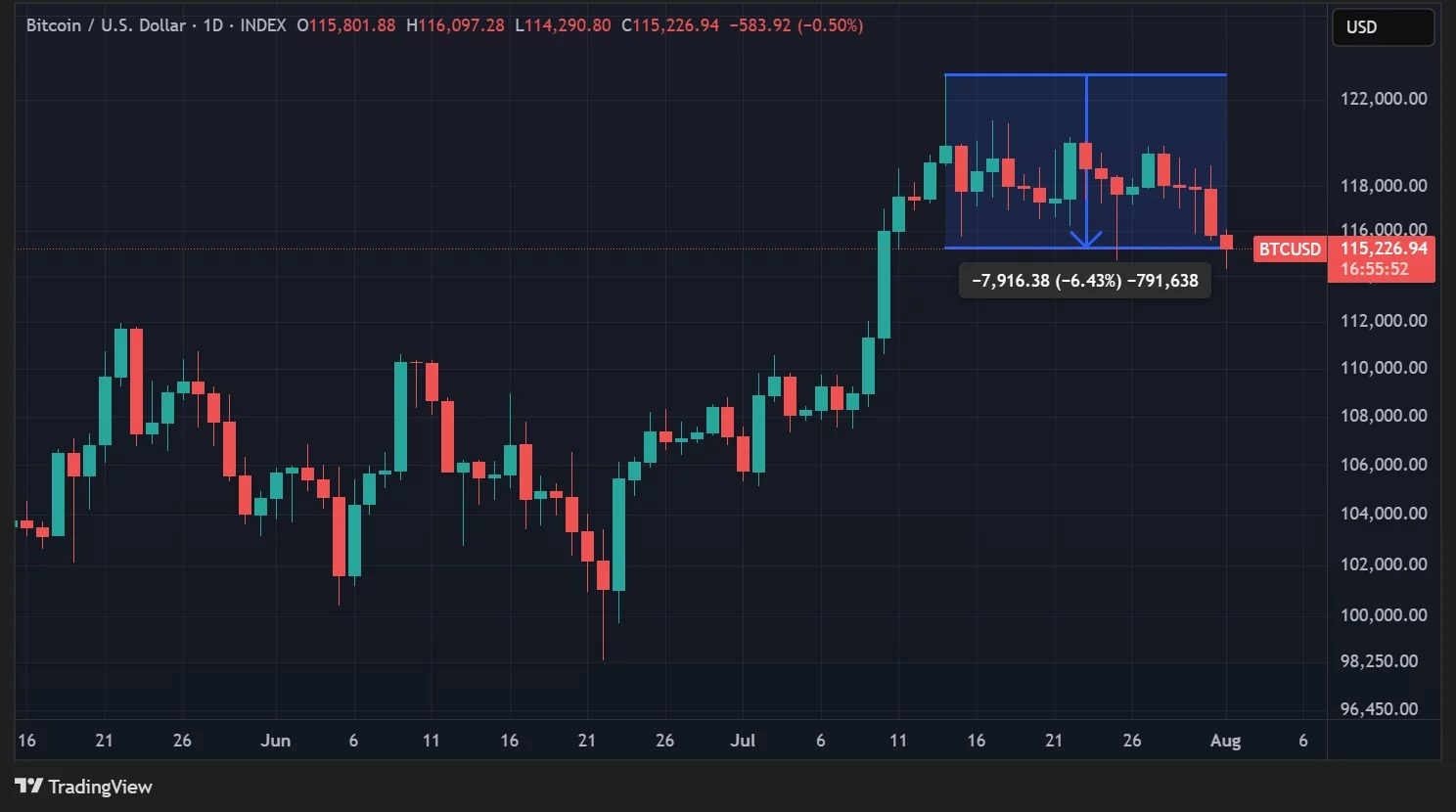
After BTC achieved the highest monthly close in its history at $115,800, the asset is now trading down 6.43% from its all-time high (ATH), after spending several days in range:
To understand this decline, beyond simple profit-taking by certain market players, we must, as is often the case, look to the United States and the macroeconomic context.
The United States, again and again
More specifically, Donald Trump is offering us a repeat of what we became accustomed to during his first term, namely tariffs and his opposition to the monetary policy of Jerome Powell, the chairman of the US Federal Reserve (Fed).
On this last point, we were able to return in more detail on Thursday evening to the comments made by the US president, who once again insulted Jerome Powell, who does not plan to cut rates before at least September.
With regard to tariffs, the White House has officially announced an update, on the grounds of rebalancing the country’s trade balance:
President Trump has challenged decades of failed trade policy. Today’s executive order underscores his determination to reclaim the economic sovereignty of the United States by addressing the many non-reciprocal trade relationships that impact our foreign relations, threaten our economic and national security, and hurt American workers.
While the European Union bowed to pressure as usual this week, we saw that the famous “tariffs” were set at 15%. For other countries, however, the bill is even higher. For example, Switzerland has been hit with a rate of 39%, Canada with 35%, and India with 25%.
In mid-April, after the first act of this trade war, financial markets, including cryptocurrencies, skyrocketed after a period of decline. We will therefore be able to judge in a few months’ time whether the scenario will repeat itself or whether the current decline is just the beginning of a deeper correction.
Another, more discreet piece of news may have dampened the enthusiasm of short-term speculators on the evolution of the Bitcoin price: Strategy is slowing down its BTC purchases.
The company no longer plans to issue common stock to purchase Bitcoin if its stock price falls below 2.5 times the net asset value of the Bitcoins held (mNAV).
In concrete terms, this means that as long as MSTR shares do not trade above this threshold (estimated at around $500 to $600 per share, compared to around $360 currently), the company will no longer finance its BTC purchases through the issuance of common shares