While Consensys may be little known to the general public, its impact within the Ethereum ecosystem is considerable. While the company recently made headlines thanks to its partnership with Swift, let’s take a closer look at this empire—the creator of the MetaMask wallet, the Linea Layer 2 solution, and many other pieces of infrastructure that underpin the famous smart contract blockchain.
Consensys, the company building the Ethereum (ETH) ecosystem
Within the Ethereum (ETH) ecosystem, the name Consensys is sometimes unfamiliar to the general public. Yet this company is the leading infrastructure provider for the famous smart contract blockchain.
Recently, Consensys has been in the news due to its partnership with Swift, the launch of its Linea token, and the latest developments in its MetaMask wallet. With that in mind, here’s an opportunity to take a look at the sectors covered by this company founded by Joseph Lubin, one of Ethereum’s co-founders.
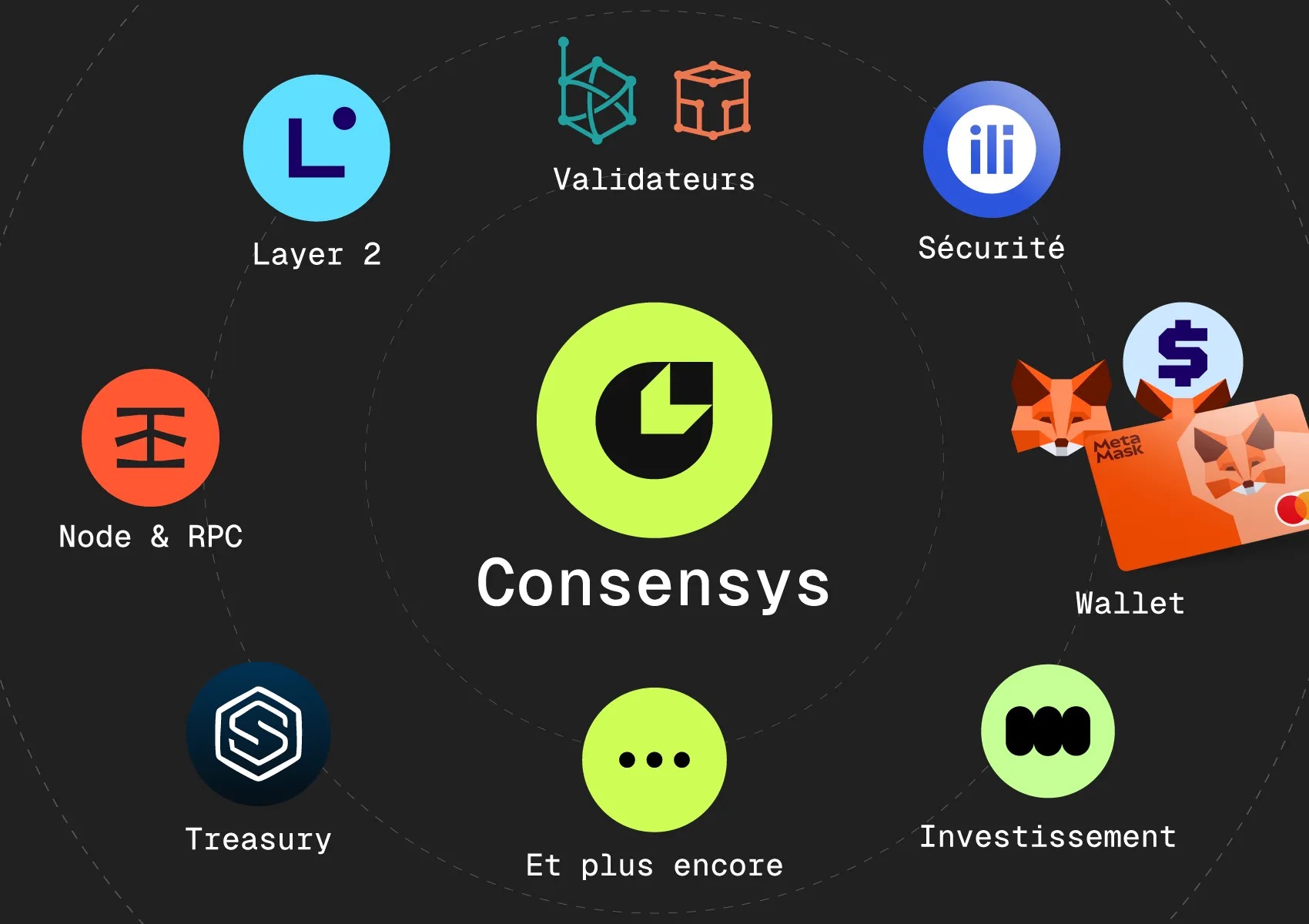
Overview of the main projects related to Consensys
MetaMask
Launched in 2016, MetaMask is likely the most well-known of the Web3 wallets. Originally a simple browser extension, the wallet has evolved over the years to also become a mobile app, and has integrated more and more features such as swaps, staking, and even a debit card.
Faced with growing competition from other wallets, such as Phantom, MetaMask has also expanded into environments that are not compatible with the Ethereum Virtual Machine (EVM), starting with Solana (SOL) and soon with Bitcoin (BTC).
In addition, the mMUSD stablecoin was recently launched and is now valued at $52.54 million, while a token is also in the works. Furthermore, it’s worth noting the integration of perpetual trading with Hyperliquid, as well as the upcoming launch of Polymarket’s prediction markets.
Linea
Among the multitude of Ethereum Layer 2 solutions is LINEA, developed by Consensys.
With its mainnet launched in July 2023, the network has been making headlines recently thanks to its LINEA token, which was deployed on September 10. Furthermore, Swift has announced that it is conducting experiments on real-time cross-border payments on Linea, alongside financial institutions from 16 different countries, including Crédit Agricole, JPMorgan Chase, Société Générale—FORGE, and Citi.
As for the LINEA token, it still has to prove itself, with a price of $0.015 and a market capitalization of $237.1 million. In terms of network adoption, Linea ranks as the third-largest Ethereum Layer 2 solution by total value locked (TVL), behind Base and Arbitrum, with $1.05 billion.
Infura
As we discussed this week in the context of the massive Amazon Web Services (AWS) outage, Infura is a so-called “node-as-a-service” provider. To communicate with a blockchain, it is indeed necessary to use Remote Procedure Call (RPC) protocols in order to “talk” to a node on the network.
As an essential component for a decentralized application (dApp), this is where Infura adds value, allowing app developers to focus on the code without worrying about hosting their own nodes.
To date, Infura offers services on at least 20 networks, including Ethereum, the BNB Smart Chain, IPFS, Polygon, Arbitrum, and Linea.
Besu and Teku
Ethereum’s architecture is based on an execution layer and a consensus layer. Simply put, the execution layer is the operational part, which manages smart contracts and transactions, among other things, while the consensus layer handles staking, including the validation and finalization of blocks.
To operate, a validator must use software for each layer, known as a client. This is where Besu and Teku come in; they are clients for the execution and consensus layers, respectively, accounting for 16% and 13.86% of the market share:
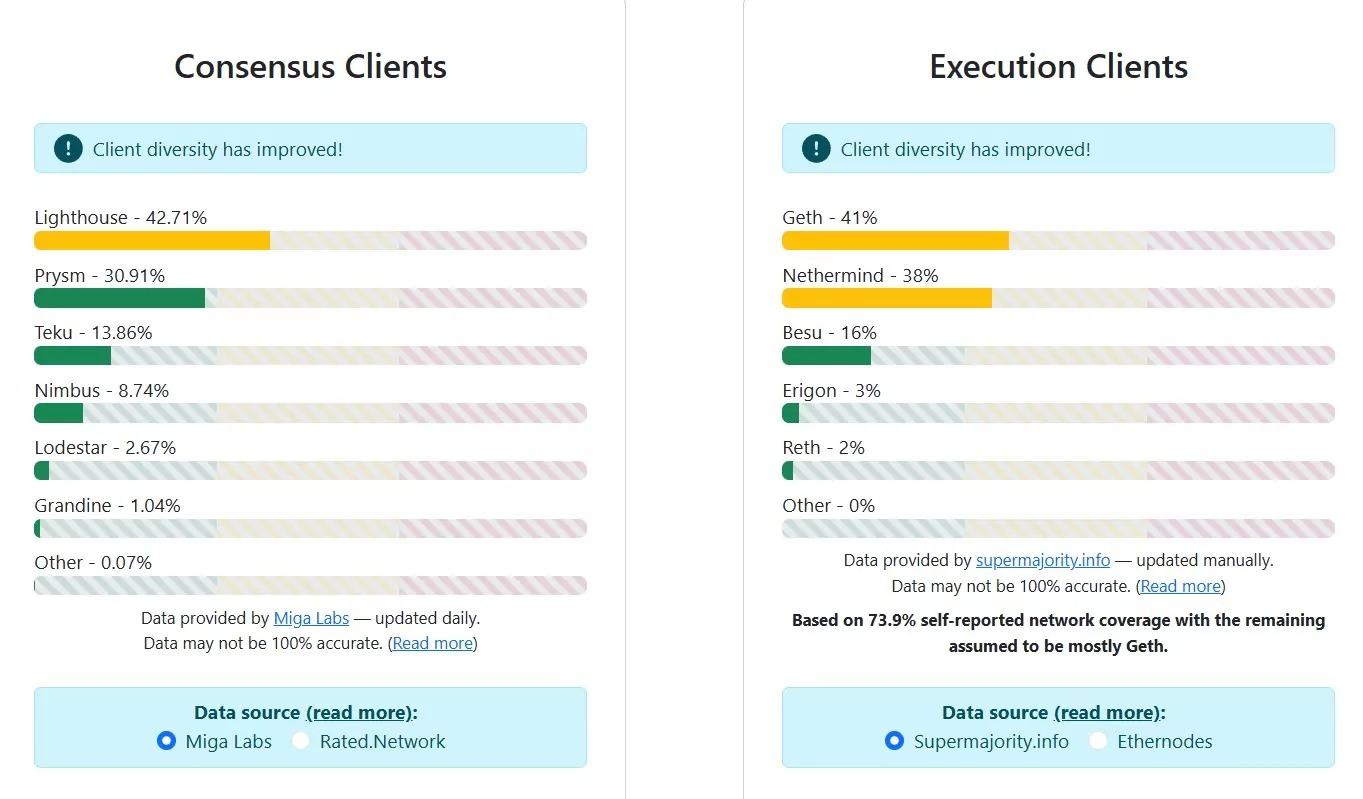
Diversity of clients on Ethereum
Staking
Naturally, Consensys is heavily involved in staking on Ethereum, with over 33,000 validators deployed.
In this area, Consensys covers several aspects of staking, whether at the individual level directly through MetaMask, on a broader scale via an API system that can be integrated into its application, or at the institutional level.
A Presence at Every Level
Of course, this is only a non-exhaustive list of all the areas in which Consensys is involved.
We could also have discussed Diligence, a platform dedicated to smart contract security and auditing, or the investment arm Consensys Mesh, which currently boasts more than 150 companies in its portfolio—Starkware, Coinhouse, Blast, Kaiko, and Sorare being just a few examples.
In addition, the company recently made headlines by leading Sharplink’s $425 million funding round, making it the second-largest Ethereum treasury company to date, with 859,853 ETH. Following this, Joseph Lubin took over as chairman of the company’s board of directors.
As for Consensys’s own valuation, it is currently difficult to estimate, but it is worth noting that in 2022, a Series D funding round had pushed it to $7 billion.