Since January 1, 2026, the European DAC8 directive has strengthened the traceability of crypto transactions, at the very same time that robberies and assaults linked to digital assets are on the rise in France. In this report, we break down what this new transparency means for French investors, with insights from Cédric Fontaine, a former military officer and police officer who is now CEO of Lima Groupe.
In an effort to improve tax transparency, France and its neighbors are implementing increasingly strict regulations regarding cryptocurrencies and their holders. Since January 1, 2026, the European DAC8 Directive has required crypto-asset service providers to submit complete customer information to tax authorities. At the same time, a French amendment also plans to make it mandatory for individuals to file an annual declaration for cold wallets valued at over 5,000 euros.
While undoubtedly well-intentioned, France is nevertheless putting holders of digital assets at risk. Indeed, this new initiative creates a truly critical vulnerability: a centralized digital database that criminals can exploit.
France is undeniably in crisis, facing a wave of data breaches (including a potential one from the Ministry of the Interior), a rising number of kidnappings across the country, and state protection deemed insufficient. This unprecedented situation thus makes the country a prime target for organized crime, unfortunately pushing investors to protect themselves through private services or simply to leave the country altogether. Can we really blame them?
A Commitment to Transparency at Any Cost
And so, an era is coming to an end in France. Indeed, as of January 1, 2026, the DAC8 Directive is transforming the tax landscape for crypto holders in Europe. According to the European Commission, this regulation will require CASPs (Crypto Asset Service Providers)—the European equivalent of PSANs (Digital Asset Service Providers) in France—to collect and report detailed information on their clients’ transactions to tax authorities.
It should be noted that France had already implemented measures regarding this issue. Specifically, the mandatory reporting of crypto accounts held abroad is required via the CERFA 3916-bis form, with penalties of up to 1,500 euros per undeclared account if the assets exceed 50,000 euros. However, wallets with a balance of less than 5,000 euros are currently exempt from this requirement, as Grégory Raymond points out in his tweet:
Info @TheBigWhale_ I Crypto Taxation
A Communist amendment was adopted Tuesday by a National Assembly committee
It proposes to require holders of self-custody crypto wallets (@Ledger, @Metamask, @Rabby_io, @DeblockApp, etc.) to bring them to the attention of… pic.twitter.com/ywJ8ylomxZ— Grégory Raymond (@gregory_raymond) December 11, 2025
According to the European Commission, these measures are intended to combat tax fraud and money laundering. As a result, France will now have visibility into activities conducted via cryptocurrency platforms, though auto-generated wallets remain out of reach for the time being, as the consulting firm Deloitte rightly points out:
In practice, member states will have access to information on digital asset transactions carried out by each individual, thereby enabling their tax authorities to address reporting omissions.
Unfortunately, this measure centralizes all sensitive information in government databases—a perfect target for hackers, especially given that data breaches in France are becoming increasingly common.
From private-sector data breaches to government ones: a goldmine for criminals
In recent years, France has seen a sharp increase in data breaches, affecting both public institutions and private companies. According to an investigation by France 2, the television network reported:
An explosion of data breaches affecting numerous French companies and public services.
Even more concerning, between 2021 and 2024, the personal identification information of at least 14 million French citizens was compromised following breaches of municipal platforms.
Crypto companies have not been spared either, and some are also unable to protect their customers’ sensitive data. In fact, in July 2020, the French unicorn Ledger, a manufacturer of hardware wallets, suffered a massive data breach exposing approximately one million customer email addresses, just over 250,000 mailing addresses and phone numbers, with 16,000 French customers directly affected.
Following this hack, the stolen data was subsequently sold on dark web forums. Consequently, in October 2024, the CNIL imposed a record fine of €750,000 on Ledger for insufficient security measures. However, this fine neither restored the victims’ privacy nor compensated those who were subsequently subjected to harassment via email or phishing letters.
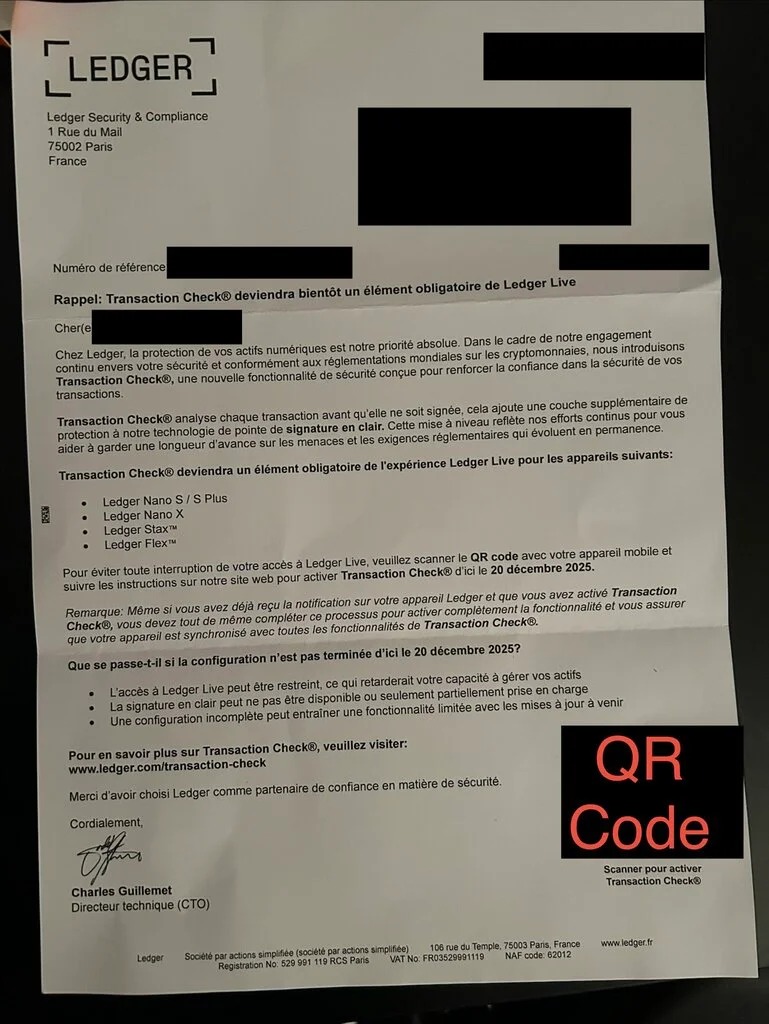
Example of a fake email from Ledger (shared by @_SaxX_ on X)
Following this leak, the consequences proved disastrous for cryptocurrency holders. According to this 2024 article in Le Monde, the publication reported that:
The CNIL told Agence France-Presse that Ledger had “failed to adequately protect its customers’ data” following two data breaches in 2020 that affected the personal data of the company’s customers and prospects.
To be clear, Ledger was indeed the victim of an unequivocal data leak in July 2020 on its Shopify-hosted website, exposing the data of 270,000 customers. This was followed by a subsequent breach in which dishonest Shopify employees exported additional data affecting another 290,000 Ledger customers.
In early 2026, the company was once again the subject of a data leak via its e-commerce partner, Global-e. The incident exposed the personal information of certain customers who had made purchases through the platform.
A recent investigation also revealed that cybercriminals have compiled comprehensive profiles of their targets following several data breaches over the years, including the Free data breach in 2024. Clément Domingo, a cybersecurity expert, explains:
The cybercriminal group behind this operation most likely cross-referenced the mailing information of cryptocurrency users with data from other leaks.
More recently, the Ministry of the Interior suffered a data breach on the night of December 11–12, 2025. The cyberattack, claimed by the hacker group BreachForums, targeted the department’s email servers.
They then described the details of their attack on their forum, specifying that they gained access to sensitive databases, including the criminal records database (TAJ), the wanted persons database (FPR), as well as the interconnected systems linking Interpol, the General Directorate of Public Finances (DGFIP), and the National Social Security Fund, granting access to personal records and exposing more than 16 million individuals.
The hackers then issued an ultimatum to the government: one week to negotiate, or else the data would be sold to the highest bidder or made public, as @AureaLibe explains in her tweet on X:
NEWS ALERT | Hackers claiming to have hacked the Ministry of the Interior have reiterated their ultimatum to the French government. If the government does not negotiate, they threaten to sell or leak the allegedly stolen data.
Their message:
“Hello everyone,
We are… pic.twitter.com/cq85hvgDJo
— Aurea (@AureaLibe) December 15, 2025
Despite this high-profile hack, the government does not seem to realize the gravity of the situation. In this regard, Interior Minister Laurent Nuñez downplayed the risks, stating on RTL that no “serious compromise” had been detected at this stage, even though one person has already been arrested in connection with the case.
Nevertheless, this intrusion reveals a chilling vulnerability. Indeed, if a lone individual was able to penetrate the Interior Ministry’s systems, what would happen if organized cybercriminals—or those backed by states—were to attempt the same?
To make matters worse, the danger does not come solely from outside. Last July, *Le Parisien* revealed that an official from the General Directorate of Public Finance was suspected of passing confidential information to organized crime. If a tax official can be corrupted and sell taxpayers’ sensitive data, how can the government guarantee the security of future DAC8-related databases?
A Growing Wave of Kidnappings: A Violent Reality
Since 2023, France has experienced a series of kidnappings primarily targeting cryptocurrency investors. The most widely publicized kidnapping was that of Ledger co-founder David Balland. The regional National Gendarmerie stated at the time:
On the morning of January 21, 2025, a couple was kidnapped from their home in Vierzon, in the Cher department, by a group of criminals. David Balland is the co-founder of Ledger, a French company specializing in cryptocurrencies.
The ransom demand was clearly made in cryptocurrency, as the kidnappers provided a video showing the entrepreneur was still alive.
A few months later, last May, the father of another entrepreneur in the sector was also kidnapped and held hostage for nearly 48 hours near Paris. The criminals also demanded payment in cryptocurrency in exchange for the hostage.
In another alarming incident, a pregnant woman—the daughter of Paymium’s CEO—narrowly escaped a kidnapping attempt in Paris’s 11th arrondissement.
On December 18, a couple of investors living near La Rochelle were held captive in their home. They were tied up and beaten for nearly two hours in an attempt to gain access to their crypto wallet. According to local police sources, the attackers reportedly stole approximately $10 million in crypto and had very specific details regarding the amounts held by the victims—information obtained through a data leak found online.
Since then, the downward spiral has accelerated: in the space of just three days, France has experienced three attacks—ranging from kidnapping attempts to targeted assaults—illustrating a disturbing shift in which holding cryptocurrency can become a physical risk, both for investors and their loved ones.
The critical situation unfolding in France is undeniable. The more regulations make citizens’ crypto holdings transparent to the government, the more criminals will adapt their targeting strategies by exploiting sensitive data—thus proving the adage: “To live happily, live hidden.”
France’s Inadequate Response to Security Concerns
Faced with the growing threat to cryptocurrency stakeholders, the government has implemented a basic level of protection that reflects its lack of interest in the matter. The Ministry of the Interior has thus announced that:
Entrepreneurs in the cryptocurrency sector would have priority access to the 17 emergency hotline and would receive briefings from elite units of the French police.
These measures are more symbolic than reassuring. Under no circumstances do entrepreneurs in the sector feel any safer, as this does absolutely nothing to address the vulnerability of centralized data systems; worse still, the government appears to be downplaying the scale of the growing threat, as Cédric Fontaine, CEO of Lima Protection, points out:
Currently, the cost-benefit analysis favors criminals. The government will be unable to take action at its level as long as the justice system remains lax.
As a result of the country’s inability to protect its citizens, some of the wealthiest crypto investors have turned to private security firms, creating a two-tiered security landscape within the country.
Presumably, demand for private security has skyrocketed, particularly among entrepreneurs and investors managing large portfolios. Jethro Pijlman, CEO of Infinite Risks International, a specialized security firm based in the Netherlands, shared his observations with Bloomberg:
We’ve received more requests, signed more long-term contracts, and seen an increase in proactive inquiries from cryptocurrency investors who don’t want to be caught off guard. They understand that smart security measures are now an integral part of their operating costs.
According to Bloomberg, Coinbase reportedly spent up to $6.2 million on personal security for its CEO, Brian Armstrong, in 2024 alone. This is a prime example of how “crypto VIPs” must now allocate a substantial seven-figure budget to their security.
Beyond close protection services, there are less expensive solutions, such as the one offered by Perimeter Lab. This French startup, founded by three former Ledger employees, provides a comprehensive audit that allows crypto investors to identify their vulnerabilities before they are exploited.
Thus, we have entered an era where government protection is insufficient and only the wealthiest can afford security commensurate with the growing threat—a reflection of France’s collapse in public safety.
France’s situation is worsening with these threats; we’re on a downward spiral. We see it in the volume of our requests, and we see it in the number of people who are being attacked, adds Cédric Fontaine
Indeed, between the potential hacking of millions of records from the Ministry of the Interior, the government’s powerlessness in the face of the cybercriminal entity BreachForums, and the implementation of DAC8 with its centralized database, France seems to be painting a clear target on the backs of the French people without realizing the impact of its actions.