While the Hyperliquid protocol enjoys widespread popularity, are there any risks to consider? Here is an overview of the important points to keep in mind, even when all signs are green for a crypto project.
Does Hyperliquid pose any risks?
In just a few years, Hyperliquid (HYPE) has established itself as the leading decentralized exchange (DEX), while its colossal airdrop at the end of 2024 propelled the project into a whole new dimension.
Beyond a simple DEX for crypto derivatives, Hyperliquid has its own layer 1 blockchain designed specifically to meet the requirements of its technology, while HyperEVM promises interesting developments to build a true financial ecosystem, with new assets and future decentralized finance (DeFi) applications.
At the time of writing, the HYPE token has managed to climb to 11th place among cryptocurrencies, thanks to a market capitalization of over $12.52 billion.
While all signs seem to be green, there are still risks present.
Amidst the hype surrounding Hyperliquid, it is also important to keep a few potential dangers in mind. Far be it from us to be contradictory just for the sake of going against the grain, but the goal here is rather to sharpen your critical thinking, even for a project that seems to be revolutionizing everything in its path and shaping up to be the real revelation of the year.
To add some nuance to our comments, Lilian Aliaga, co-founder of OAK Research, who has taken a keen interest in the Hyperliquid ecosystem in recent months, will be contributing his views from time to time.
The dangers of FOMO
Let’s talk about the HYPE token first. In the wake of its promises, the asset has risen sharply in value, as we pointed out earlier. Many content creators are promoting it, and while the price of HYPE has risen by more than 900% since its launch to nearly $4 at the end of November 2024, it could be easy to succumb to the fear of missing out (FOMO) syndrome. This first risk is therefore not technical, but financial.
It should be noted that to date, only 33.37% of the planned billion tokens have been released, and the current price equates to a fully diluted market capitalization of nearly $40 billion, which would place HYPE in 8th place, between USDC and TRX.
Given the relevance of the project, such a valuation may seem consistent, but it should nevertheless be remembered that after its first ATH in December, the asset lost nearly 74% from its all-time high (ATH) before recovering. Although the correction was common across the entire ecosystem, it nevertheless serves as a reminder of the famous stock market adage: “trees don’t grow to the sky.”
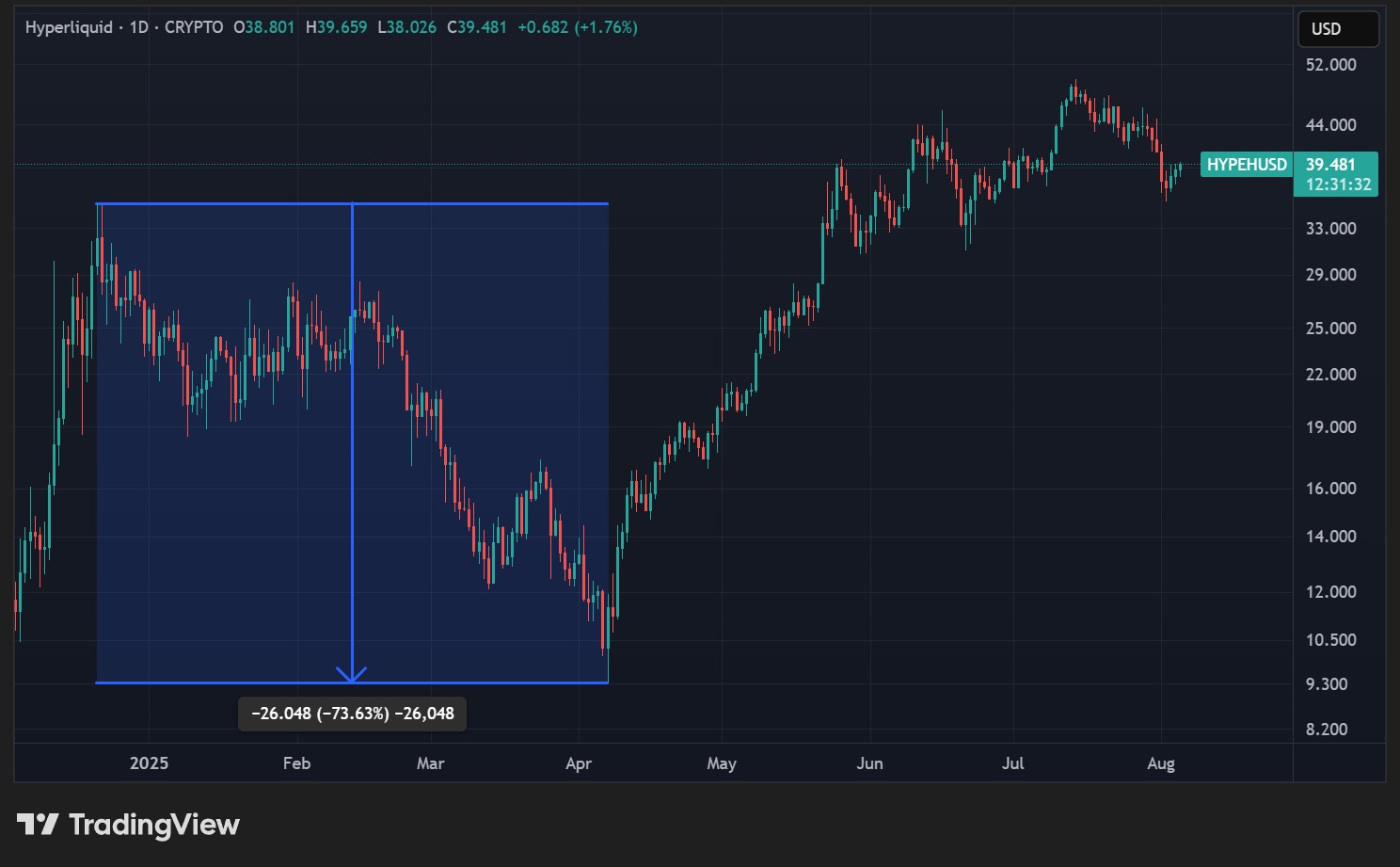
For his part, Lilian Aliaga is taking a more cautious view, explaining that, ultimately, the correction in HYPE mentioned above is part of a general market downturn, pointing out that between December and April, we saw the following corrections:
BTC: -35%;
ETH: -66%;
SOL: -73%;
While HYPE has since rebounded by 325%, BTC, ETH, and SOL have risen by 54%, 165%, and 80% respectively, supporting the idea that altcoins with the potential to outperform the market are worth paying attention to:
Today, investing in cryptocurrencies is riskier than before, as very few altcoins are still performing well. It is therefore necessary to focus on those that are showing the most strength, and HYPE is undeniably the one that has shown the most in this movement.
In an investment thesis published on Oak Research, our guest defended a target price of around $50 per HYPE.
Centralization still too prevalent
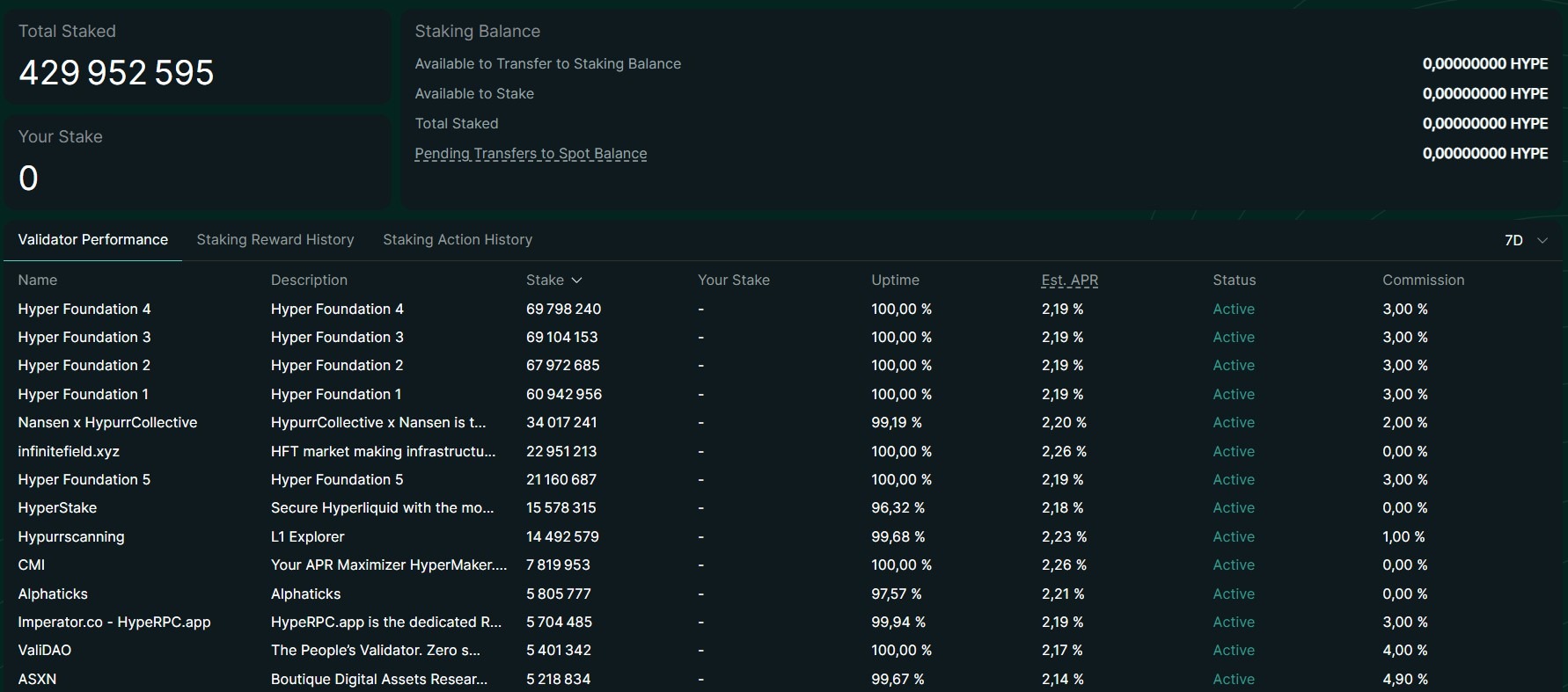
Although the Hyperliquid teams have opened staking to other validators, its network remains highly centralized to date. Of the 429.95 million tokens deposited in staking, the foundation’s four initial validators account for 62.3%. If we add the fifth wallet, this figure rises to 67.21%:
While there is no need to be alarmist, and this situation is shared by a large number of Web3 projects, it does mean that we need to keep at least two possibilities in mind:
- The foundation has almost total control over the governance of the project;
- A failure or hack on its validators could have disastrous consequences for the Hyperliquid ecosystem.
However, there is also a nuance to this situation, since anyone can delegate their tokens to a Hyper Foundation validator. Solo stakers are therefore free to move their HYPE tokens to other validators if they wish. For his part, Lilian Aliaga also points out that, following the same logic, the foundation has also delegated a portion of its HYPE to other validators:
In reality, the total supply of HYPE in circulation is currently 334 million HYPE. Of this, approximately 117.9 million HYPE (unlocked) are staked, representing 35% of the supply. The foundation’s five validators started with 60.2 million HYPE staked on them:
Some are below that today because the foundation is delegating tokens to other validators to improve decentralization.Validators are being deployed gradually, but 27 validators is not a lot. Now, that’s what you need if you want to run such a high-performance protocol, and unfortunately, you don’t have a choice.
The risk of hacks or bugs
We recently saw an example of this with competitor GMX. No crypto application is immune to a hack of varying severity. In such cases, lost funds will be reimbursed at the discretion of the project teams and according to their means.
Although Hyperliquid has proven its commitment to its community on several occasions, the risk is still there, especially given the youth of the protocol, and we therefore recommend that active traders do not put all their eggs in one basket.
A more insidious risk may also arise in periods of high volatility and is not unique to Hyperliquid. A potential lack of liquidity could effectively lead to positions that are theoretically liquidatable because they are undercollateralized but cannot be absorbed by the market. This would result in losses on the protocol.
This is reminiscent of the JELLY memecoin incident last March, which we reported on in detail at the time. In short, a trader managed to manipulate the price of the token, generating gains on one side while passing on their own losses to Hyperliquid. The protocol’s governance then decided to manipulate the token’s oracle before delisting it, a choice that directly echoes the potential centralization issues we mentioned earlier.
To mitigate such losses, the Hyperliquidity Provider (HLP) vault is, among other things, designed for this purpose. With current annual returns of 6%, it should be kept in mind that losses can also occur.
Conclusion on the risks of Hyperliquid
As you can see, we have only touched on a few general risks, which are also shared by many other protocols. Another point we could have mentioned in this regard is copy trading through the Vault features. Here, the danger lies more in the potential underperformance of the trader you choose to trust than in the protocol itself. In short, the purpose of this article is not to criticize Hyperliquid, which remains a particularly interesting protocol in many respects, but rather to encourage you to take a step back and consider its popularity.
Year after year, the market has reminded us that even the most popular projects can fail in one way or another. While this is not an immutable law, it is nonetheless a warning to keep in mind during periods of euphoria, especially in an ever-changing ecosystem such as that of cryptocurrencies.