
From a marginal crypto product to a strategic tool for American finance, stablecoins have taken on a whole new dimension. With the signing of the GENIUS Act, Donald Trump legalizes and legitimizes the use of dollar-backed stablecoins. But is this really good news for crypto?
The GENIUS Act is passed: dollar-backed stablecoins have the green light
After years of regulatory uncertainty in the United States, with crypto companies never having benefited from a framework conducive to their development, Donald Trump has signed the first ever law dedicated to cryptocurrencies, the GENIUS Act.
It is important to note, however, that it does not concern cryptocurrencies in the broad sense, but rather stablecoins, which are crypto assets backed by the value of another asset: often currencies, or gold. And among these currencies is, of course, the dollar. It is by far the leading asset in the stablecoin sector, as of the $267 billion worth of stablecoins in circulation, $262.7 billion are backed by the greenback.
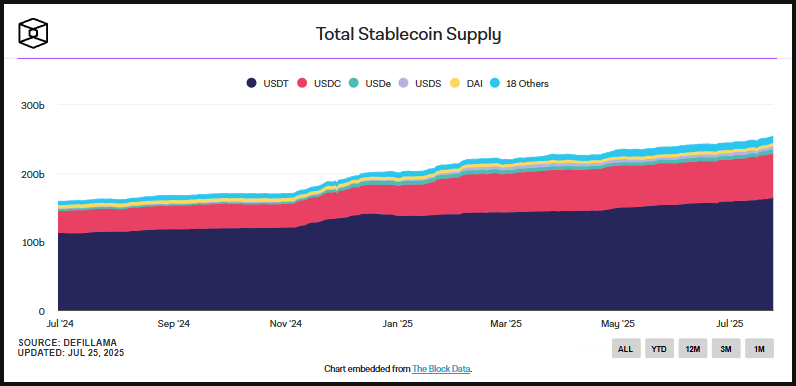
It is a rapidly evolving market, with its capitalization climbing nearly 60% in one year. And if stablecoins are of such interest to US regulators, it is not because of a sudden love for the principle of decentralization and financial freedom, but rather because they are an unparalleled means of perpetuating the hegemony of the dollar while helping to repay the debt.
How? Thanks to US Treasury bills. During the years 2020-2022, after US banks were encouraged to accumulate long-term Treasury bills, many of them went bankrupt under the weight of rising interest rates. That is why investors and banks are now unwilling to invest in this type of bond. This is where stablecoin issuers come in: they are required to collateralize their assets at a ratio of 1:1. This is fortunate, as a specific provision of the GENIUS Act concerns how stablecoins must be backed: with assets considered ultra-liquid, such as US Treasury bills or repos/reverse repos, which are themselves backed by the bills. Money market funds investing in T-bills are also accepted.
And it’s no secret: Donald Trump said when signing the bill that it was intended to “secure the dollar’s status as the world’s reserve currency.”
Towards all-out development
The bill was passed by the House of Representatives with broad bipartisan support, despite internal tensions. A group of conservative lawmakers had temporarily blocked the bill, demanding that it prohibit the Federal Reserve from issuing a central bank digital currency (CBDC). But their wish was granted, with the Anti-CBDC Act being passed by the House of Representatives (the bill still has to pass the Senate).
Tether and Circle, which issue the USDT and USDC, respectively, the two most capitalized stablecoins on the crypto market, have already stated that they intend to take full advantage of this new regulatory framework to develop their business. Paolo Ardoino, CEO of Tether, said it was “crazy that sometimes people think Tether won’t comply.”
But with the signing of the GENIUS Act, stablecoins are set to expand beyond the still relatively closed crypto sector. JPMorgan, Citigroup, Morgan Stanley and Bank of America – the largest US banks – are already considering launching their own. On the corporate side, the same is true for giants such as Amazon and Walmart. “This may be the biggest technological revolution in finance since the advent of the internet,” Donald Trump said when signing the bill. “The GENIUS Act establishes a clear and simple regulatory framework to unlock the full potential of dollar-backed stablecoins.”
Today, the “dollar-blockchain” couple has sealed their love, and God only knows who can stop them.