
Bitcoin has been navigating uncertain waters since its last historic high in early October. This situation is not good news for the leader in Bitcoin spot ETFs, BlackRock’s IBIT, which has recorded a new record of six consecutive weeks of net outflows.
BlackRock’s IBIT: 6 consecutive weeks of net outflows
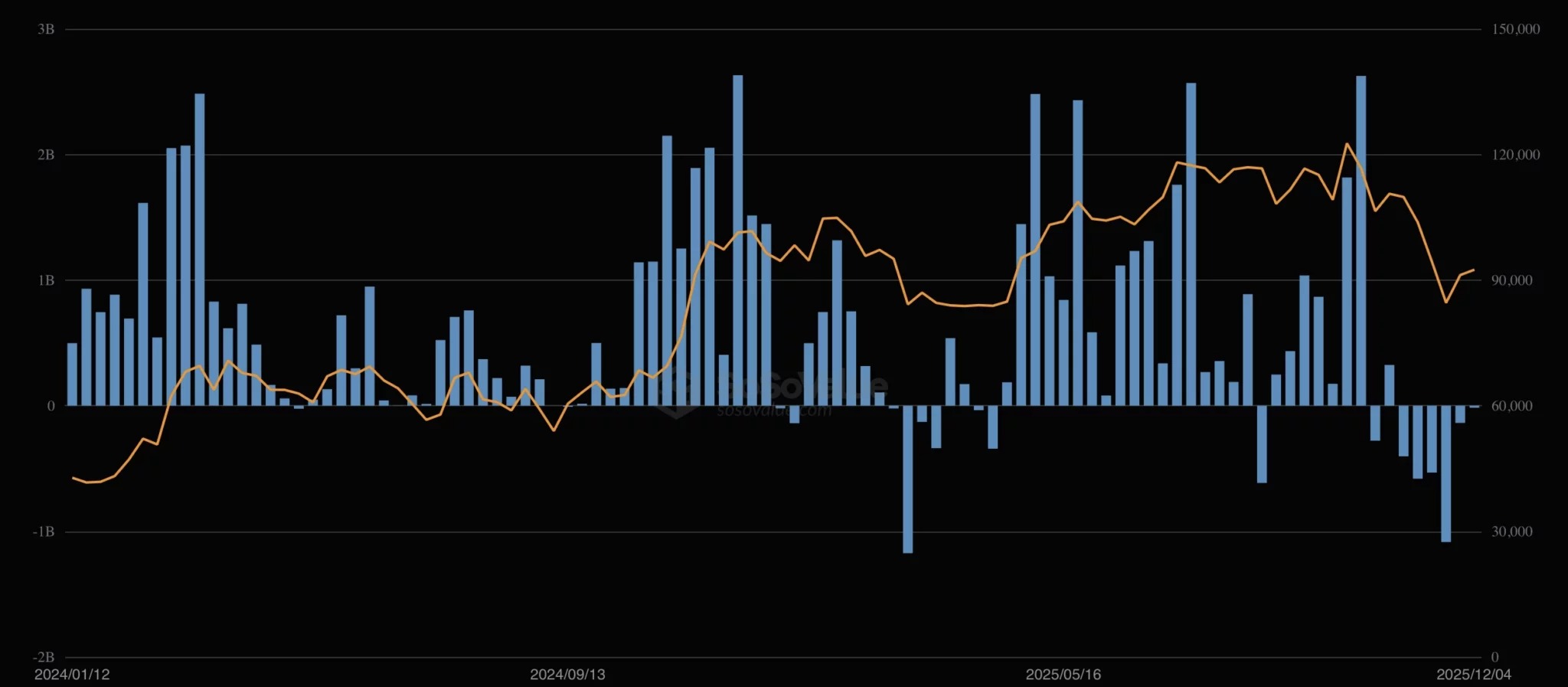
Since its historic high of around $126,000 on October 6, Bitcoin has entered a worrying and sustained downtrend towards the $90,000 level. The BTC price is currently hovering around this threshold, with no real certainty as to its future direction. This situation is inevitably having an impact on the US spot Bitcoin ETF market, particularly given that these funds are much more widely held by retail investors rather than the famous institutional investors, who are reputed to be less volatile.
As a result, net outflows in this market have been accumulating over the weeks, reaching a critical threshold at the beginning of December. Indeed, the iShares Bitcoin Trust (IBIT) fund, managed by the world’s leading asset manager BlackRock, is preparing to set a new record that is not particularly positive.
And with good reason: for five consecutive weeks now, its fund has been experiencing massive and regular withdrawals, estimated at more than $2.7 billion in total. The problem? A sixth identical week seems to be confirmed this Friday, December 5, with the risk of setting a new record for the longest series of weekly outflows since its launch in January 2024.
Downward trend or year-end trap?
By comparison, the second spot Bitcoin ETF on this market, Fidelity’s FBTC, posted estimated net outflows of $534 million over the same period, but with a significant reversal over the last two weeks, which saw net inflows of $270 million.
Nevertheless, the continued hemorrhage shown by BlackRock’s IBIT is forcing Bloomberg analysts to remain cautious, as they see it as a sign that “institutional appetite for the world’s largest cryptocurrency remains weak, even as prices stabilize.”
This view is also shared by the analysis firm Glassnode, which believes that this accumulation of outflows “marks a sharp reversal from the regime of persistent inflows that supported prices earlier in the year, and reflects a cooling of new capital allocations to the asset.”
It must be said that the current situation of Bitcoin leaves many analysts quite perplexed, between a repetition of its old cyclical model based on halvings, which seems to have become obsolete, and the prospect of seeing it evolve towards a model closer to traditional assets, which could well become the trap at the end of this year.