Senator Cynthia Lummis has introduced a bill to reduce taxation on Bitcoin payments. The initiative has been welcomed by the community, notably by Jack Dorsey, who called for an exemption for small transactions the day before.
Jack Dorsey influences Cynthia Lummis and US law
Yesterday, Jack Dorsey advocated on the X network for a tax exemption on everyday Bitcoin payments. This stance follows the introduction of a new feature on Square, the payment solutions company he founded, allowing users to accept Bitcoin payments.
However, using Bitcoin on a daily basis can quickly become burdensome if each transaction requires a flat tax calculation, especially for those who acquired their BTC several years ago. Reducing the tax burden on capital gains related to Bitcoin spending on everyday goods and services would greatly encourage its adoption, particularly among new users.
In response to Jack Dorsey’s tweets, Cynthia Lummis, a senator from Wyoming, best known for initiating the GENIUS Act on stablecoin regulation and advising Donald Trump on the creation of a strategic BTC reserve, initially hinted that she was working on the issue.
Less than 24 hours later, she introduced a new bill aimed at reducing taxation on Bitcoin and cryptocurrencies.
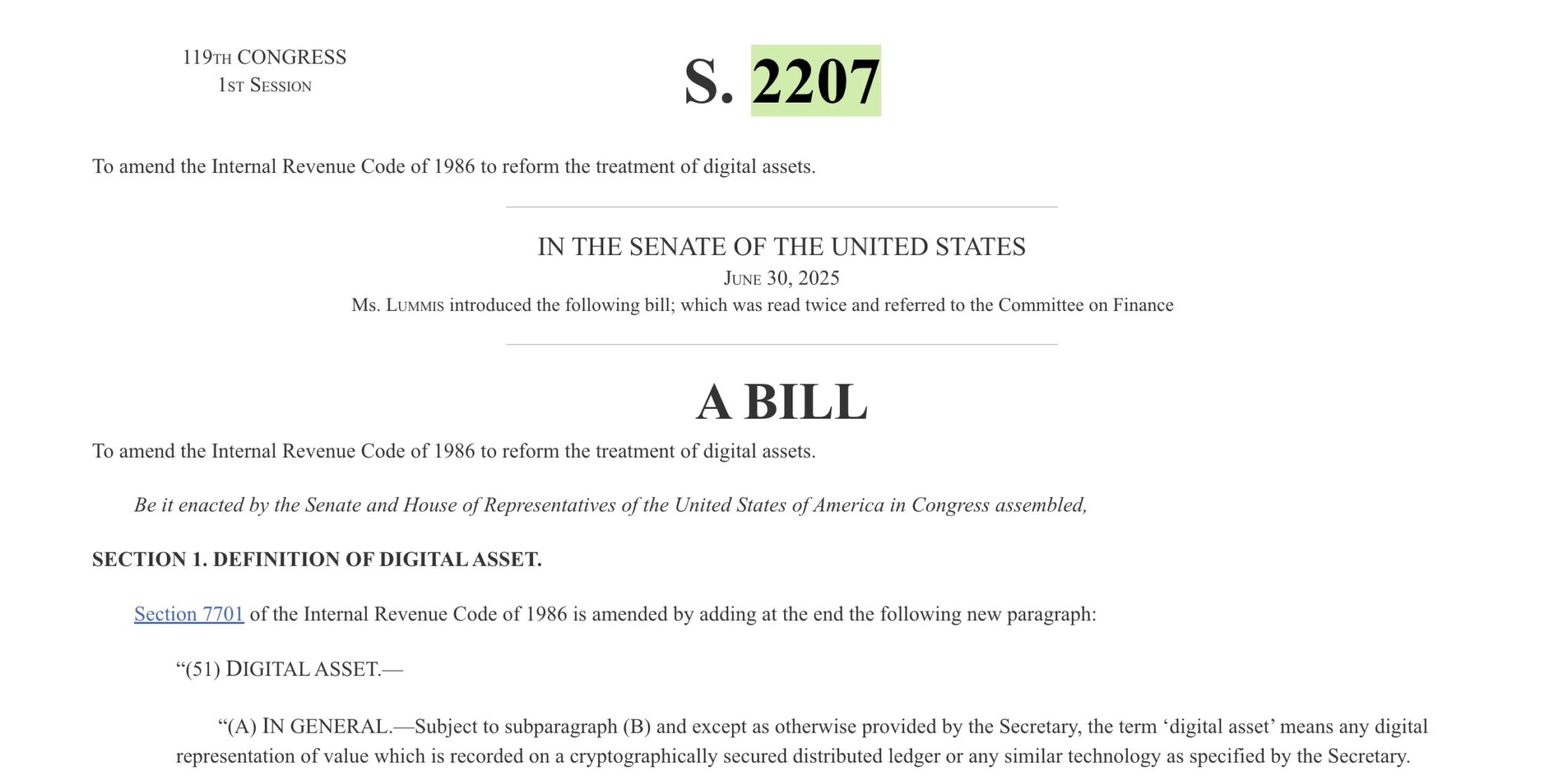
Here is what Bill S.2207 could change:
- Transactions under $300 would be tax-exempt;
- These exemptions would be limited to $5,000 per year;
- Losses incurred in cryptocurrencies could be deducted from other investments;
- Income from miners and stakers would only be taxed at the time of conversion to fiat currency;
- Cryptocurrencies could become eligible for charitable donation tax deductions.
This law would remain in effect until 2035, at which point the US Congress could reevaluate it to adapt it to the needs that will have emerged over the decade.
With this proposal, the US is moving closer to the more flexible policies already in place in countries such as Germany and Switzerland, where BTC held for more than a year is tax-exempt. It also draws inspiration from models where small payments in cryptocurrencies are exempt from taxation below a certain threshold.
In France, where taxation begins from the first euro spent, this US initiative could serve as an argument to encourage the adoption of more favorable legislation.
Bitcoin competes with both gold and the dollar
Bitcoin is now widely adopted as an investment asset, and more and more institutions are offering their clients the opportunity to invest part of their assets in it. It is also increasingly recognized as a store of value: some countries and companies, such as El Salvador and MicroStrategy, hold it in reserve with the intention of keeping it for several years, with no plans to sell it in the short term.
However, its status as a currency remains controversial, particularly due to its high volatility, although this is decreasing over time.
Another argument often put forward is that Bitcoin is only a store of value and therefore cannot be a currency. This idea is based on the belief that these two functions are necessarily separate.
However, apart from Bitcoin, gold acts as a global store of value, while the dollar is the international reference currency. This separation between the two has led to numerous economic imbalances.
Indeed, fiat currencies were created to allow governments to create money out of thin air in order to finance their policies.
This has certainly enabled strong growth since the end of the gold standard, but it has also led to economic distortions whose full extent we are only now beginning to perceive: exploding debt, the emergence of systemic banks, inflation that is difficult to control, and a growing disconnect between employee income and corporate profits, etc.
Bitcoin revives the idea of a monetary standard, with one distinctive feature: it requires no third-party custodian to carry out transactions, while enabling global, private, and low-cost exchanges.