
After an entrepreneur accused Binance of charging high fees for listing cryptocurrencies, the exchange defended itself and threatened to take legal action. Let’s take a closer look at this case.
Binance claims it does not profit from its listing process
On Tuesday afternoon, Binance’s customer service department posted a message on X, in which it defended the platform’s cryptocurrency listing conditions, stating that Binance does not profit from them:
Binance does not profit from its listing process; token allocations are intended for Binance users. Binance does not charge listing fees, and a security deposit is required for user protection. This ensures that projects remain operational after listing. This deposit is generally refundable within one to two years, under certain conditions. CJ’s allegations are contradicted by the alleged conditions proposed by Binance, which he himself published.
To understand this intervention, it is worth taking a closer look at the aforementioned CJ. Entrepreneur CJ Hetherington is the founder of Limitless, a prediction market protocol similar to Polymarket, specializing in very short-term cryptocurrency price direction. On Tuesday, he disclosed what he claims to be Binance’s listing conditions for a token:
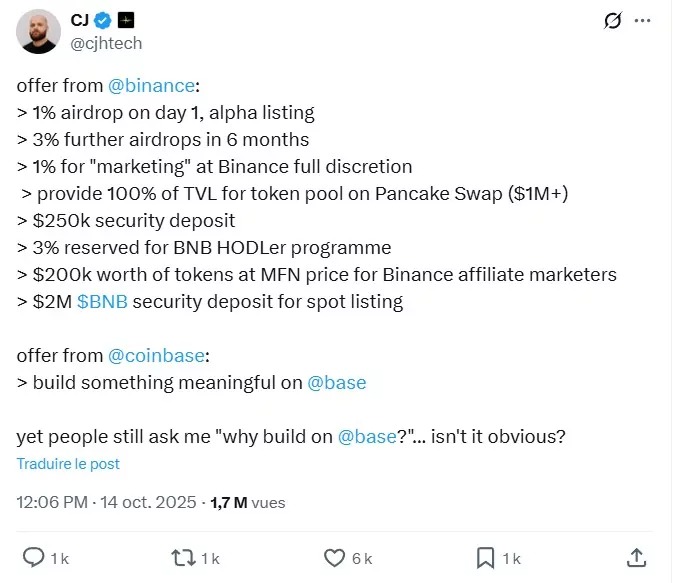
In light of the above, we might think that listing a token on Binance is particularly expensive, even though Binance claims that it “does not profit from its listing process.”
What makes the case ambiguous is that, despite Binance describing CJ Hetherington’s allegations as “false and defamatory,” it refers in the same tweet to “illegal and unauthorized disclosure” and “confidential communications,” an inconsistency that the defendant was quick to point out:
Wait a minute… if I disclosed the information… that means the offer was real… right?… right…
While it is necessary to remain cautious, it is possible that Binance does not charge any fees, but that the words were carefully chosen to gloss over other forms of remuneration.
Last April, for example, Yi He, co-founder of Binance, mentioned the possibility of allocating a budget to exchange users for the deployment of a project on other services:

While all of these listings also do not require any fees according to the exchange, it is unclear whether Binance, through its own BNB reserves, can obtain a certain allocation of the newly listed tokens.
In any case, Binance has announced that it reserves the right to take legal action against CJ Hetherington.
At the same time, a user of X described Binance’s intervention as a communication error, highlighting the comments of a relatively unknown person, without which the case might have been ignored.