
New year, new recovery for BTC prices? Today we take a look at the bullish and bearish theories for the crypto market!
New year, new trend?
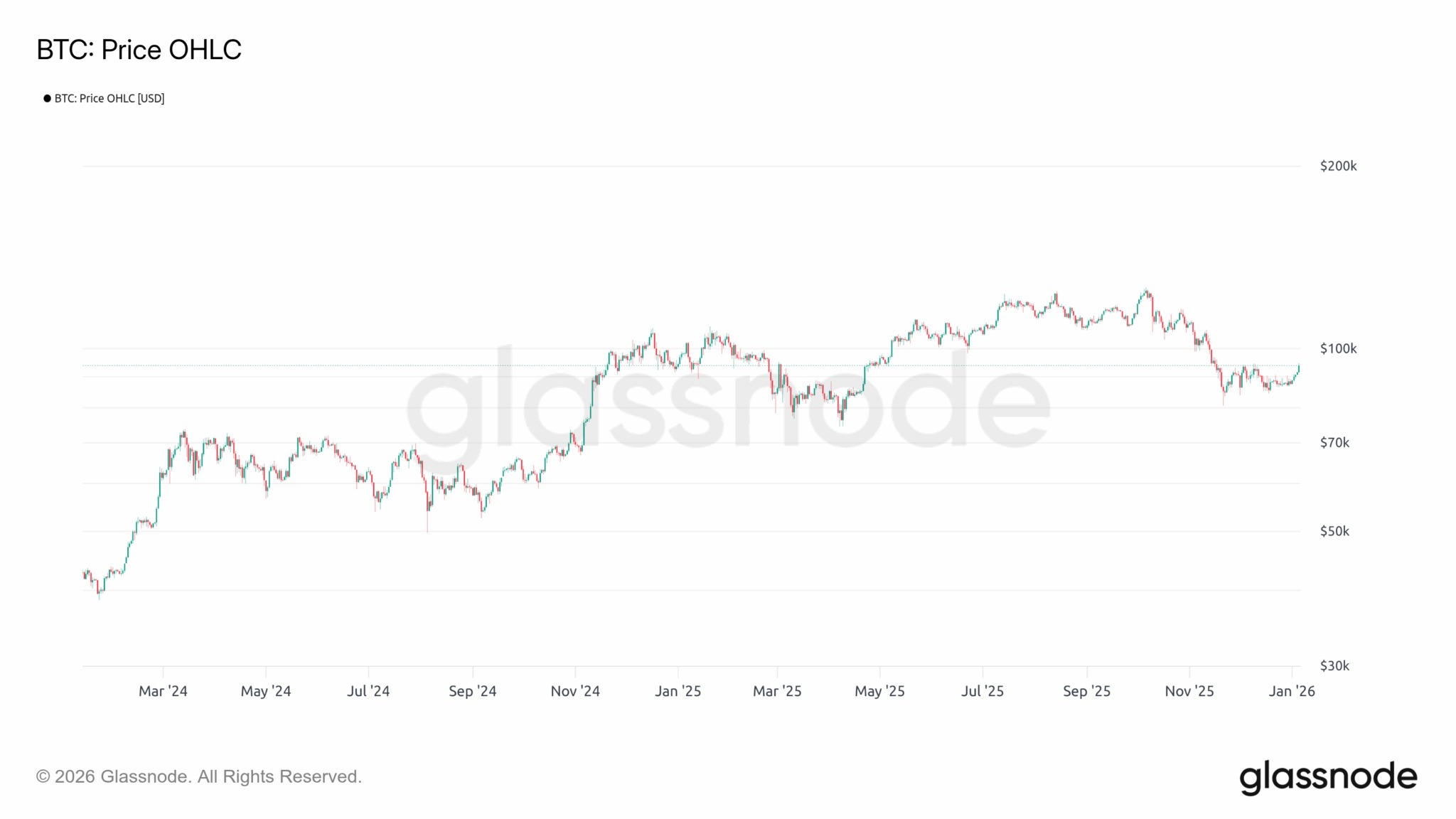
As 2026 begins, the BTC price is once again attempting to break through the $95,000 resistance level.
At the same time, the on-chain structure of the market is showing new encouraging signs, while a shift in capital flows towards ETH and altcoins is beginning to emerge.
What can we expect from the first few weeks of 2026? Let’s take a look together!
An optimistic start to the year
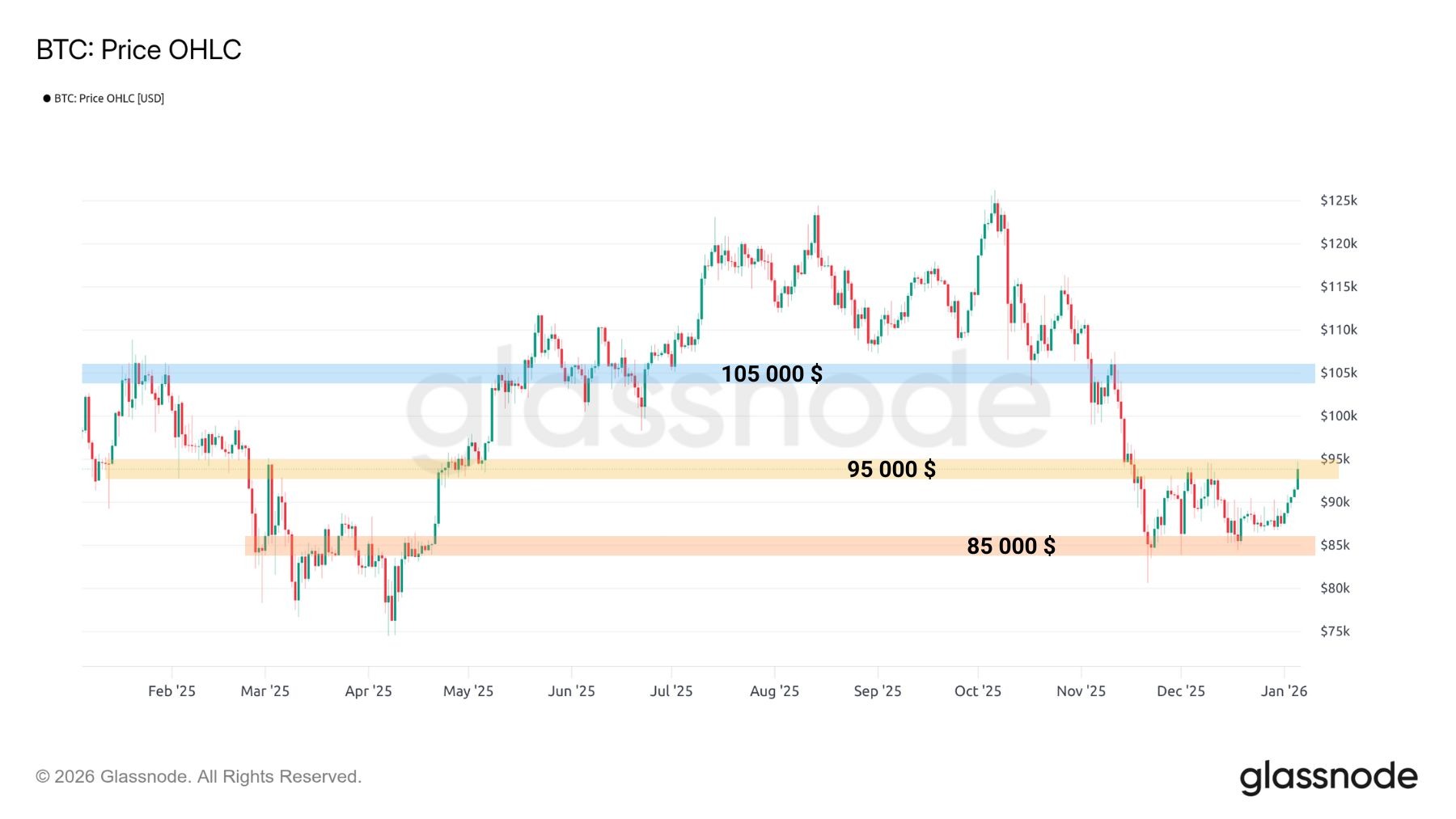
As the new year begins, the BTC price is once again attempting to break through the $95,000 threshold. This resistance has been holding back the market’s rise since December 2025, having already been rejected twice.
Even if the price breaks above this level, it won’t necessarily be smooth sailing for BTC. For a complete trend reversal to be confirmed, the price will also need to break through the $105,000 resistance level, which will be no easy feat.
Once this threshold is crossed, the odds of the market reaching new price records above $125,000 would once again become the majority.
Conversely, in the event of a further rejection below $95,000, the $85,000 support level will need to hold in order to prevent BTC from falling further, which would confirm the onset of the bear market that many fear.
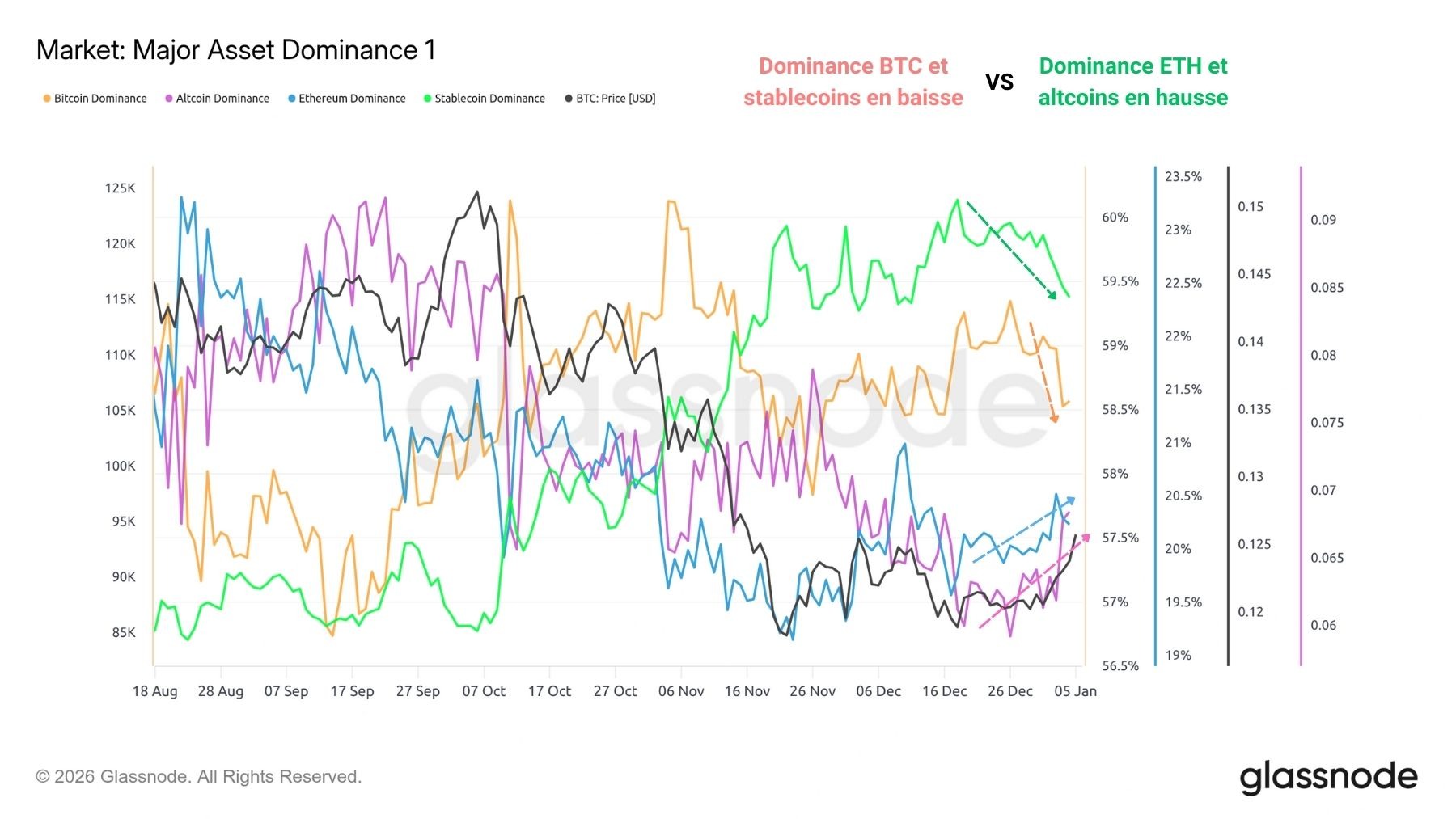
In addition, the cryptocurrency market is currently witnessing a particularly interesting potential structural change: a gradual rotation of capital from safe-haven assets to riskier assets seems to have been taking place since the beginning of the year.
Indeed, BTC and stablecoins—considered the least volatile assets on the market—have seen their dominance decline in favor of ETH and altcoins. This development suggests a migration of capital away from BTC and stablecoins towards ETH and altcoins, a dynamic that could lead to an altseason if it continues and gains momentum.
However, caution is advised: this signal is still recent and will need to be monitored closely to determine whether it is a sustainable capital rotation or simply a temporary diversification at the beginning of the year.
End of the correction?
At the same time, the on-chain structure of the market is showing new encouraging signs, particularly with regard to short-term momentum.
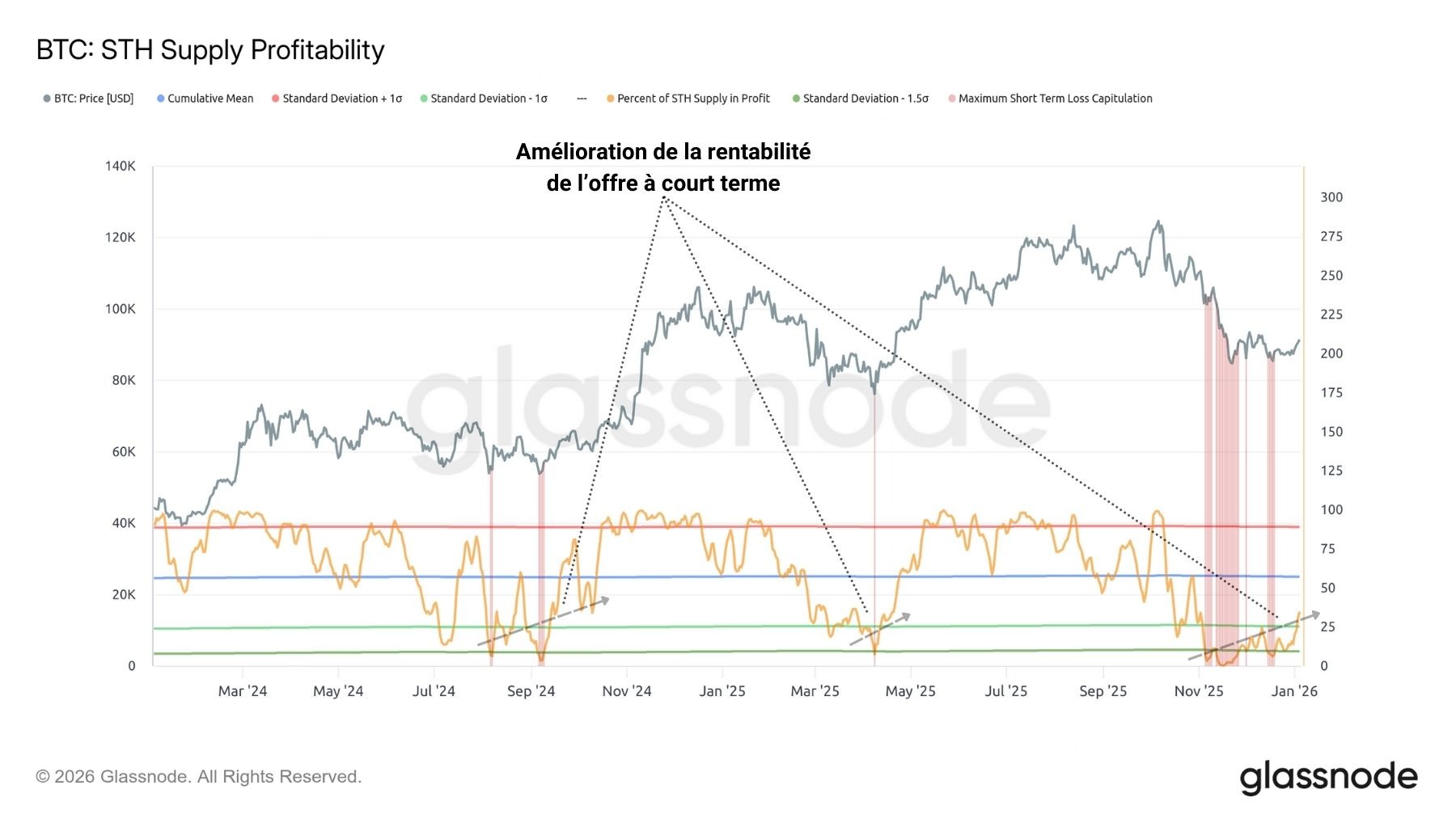
This trend is particularly visible in the chart showing the percentage of supply held at a profit by short-term holders (STH), which measures the proportion of BTC held at a profit by recent buyers.
The indicator had reached 2% at the end of November 2025, signaling that 98% of the supply held by STHs was then at a loss. This is an extreme value, characteristic of a major short-term capitulation phase, often followed by an end to the downtrend (as observed in September 2024 and May 2025).
Since then, the price of BTC has stabilized, allowing for a gradual improvement in the profitability of short-term holdings. To date, nearly 27% of short-term investors’ holdings are in profit, a context more conducive to optimism and short-term buying sentiment.
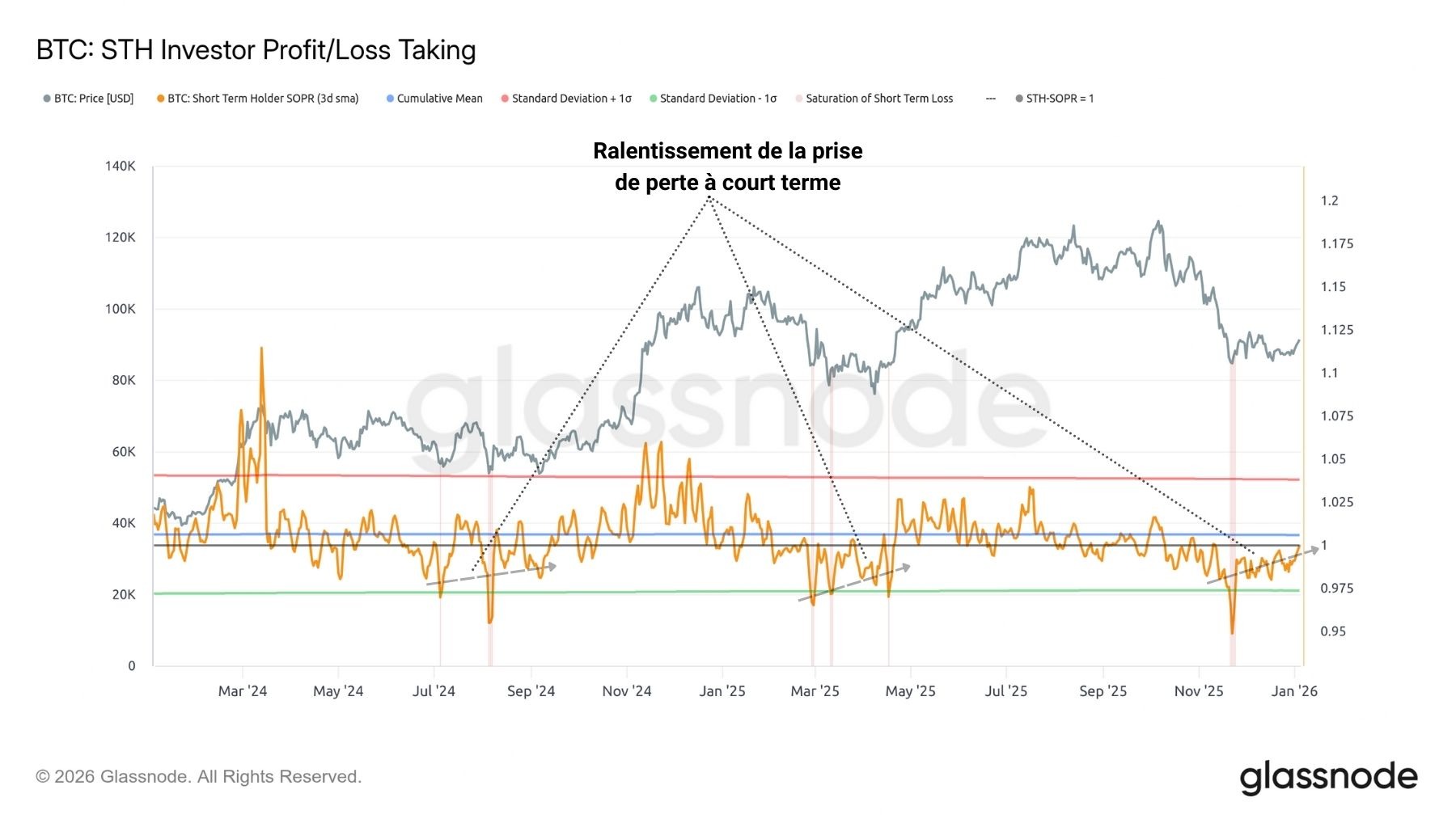
A similar dynamic can be observed in the SOPR ratio of short-term investors, which tracks their spending behavior. After a sharp peak in losses at the end of November—corresponding to a phase of capitulation—the losses incurred by STHs gradually decreased, to the point where they are now virtually zero. This slowdown in losses suggests a gradual easing of selling pressure, providing BTC with an environment more conducive to a bullish recovery in the coming days or weeks.
If this indicator manages to remain above 1 for a sustained period, the probability of the downtrend coming to an end would increase significantly, paving the way for a new bullish test of the BTC price.
Cyclical behavior
To qualify these rather optimistic observations, let’s take a step back and look at recent price action. Against all odds, the price of BTC has remained remarkably consistent over the last three bull cycles.
The time dimension seems to play a key role in the development of BTC’s bull and bear cycles between 2017 and 2025.
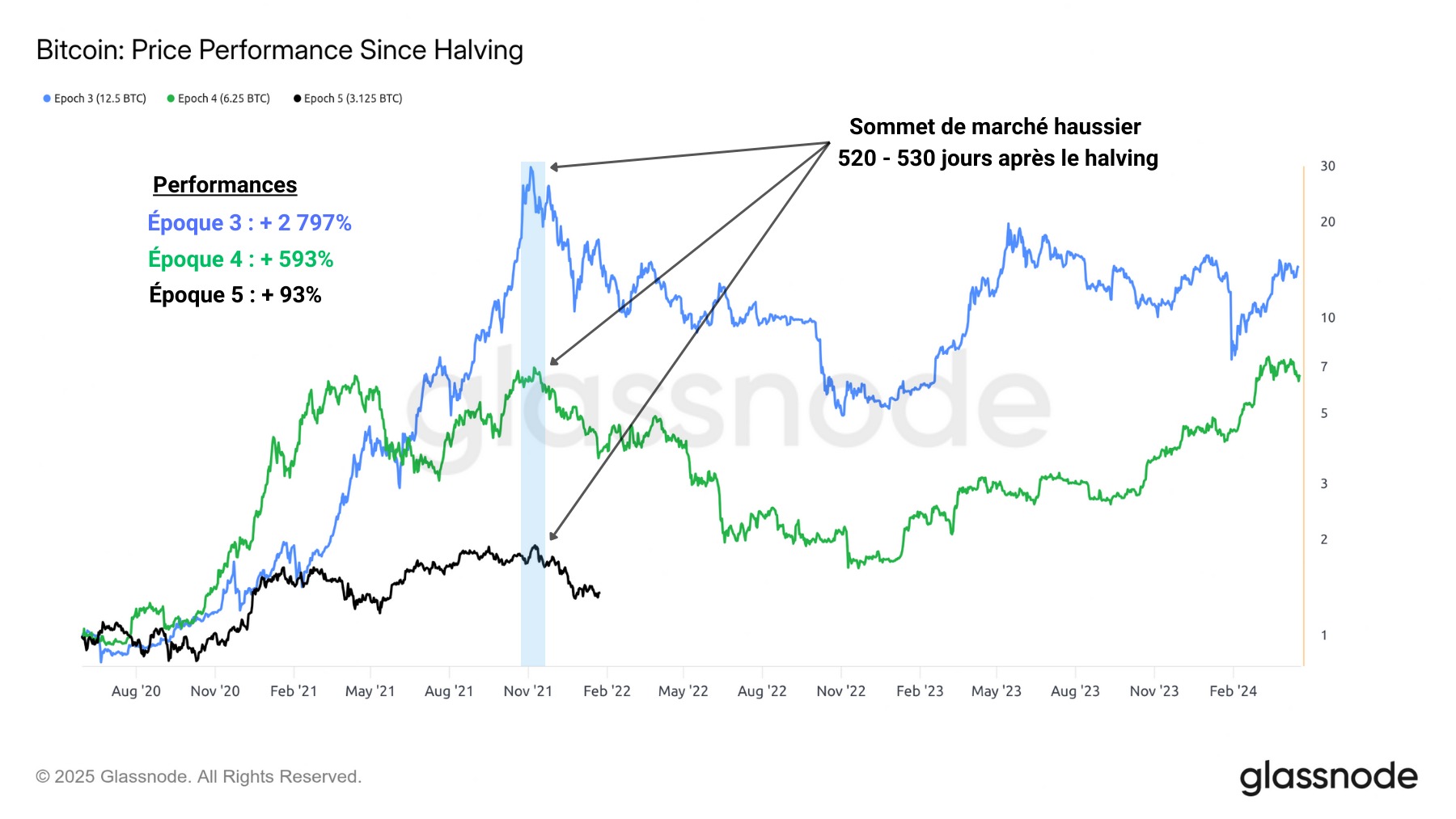
Indeed, the time elapsed between a halving and the subsequent cyclical peak coincides surprisingly well over the last three cycles, with approximately 520 days post-halving required to reach a new market peak.
Although this phenomenon could be seen as a mere coincidence, the regularity observed is nevertheless worth noting.
Beyond these temporal similarities, there is a major difference in terms of performance: the current bull cycle is the first to show an increase of less than +100% after a halving.
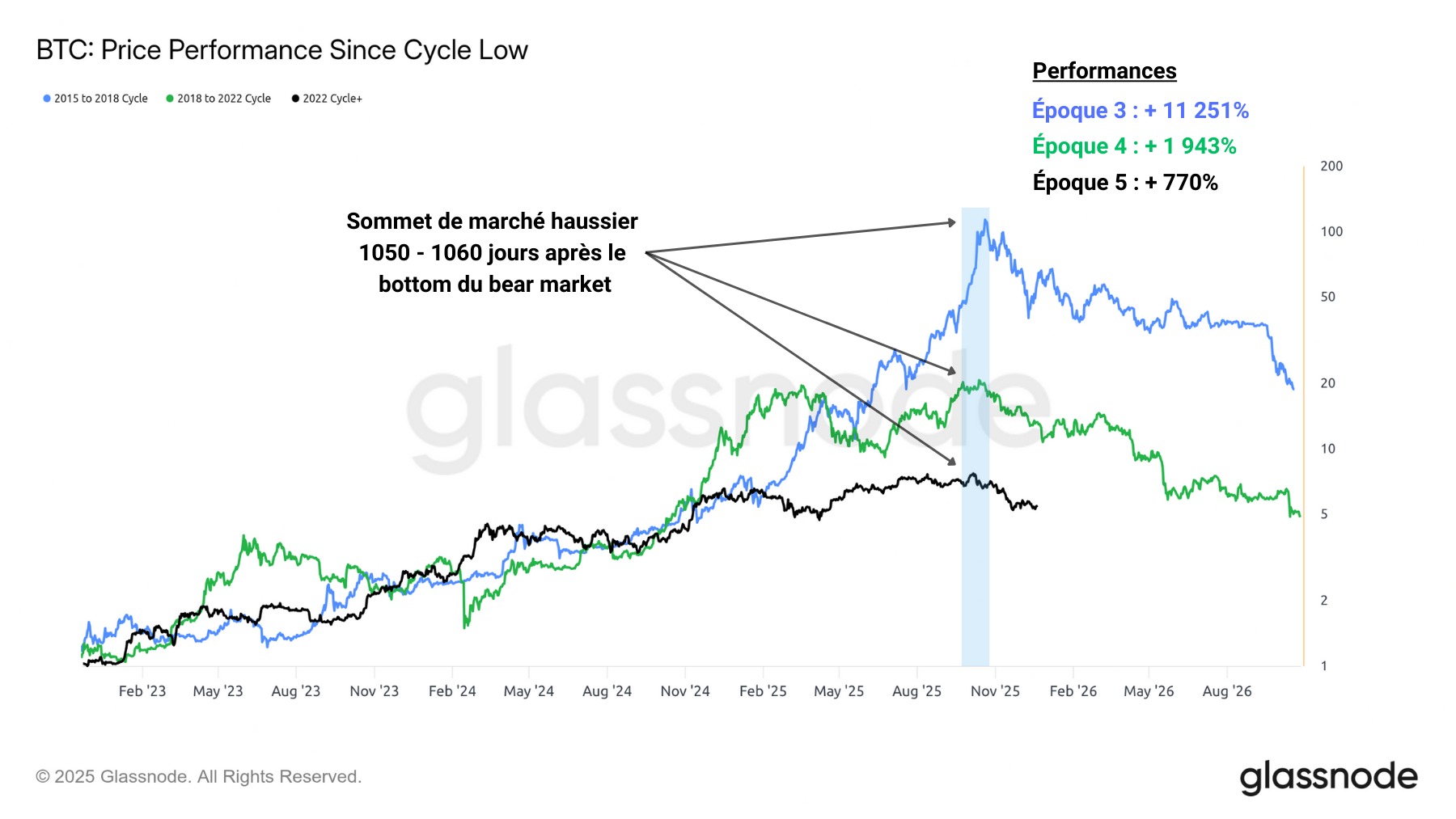
A similar observation applies to the time elapsed between the low point of the previous bear cycle and the peak of the subsequent bull market. Historically, bull cycles last between 1,050 and 1,060 days before reaching their peaks.
Here again, a notable contraction in performance can be observed between the last three bull cycles. The current market is the first to record a performance of less than +1,000% since the low point of the previous bear market. Based on the dynamics observed in the two previous cycles, BTC could now face a prolonged bearish trend before reaching a low point around November or December 2026.
Summary of this on-chain analysis of Bitcoin (BTC)
As 2026 begins, the price of BTC is once again attempting to break through the key threshold of $95,000, while encouraging signals are emerging from on-chain data and capital rotation towards riskier assets.
However, if historical cyclical dynamics were to repeat themselves, the market could still go through a prolonged period of weakness before hitting a new low towards the end of 2026.