
The Lightning Network continues to expand. The capacity of public channels has reached a new record, surpassing 5,600 BTC, despite a sharp decline in the number of channels. This is a strong signal of Bitcoin’s adoption as a means of payment.
The Lightning Network continues to gain traction: slowly but surely
The Lightning Network, an instant and low-cost payment solution built on top of Bitcoin, has just reached a new peak: the capacity of public channels now exceeds 5,633 BTC, or nearly $500 million.
A historic record that confirms the continued momentum of Bitcoin’s adoption as a means of payment. However, we are also seeing what appears to be a gradual centralization of the network.
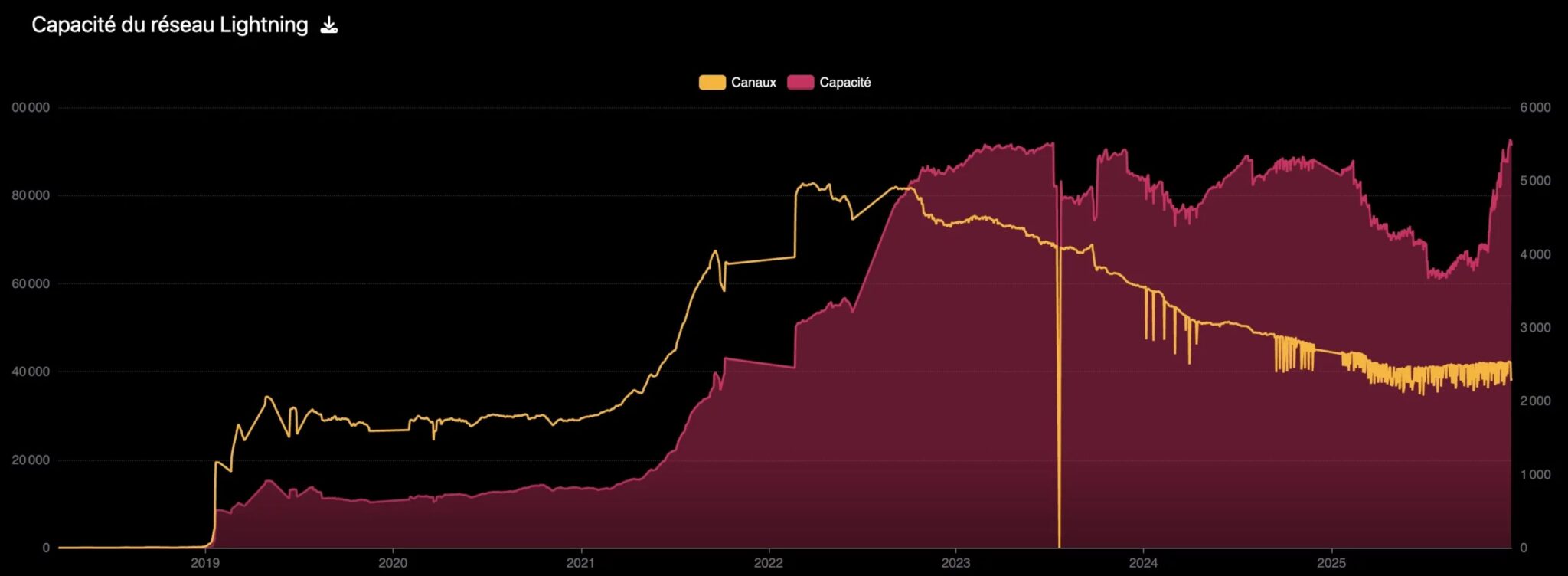
Evolution of the number of public channels on the Lightning Network and their capacities
First, it is important to note that the majority of Lightning Network adoption—as evidenced by the opening of new channels and nodes—actually occurs privately, that is, outside of on-chain data.
Consequently, the metrics available to measure Lightning Network adoption are incomplete and potentially misleading. The recent wave of adoption by individual users, which began 1 or 2 years ago, largely escapes traditional measurement tools.
Furthermore, due to the relative complexity of channel management, a significant portion of this adoption occurs through trusted third parties such as custodial wallets like Wallet of Satoshi or Blink, as well as through solutions integrating Lightning via the Liquid network, such as the BULL or Aqua wallets, which simplify the user experience by requiring management of only a single private key.
On the public data front, there has been a sharp decline in the number of public channels, down from 82,000 in 2022 to 42,000 today, while their total capacity is increasing. This indicates a growing concentration of liquidity in a smaller number of channels.
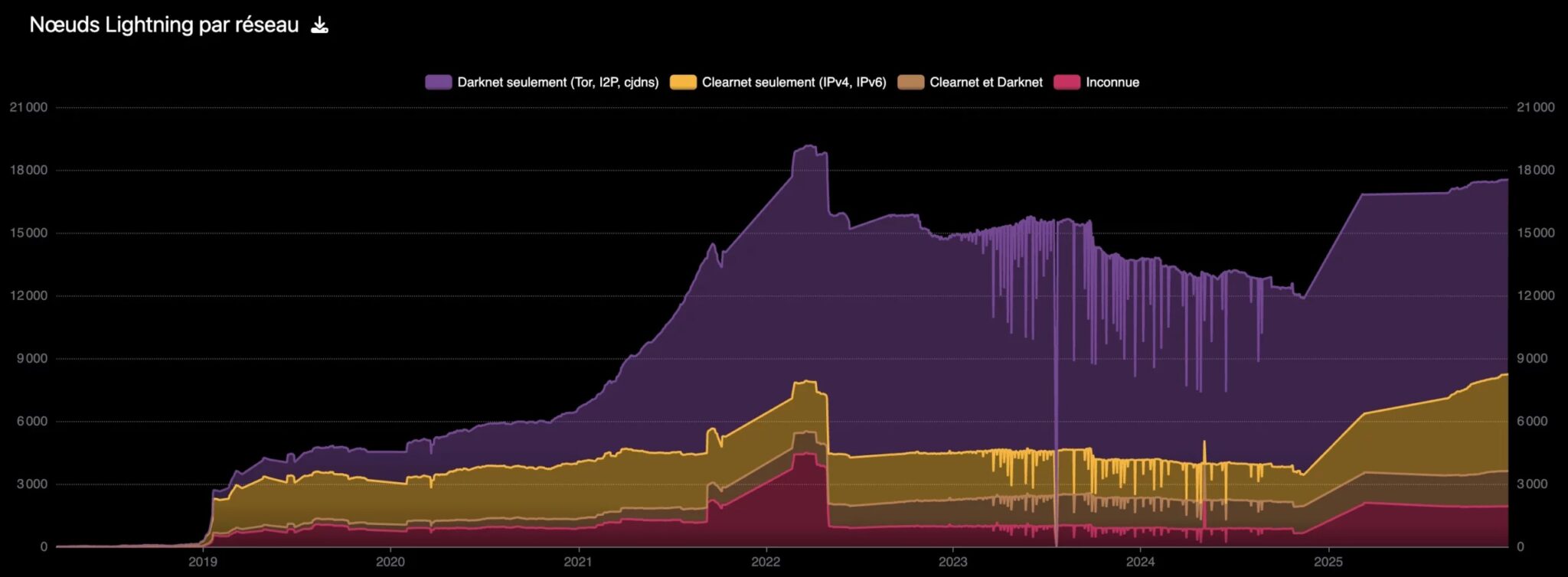
At the same time, the number of public nodes is on the rise, with a 32% increase since November 2024, growing from 11,900 to over 17,500 nodes today, thus approaching its all-time highs and contradicting suspicions of centralization.
Finally, even if liquidity on the Lightning Network were to become concentrated in the hands of a small number of nodes, these nodes could neither completely censor payments nor steal funds, since each channel remains secured by a private key held by each of the two peers, whose funds can be unilaterally withdrawn on-chain.
Does Gresham’s Law prevent Bitcoin from achieving the status of a medium of exchange?
Some critics of Bitcoin argue that BTC can never be adopted as a currency for everyday use, particularly because of Gresham’s Law.
This law states that “bad money drives out good,” meaning that when an individual holds both a weak currency and a strong currency, they will tend to spend the weak one and carefully hoard the strong one, never using it. Applied to a European Bitcoin user, this would mean that they would always prefer to spend their euros and keep their Bitcoins.
However, Gresham’s Law truly applies only in a context of state compulsion, when acceptance of the weak currency is imposed by its status as legal tender. Indeed, when we are legally required to accept this currency, it is the one we have in our pockets ready to be spent.

However, when confidence in this currency collapses—due to inflation, mistrust of the banking system, or the risk of default by the issuing government—economic actors naturally turn to stronger monetary alternatives.
Even without a total collapse of the currency, as soon as an economic actor has the option to accept payments in a strong currency, they will naturally tend to favor it.
They may even discourage the use of the weak currency by imposing an additional cost, as is already the practice in some Asian countries where credit card payments incur extra fees.
If you’re still not convinced, consider the example of Argentina, where the population, facing high inflation, naturally turned to the dollar, perceived as strong relative to the peso. Or take Nigeria, where the population rejected the digital naira in favor of alternatives like Bitcoin, stablecoins, or the dollar, fleeing the weak currency imposed by the state.
In this context, accepting payments and managing cash flow in a strong currency becomes a means of hoarding: a way to preserve value while remaining liquid.
This is a phenomenon we are already seeing, among individuals as well as businesses, and even certain governments, which are choosing to save in Bitcoin and use it to pay whenever possible.
This dynamic reinforces Bitcoin’s role not only as a store of value but also as a functional currency in the real economy, returning to a gold standard system abandoned in the last century due to technological limitations—limitations from which Bitcoin can break free thanks to the Lightning Network.