
What if Bitcoin’s cyclical peak hasn’t been reached yet? While many analysts view the $126,000 level, reached in early October 2025, as the peak of the current cycle, several indicators suggest it could be merely an intermediate plateau. Two main arguments support this hypothesis: the trend toward longer post-halving cycles and the macroeconomic context embodied by the copper/gold ratio, a leading indicator of the global economic cycle. Here is Vincent Ganne’s technical analysis of BTC.
The hypothesis of an extended cycle beginning in early 2026
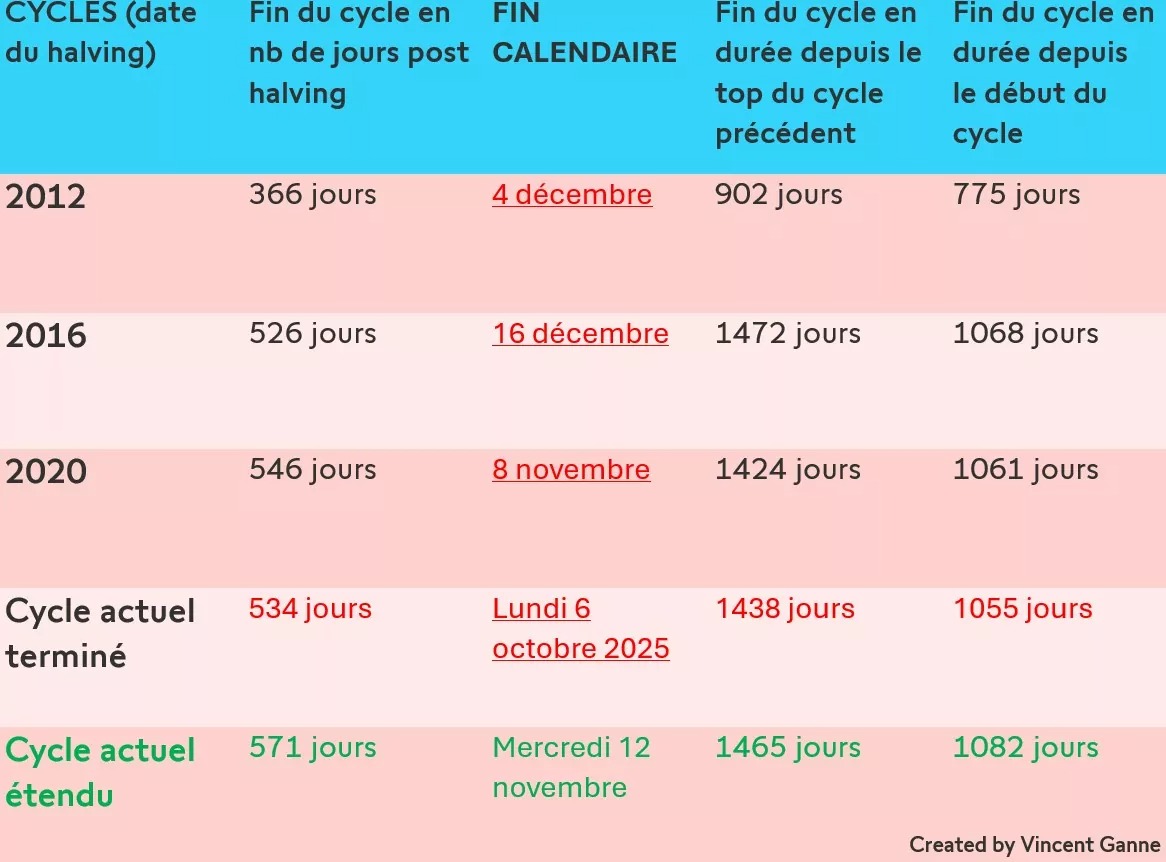
Historically, each Bitcoin bull cycle, measured from its halving, has been longer than the previous one. The 2012 cycle ended 366 days after the halving, the 2016 cycle after 526 days, and the 2020 cycle after 546 days.
This trend toward longer cycles reflects a maturing market: as Bitcoin’s price rises and its investor base expands, price movements become slower, more structured, and take longer to reach their peak.
Following this logic, the current cycle, which began after the 2024 halving, may not have ended on October 6 and could extend into the first quarter of 2026.
The promising message from the Copper/Gold ratio
Furthermore, from a macroeconomic perspective, a compelling argument supports this hypothesis: the dynamics of the Copper/Gold ratio. The Copper/Gold ratio is a reliable barometer of the global economic cycle. Copper, the quintessential industrial metal, reflects the strength of global economic activity, while gold, a safe-haven asset, reflects caution and a search for security.
When the ratio rises, it signals a resurgence in growth and risk appetite, conditions often associated with bull markets in equities and crypto assets. Conversely, a falling ratio indicates an economic slowdown and a defensive phase among investors.
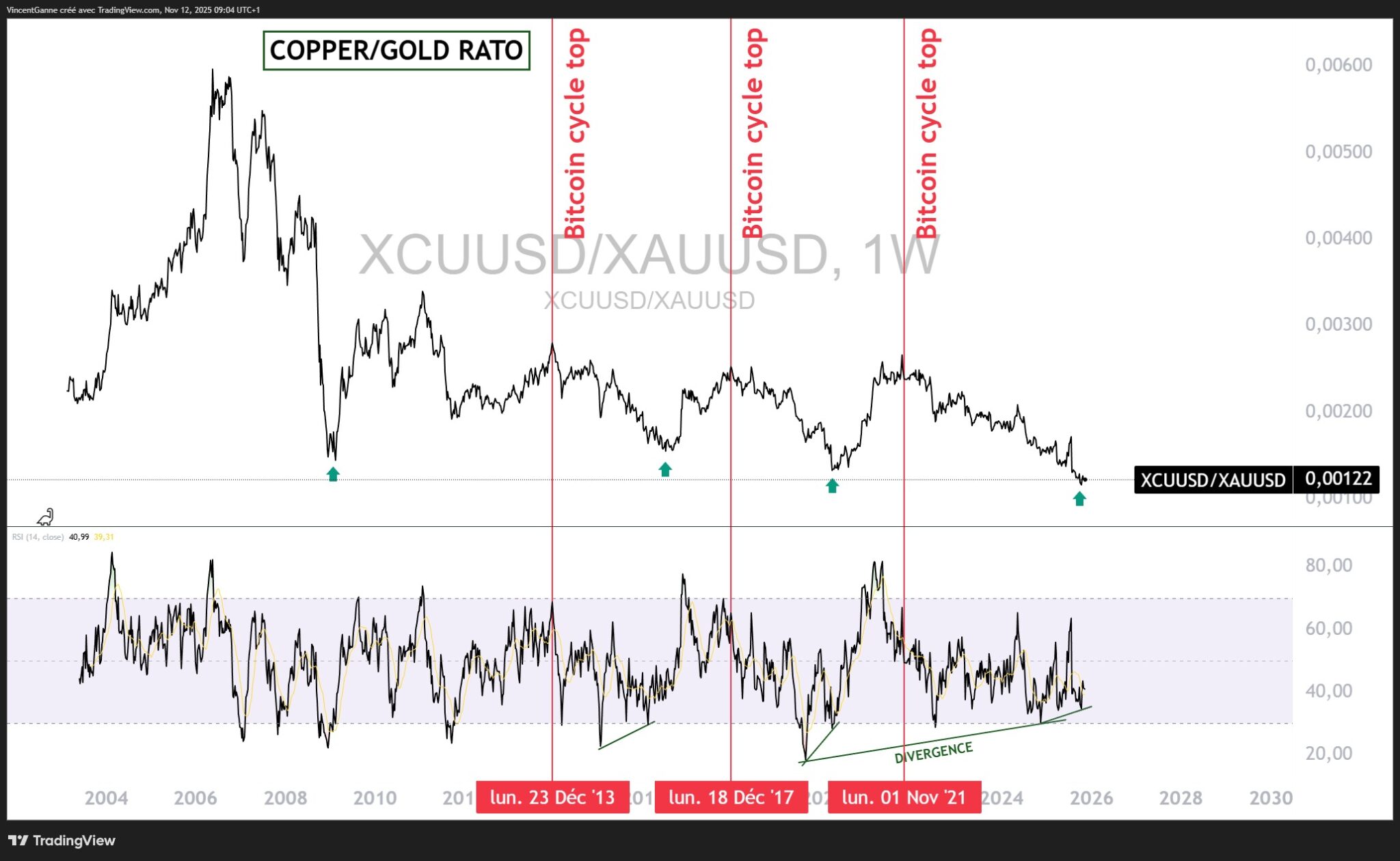
However, Bitcoin’s all-time highs (December 2013, December 2017, November 2021) coincided with the peaks of the Copper/Gold ratio.
Today, this ratio is at historically low levels, marked by a bullish divergence on the RSI, suggesting a potential trend reversal in the coming months. If this macro signal is confirmed, it could accompany—or even precede—a final major uptrend for Bitcoin, thereby extending the current cycle into 2026.’
In conclusion, it seems premature to assert that the peak of the cycle linked to the 2024 halving is already behind us. The macroeconomic context does not yet exhibit the usual characteristics of a cycle peak, and the internal logic of Bitcoin cycles suggests a temporal extension based on the number of days elapsed since the halving.
Thus, a scenario of an extended cycle, peaking between late 2025 and mid-2026, would fit perfectly within the market’s historical and structural continuity. If this is the case, the current phase would not be the end, but an intermediate correction. This hypothesis holds up as long as major support levels are not broken, namely the $95,000–$100,000 range.