
Since its launch, the Bittensor project has aimed to revolutionize the AI sector with a decentralized offering based on a subnet system. This vision is backed by enthusiastic investors who have just sent the price of its TAO token soaring by over 45% in one week. Here’s an update…
TAO up 45% over 7 days: what’s happening with Bittensor?
The rapid development of the artificial intelligence sector relies on largely centralized models, the most popular of which are currently ChatGPT, developed by OpenAI, and Claude from Anthropic, which is clearly capitalizing on its competitor’s questionable development decisions.
However, another project could soon emerge as a major crypto player in this constantly evolving ecosystem, in a decentralized, blockchain-based form. This is Bittensor and its system of 128 subnets specialized in specific tasks, often referred to as the “Bitcoin of AI.”
A project backed by the TAO cryptocurrency, which has risen by over 45% in the last week, making it one of the best-performing tokens in the crypto sector during this period, while the cumulative value of Bittensor subnets has just reached an all-time high, accounting for 27% of the token’s total market capitalization, currently estimated at $2.8 billion.
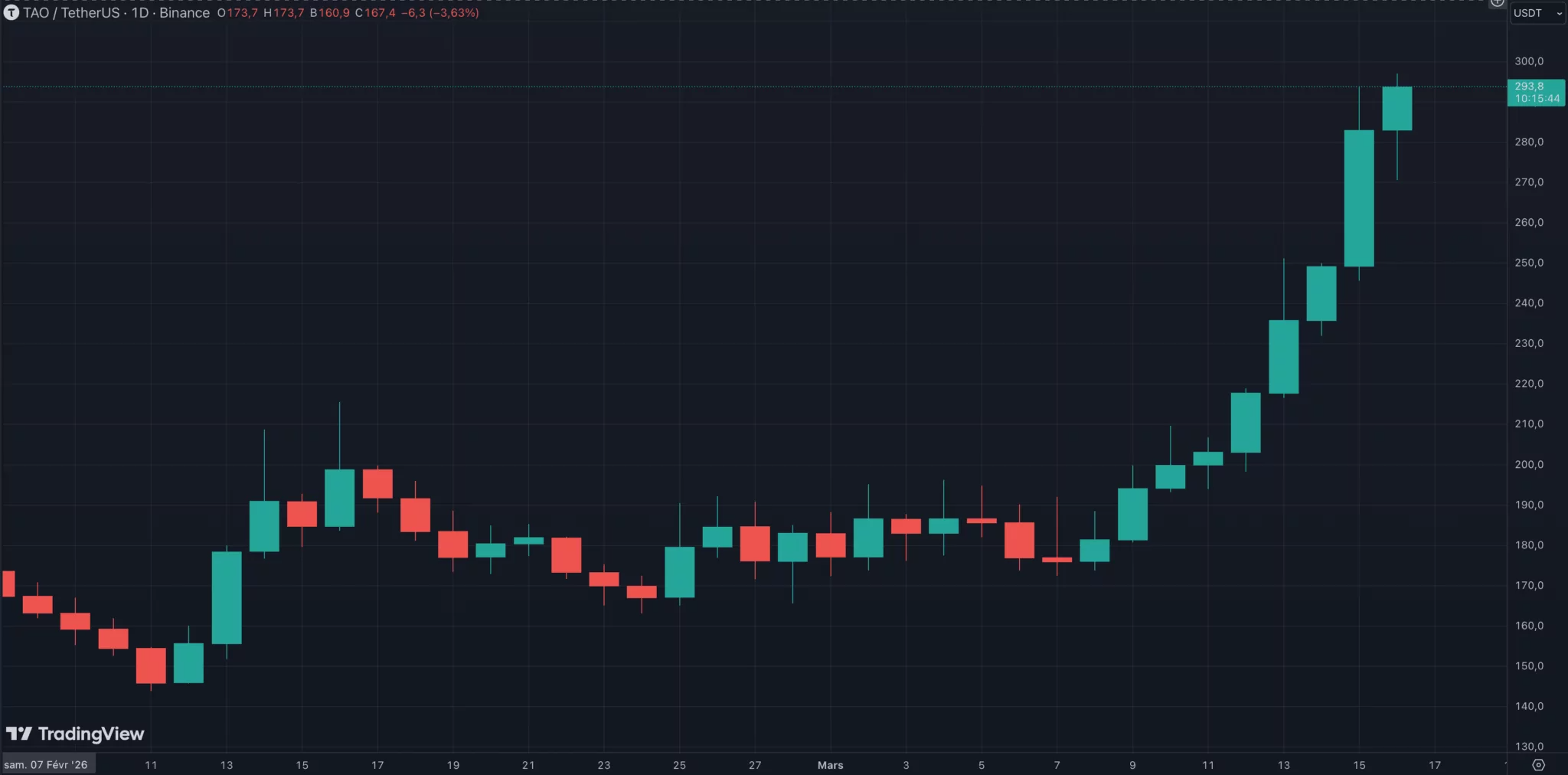
Bittensor’s TAO surges 50% over the past week
Why such a surge? It appears that certain ongoing developments are catching investors’ attention, such as the Templar project, which has just announced “the largest decentralized LLM pre-training run in history: Covenant-72B,” according to the TAO Telegraph account on the X network. But that’s not all…
Templar and Score: Bittensor’s two current flagship projects
Two projects are currently attracting particular attention from AI and decentralization enthusiasts on Bittensor, first and foremost the largest language model ever trained in a decentralized manner, Covenant-72B, created by the developers of Templar (subnet 3).
The secret behind this new model? An algorithm developed by Covenant AI and the Mila laboratory that reduces bandwidth requirements by a factor of 146, according to its developers, making it accessible for standard home internet connections, with the associated goal of building a fully decentralized cutting-edge research lab.
Next comes the Score project (subnet 44) and its intelligent visual analysis system, named Manako, designed to provide a decentralized marketplace for computer vision. As a result, companies can submit image and video analyses to it, which its tool immediately converts into structured, actionable data.
This efficiency is made possible primarily by fostering continuous competition among miners, in order to “quickly match and surpass the performance of centralized solutions for specific vision tasks,” according to the Bittensor France website.
A subnet infrastructure serving a shared framework
With its 128 constantly re-evaluated and interconnected subnets, Bittensor is developing a truly decentralized ecosystem dedicated to all tasks applicable to artificial intelligence. Within this ecosystem, the Chutes platform (subnet 64) allows any developer—or other subnet—to deploy an open-source AI model in just a few clicks, without managing infrastructure and paying only for the tokens consumed.
An effective solution to “the problem of complexity and cost associated with deploying AI applications,” with pricing that appears significantly lower than solutions such as Amazon Web Services (AWS), thanks to thousands of GPUs distributed worldwide and directly compensated by the protocol.
At the same time, the “confidential compute” service Targon (subnet 4) offers a trusted virtual machine architecture (Trusted Execution Environments) that allows verification that participants are using authentic hardware to perform the requested work, while also ensuring that data remains encrypted throughout the entire processing period.
This is an option that only Microsoft’s Azure cloud computing service currently offers—partially—with certain access limitations. These restrictions do not apply to the Targon project, as it operates without any geographic restrictions, with H200 GPUs available for less than $2 per hour.
Bittensor: The Worthy Successor to Bitcoin and Ethereum
All these subnets and joint developments aim to achieve a common goal: to break free from the current high concentration of the AI sector in the hands of a few highly centralized tech giants—such as OpenAI, Anthropic, Google DeepMind, or Meta AI—who pay little attention to transparency or how they manage the data they collect.
An almost natural evolution, according to analysts at Stillcore Capital, who released a comprehensive report on Bittensor just two weeks ago, presenting this decentralized AI project as the worthy successor to the revolutions sparked by Bitcoin and Ethereum in the monetary and financial sectors.
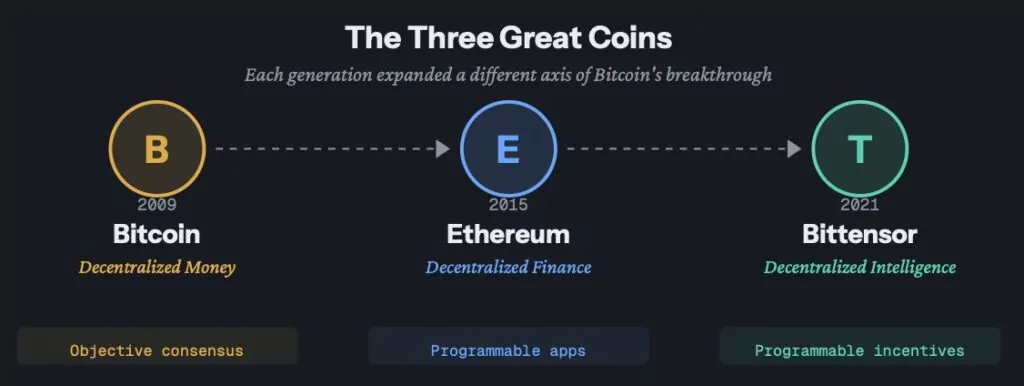
If Bitcoin was the first major decentralized monetary innovation and Ethereum the second with decentralized finance (DeFi), then TAO could well be the third: decentralized intelligence, applied to the defining economic transformation of this century.
Stillcore Capital