
Every bull market associated with cryptocurrencies is based on more or less seasonal or sustainable themes—also known as narratives—that drive the performance of their popular tokens. This reality marked 2025 with a rapid succession of narratives, providing some essential lessons.
Too many narratives kill the narrative
If we were to boil down the previous bull markets in the cryptocurrency sector to their essentials, they could be summarized with Initial Coin Offerings (ICOs) in 2018 and NFTs in 2021. But then what was the narrative of 2025, when Bitcoin exceeded $125,000 for the first time?
This question was raised by the X Tiger Research account, and it does not seem so easy to answer, firstly because of a clear lack of hindsight, but also because it would appear that this latest edition was based on a succession of different themes like never before.
Speculative euphoria was short-lived, to the point where “the market’s attention moved on to the next narrative before properly validating the previous one.” And it’s fair to say that in this area, memecoins quickly set the trend as a driver of instability in the first few months of the year.
The fundamental problem is that most of these narratives turned out to be one-off events. They consumed short-term attention without building structures capable of evolving into real sectors. Some players even created false narratives to exploit investors.
Tiger Research
As a result, it seems possible to identify a new narrative for each month of 2025, to the point of pushing investors to “become more critical and increasingly skeptical” of these bullish impulses, even if it seems possible to admit that “some have established themselves as real sectors to the point of helping to advance the crypto market.”
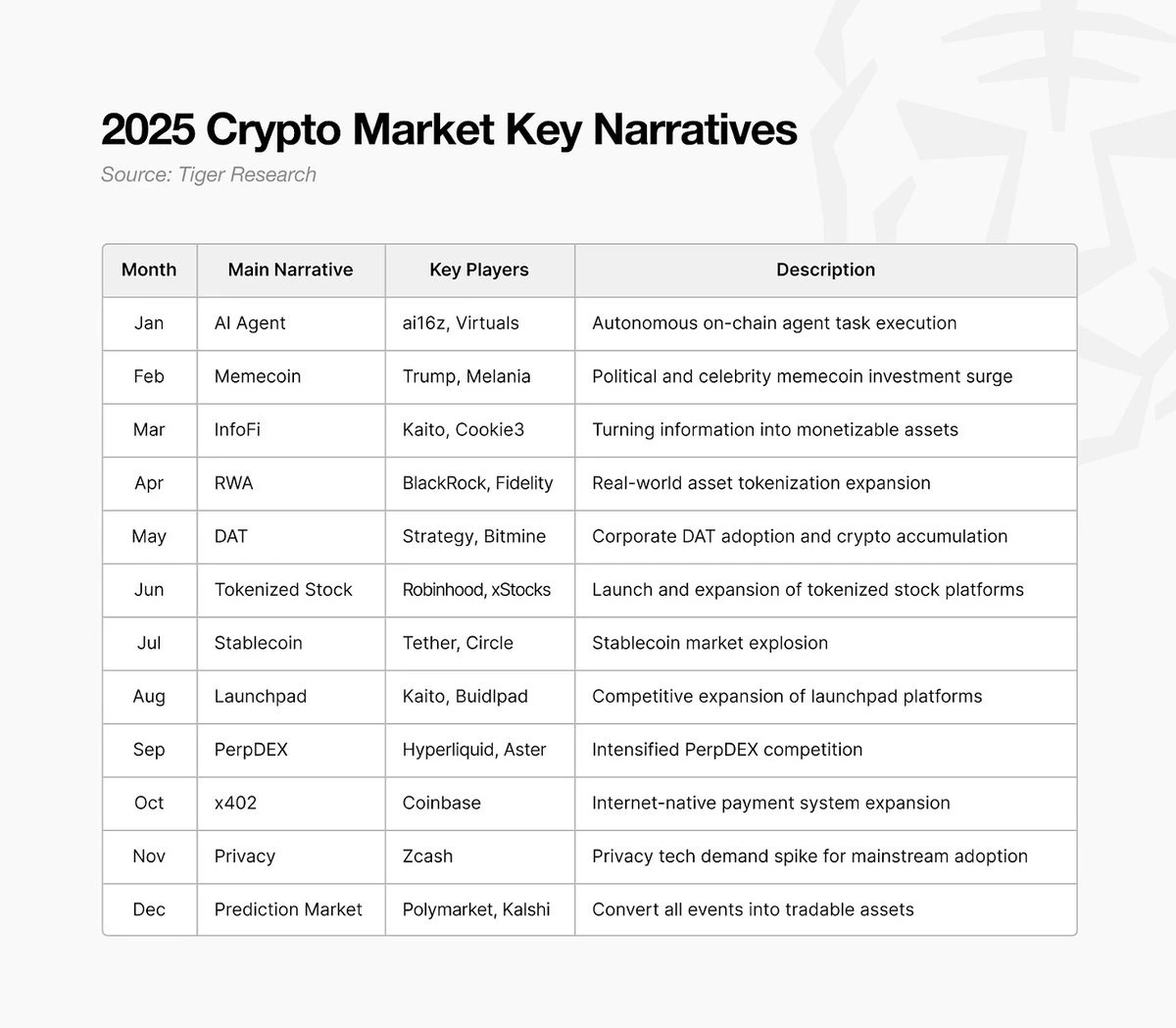
Key trends to remember from 2025
Beyond memecoins, which are simple and intuitive enough to attract new investors before spitting them out again with no lasting trickle-down effect, the report highlights the “InfoFi” services developed around Kaito.
This is an interesting approach to content creation, but one that will come up against its reward system, to the point of ultimately “prioritizing sensationalism over accuracy.”
Other narratives with more solid fundamentals have made it possible to create long-term engagement, particularly through proposals capable of “taking crypto from abstract potential to concrete and functional use cases.”
In this area, Tiger Research’s analysis points more specifically to the significant rise of stablecoins, the development of Coinbase’s x402 payment protocol, and the success of prediction markets.
All this was accompanied by “numerous experiments taking place behind the scenes at the same time, as institutions began to seriously integrate,” such as the tokenization of real-world assets (RWA) and perpetual DEXs.
Between increased privacy and user retention
Finally, particular attention is being paid to privacy-based projects, in an environment where transparency, initially presented as positive, is turning into “an environment that exposes the size of transactions, their timing, and positions involving strategic exposure for institutional investors.”
Or how to bring opacity back to the blockchain to encourage traditional players to come on board…
The conclusion of this article comes from analysts at Tiger Research:
Massive inflows are possible when the right catalyst meets a low barrier to entry—memecoins are proof of this. But it also shows that inflows alone are not enough. If projects don’t come up with reasons to keep users around, those inflows quickly turn into outflows. Retention remains a key challenge.
Tiger Research