
Since its launch, the Ethereum blockchain has evolved in line with trends and technical developments in the cryptocurrency ecosystem. This is sometimes a complex exercise, and its co-founder, Vitalik Buterin, calls for a focus on maintaining low-risk DeFi, which is much more useful than memecoins.
Vitalik Buterin advocates for low-risk DeFi on Ethereum
Despite attempts by many competing blockchains to take market share away from it, Ethereum remains the undisputed leader in decentralized finance (DeFi). And for good reason: it alone accounts for around 60% of its current total value locked (TVL), with more than $92 billion on the books.
According to its iconic co-founder Vitalik Buterin, this position is based on two essential fundamentals that were previously separate. On the one hand, there are applications capable of generating revenue (NFTs, memecoins, speculative DeFi) and, on the other, those that address more ideological concerns (social tools, identity, privacy).
One of the significant tensions in the Ethereum community for a long time has been between applications that generate enough revenue to economically support the ecosystem — whether that means maintaining the value of ETH or funding individual projects — and applications that address the fundamental goals that attracted people to Ethereum.
Vitalik Buterin
This is a gap that Vitalik Buterin clearly wants to bridge in order to reconcile these two aspects, which are presented as essential to the development of a blockchain, by drawing inspiration from the economic model established by Google, based on search and advertising.
Except that in the case of Ethereum, advertising would give way to a “low-risk” DeFi capable of supporting “an alignment between ‘doing well’ and ‘doing good’ to a degree that does not exist in advertising.” What does that mean?
A new global financial paradigm
Of course, Vitalik Buterin does not want to apply Google’s advertising model to Ethereum. However, he questions the relevance of having an activity capable of reconciling revenue and values within its ecosystem. The goal is to do much better than this “anti-social company seeking to maximize profit.”
In practice, this low-risk DeFi will have to focus on two essential objectives:
- Provide irreplaceable value, both for Ethereum and its users;
- Be in line with the goals of the Ethereum community.
In “low-risk DeFi,” I include both the basic functions of payments and savings, well-understood tools such as synthetic assets and fully collateralized lending, and the ability to trade between these assets.
Vitalik Buterin
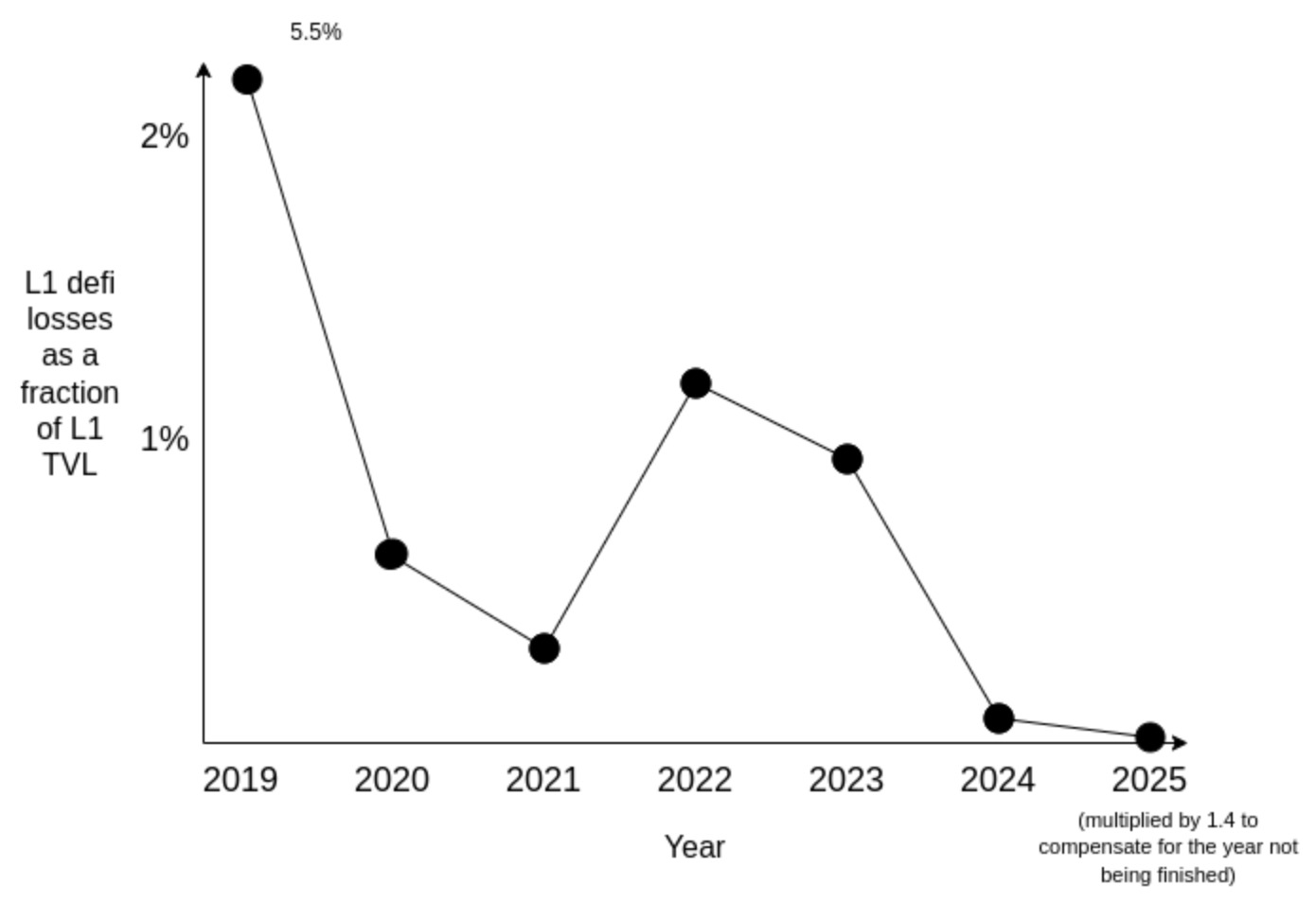
This shift has been made possible largely by the maturity now achieved by certain iconic DeFi protocols, to the point where using decentralized finance is less risky than TradFi in some countries, “given the growing global political instability.”
The development of the Ethereum blockchain must find its main support in applications that will “change the world in a positive way.” This was an opportunity for Vitalik Buterin to remind us that “it is impossible to seriously say that you are enthusiastic about the ecosystem (…) if its biggest application is political memecoins.”