The cryptocurrency market had reacted positively to the Fed’s recent announcement of a cut in its key interest rates. However, this enthusiasm was short-lived, given the widespread decline that has just led to $1.7 billion in liquidations over the last few hours. Let’s take stock of the situation.
$1.7 billion in liquidations over the last 24 hours
It’s going to be a difficult wake-up call at the start of the week for cryptocurrency investors. A sudden drop in Bitcoin to around $112,000 a few hours ago has triggered a widespread decline, the main consequence of which is currently being felt in the form of massive liquidations.
Over the last 24 hours, BTC has fallen 2.5%, accompanied by declines ranging from 2.5% (TRX) to 10% (DOGE) for the top 10 cryptocurrencies. As a result, data from the Coinglass website shows estimated liquidations totaling $1.7 billion over this period, involving more than 400,000 traders.
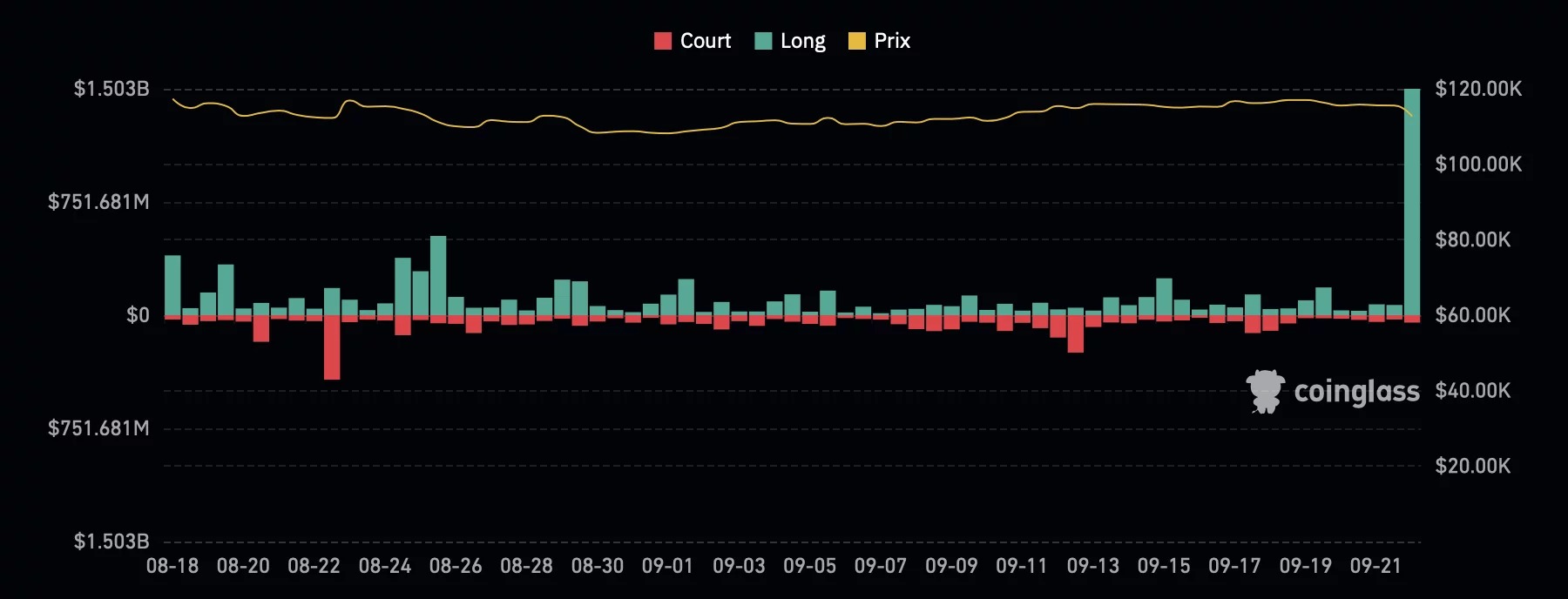
In detail, it is obviously the long positions—those betting on an increase—that are suffering the most from this situation. In fact, they account for an estimated total of $1.6 billion over the last 24 hours, representing more than 95% of liquidated positions, with $1.06 billion in the last four hours alone.
According to data from the Coinglass website, the largest liquidation to date has been recorded on the OKX cryptocurrency exchange platform, with a BTC-USDT-SWAP position estimated at $12.74 million. However, the Bybit platform has the largest amount, with a balance of $897 million.
Ethereum peaks at $500 million
As part of these massive liquidations, Ethereum currently has the worst balance sheet with a total of $500 million over the last 24 hours, including more than $300 million in the last hour alone.
Bitcoin ranks second, with a total of $284.5 million over the last 24 hours, far ahead of third-ranked Solana (SOL), which has accumulated just over $96 million.
Why such a decline just days after the US Federal Reserve’s (Fed) positive decision to finally lower its key interest rates by 25 basis points? According to Michael Rosen, chief investment officer at Angeles Investments, this is a direct consequence of Jerome Powell’s latest statements on the subject.
Powell tempered some of the markets’ initial enthusiasm for more aggressive monetary easing. He highlighted the weakness of the labor market, but reserved a more significant rate cut for more serious conditions, which are not present today.
Michael Rosen
Indeed, Jerome Powell stated at the end of last week that the recent rate cut was part of a risk management reduction that did not necessarily imply a continuation in the near future. This undermined the morale of a market already under considerable pressure in the face of an uncertain macroeconomic situation.