Hyperliquid, known for its rapidly growing perpetual DEX, has just announced USDH, its own native stablecoin. Issued directly on Hyperliquid, USDH could well become the cornerstone of a complete and self-sufficient ecosystem.
Hyperliquid wants its own native stablecoin
From perpetual DEX to a true ecosystem. Much more than a cryptocurrency exchange platform, Hyperliquid now has many tools at its disposal to continue growing its dominance, including Builder Codes, HIP-3, and CoreWriter. HyperEVM, on which many protocols are being developed, currently has $3.18 billion in TVL. One of the cornerstones of Hyperliquid is stablecoins. More specifically, USDC, Circle’s stablecoin, which is also the second most capitalized on the market. The reason for this is simple: to trade on Hyperliquid, you need to provide liquidity by depositing USDC via an Arbitrum-Hyperliquid bridge. The USDC-Hyperliquid duo is now a given for all DEX users, but that could change very soon. The Hyperliquid teams have just announced that the ecosystem will soon have its own native stablecoin: USDH.
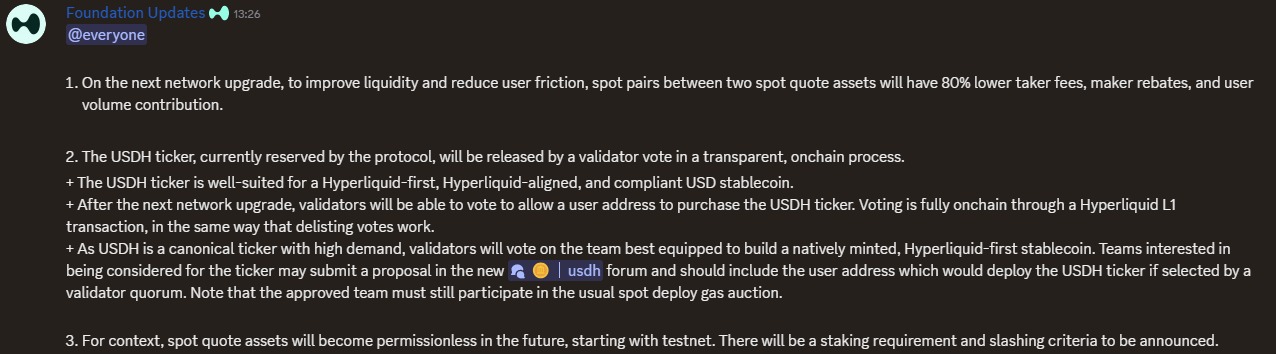
Specifically, we learn that Hyperliquid has reserved the USDH ticker with a view to launching a stablecoin backed by the US dollar. The process for launching the USDH will be carried out in the same way as for delistings, i.e., via the established on-chain governance system. Validators will have to select the team of developers they deem most appropriate to oversee this new stablecoin. It is already possible to submit applications via a dedicated channel.
The manner in which the USDH would be collateralized was not addressed in the announcement.
Unlike USDC, USDH will be natively issued on Hyperliquid. This implies fewer technical risks (particularly bridging), but also better integration with the platform’s products: collateral for derivatives, spot trading, and even future use in DeFi applications built on HyperEVM.
Reduced fees and permissionless listing
Another new feature is expected on the trading side. Specifically, taker fees on spot quote asset pairs (USDC/USDT, USDE/USDC, etc.) will be reduced by 80%, and maker rebates will also be reduced by 80%. Similarly, to prevent abuse, the volumes recorded on these pairs for users will be reduced by 80%.
With the 80% reduction in fees, arbitrage and high-frequency trading could become a serious feature of Hyperliquid. This would attract new players who would bring liquidity and mechanically narrow the spread between bid and ask prices. In doing so, the trading experience would resemble that of a centralized exchange, but with the transparency of a DEX and the efficiency of an on-chain order book.
Finally, Hyperliquid has announced that spot quote asset pairs will soon be permissionless, meaning that anyone (with a minimum amount of HYPE tokens staked) will be able to launch a new pair of this type. A slashing process will also be put in place, again to prevent abuse.