In Iran, mining 1 Bitcoin would cost around $1,300 in electricity, while it is worth more than $110,000 on the market. This is a huge opportunity, but also a paradox in a country facing an energy crisis, where Bitcoin is both a lifeline and a scapegoat.
Bitcoin, a tool that has become almost indispensable for the survival of Iranians
Iran is a unique country when it comes to Bitcoin. It alone concentrates most of the problems that Satoshi Nakamoto’s creation can help to repair or even solve.
Since the 1980s, Iran has accumulated:
- Argentina’s chronic inflation,
- Lebanon’s mass exodus,
- Cuba’s suffocating embargoes,
- North Korea’s censorship,
- Russia’s geopolitical threats,
- and Venezuela’s energy abundance.
Faced with this cocktail of constraints, the population is multiplying its strategies to resist its relentless fate: shell companies abroad, use of VPNs, tax evasion, and of course the growing use of Bitcoin and stablecoins. Any means necessary to survive.
In Iran, the social utility of Bitcoin is no longer in question. Since 2020, its use, along with that of stablecoins, has become widespread. By 2023, more than a quarter of the population was already using these currencies.
This adoption has also encouraged the rise of mining, the most direct way to move Bitcoin across borders and customs. The phenomenon has grown to such an extent that in 2024, it was estimated that approximately 4.5% of the global hashrate was located in Iran.
But in May 2025, a severe energy crisis led to the closure or slowdown of many industries, further aggravating the economic situation. Although this crisis was mainly the result of poor government management, Bitcoin miners served as scapegoats, leading to a temporary ban on mining.
$1,300 for a Bitcoin: too good to be true?
Thanks to its vast fossil fuel reserves and government subsidies, electricity is particularly cheap in Iran.
According to recent estimates, the cost of electricity to mine 1 BTC is around $1,300, which is nearly 80 times lower than its market price, currently over $110,000.
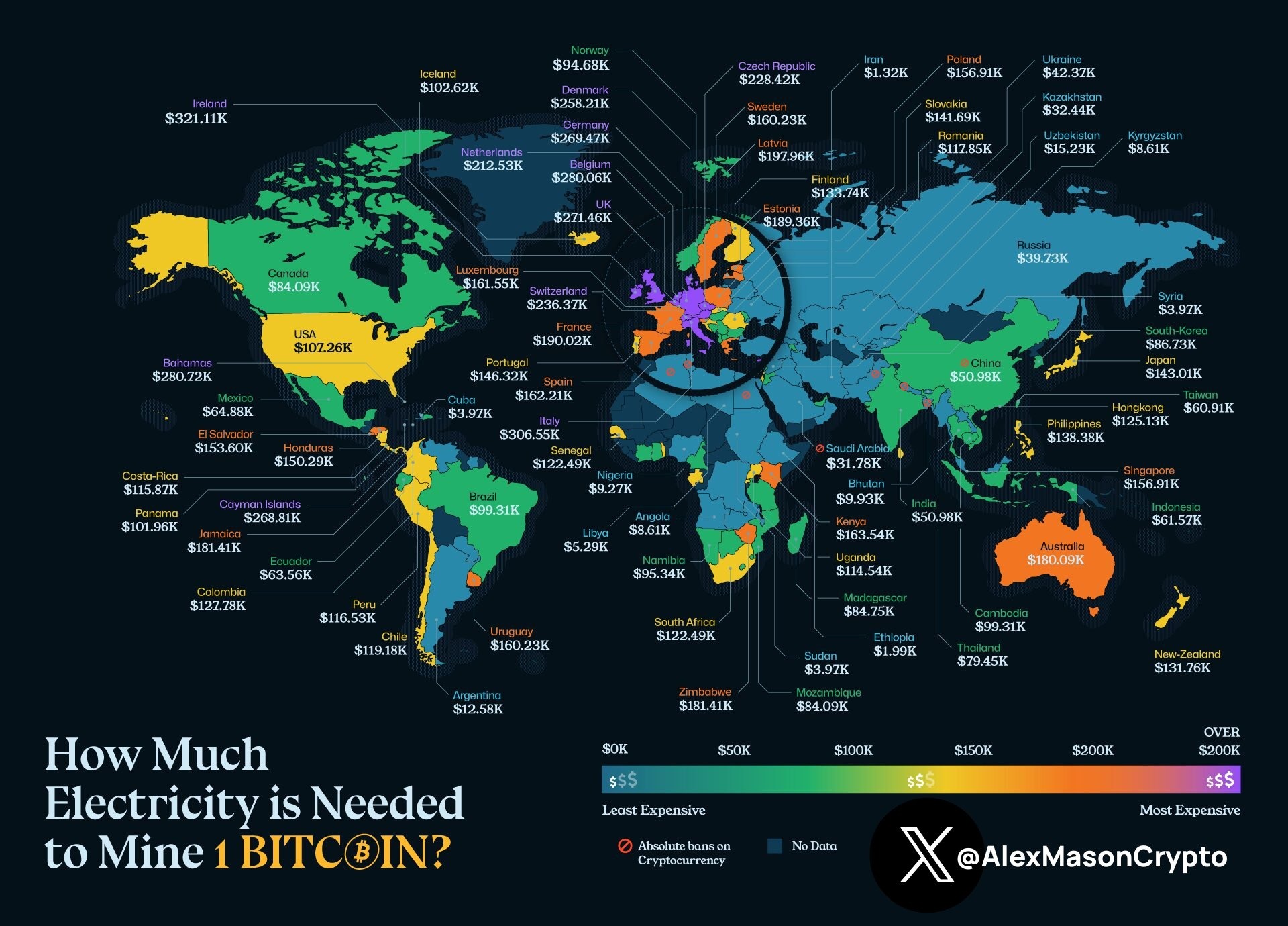
Although the source of this document is AlexMasonCrypto himself, the figures presented seem close to reality, but remain incomplete. Indeed, Alex’s map and publications do not indicate the type of energy taken into account. It is probably domestic electricity, and not that consumed by mining industries.
For example, in the United States, the electricity cost to mine 1 BTC is estimated at $107,260, which is almost the current price of Bitcoin. This data does not seem to take into account differences between states, nor the preferential rates enjoyed by industrialists who collaborate with power plants and participate in load shedding programs.
These estimates must therefore be put into perspective. Electricity costs are not the only expense for miners: they also have to purchase and maintain machines worth several thousand dollars, pay customs fees, and pay for registration with the government.