
While Bitcoin (BTC) is still struggling to find a clear direction, one analyst is trying to find correlations with the Bank of Japan’s monetary policy. If interest rates rise, he predicts a drop to $70,000. Is this relevant?
Will Bitcoin (BTC) fall back to $70,000 because of Japan’s monetary policy?
Whether in times of rising or falling prices, more or less shaky analyses follow one another, promising a Bitcoin (BTC) price at this or that level.
With BTC trading at a 29% decline from its all-time high on October 6, analyst AndrewBTC shared his opinion on X that the asset could fall to $70,000 if the Bank of Japan (BoJ) raises its key interest rates by 25 basis points.
According to him, every time the BoJ has raised its key rates, BTC has fallen by more than 20%:
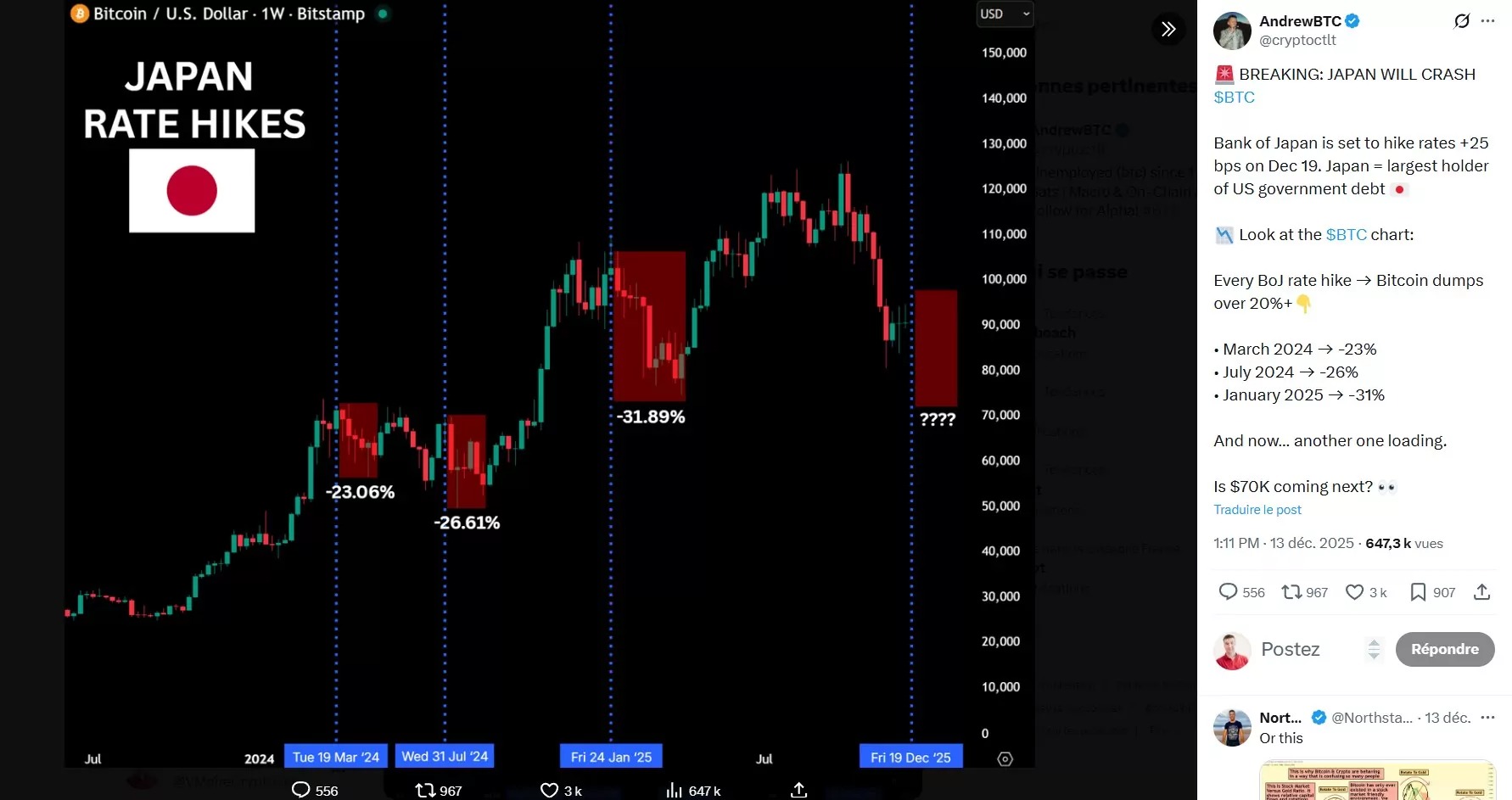
While BTC could indeed fall to $70,000 in the short term, the hypothesis presented here seems to be an easy shortcut.
Firstly, the chart used as an example here is from Bitstamp, not the TradingView index, which instead shows a 16% decline in March 2024. More importantly, just because two events occur at around the same time does not necessarily mean they are correlated.
In March 2024, for example, it is important to remember that the price of BTC was pausing after a rally that had been triggered by the launch of spot Bitcoin ETFs in the United States. Last January, we faced a similar scenario after the market euphoria that followed Donald Trump’s election.
Even if there were a correlation between key interest rates in Japan and Bitcoin, which is far from proven given the low historical rate of increase, it should be added that the hypothetical increase on December 19 is already being anticipated by the market. If there is to be any influence, this possibility may already be factored into prices.
Japan or not, BTC fell back below $90,000 over the weekend and is currently trading at $89,700. If the decline continues, it could mainly be attributed to the usual four-year cycles, according to which Bitcoin alternates between bear and bull markets around its successive halvings.