
October 10 will go down as one of the most turbulent days in crypto history. A tsunami of liquidations swept through the market, leaving some projects in serious trouble. Aptos and Bittensor were among the hardest hit. Why did they crash so sharply? Is their future in jeopardy?
Extreme conditions for the crypto market
The crypto market is characterized by volatility far greater than that of traditional assets (stocks, real estate, etc.). Investors know this. Yet even the most cautious investors suffered considerable losses on October 10.
This was the largest liquidation event ever observed in the crypto universe. Neither the collapse of FTX nor that of Terra Luna had caused such a tidal wave. This phenomenon is telling. The majority of projects were hit hard by this extreme volatility. Some will manage to bounce back, slowly rebuilding their credibility and investor confidence. For others, it is already too late: the crash was so brutal that a comeback seems impossible.
In this article, we will analyze two cryptocurrencies that were severely affected in November. We will highlight the key factors that contributed to the collapse of the APT token and the TAO token:

Table showing two major cryptocurrencies that fell in November
Aptos: -36.6%
Aptos is a Layer 1 blockchain born from the ashes of Diem, a crypto project abandoned by Facebook (Meta) due to regulatory pressure. Based on the Move language, Aptos is an ultra-fast blockchain. It offers significantly lower transaction fees than the Ethereum blockchain, making it a relevant option in the high-frequency trading sector.
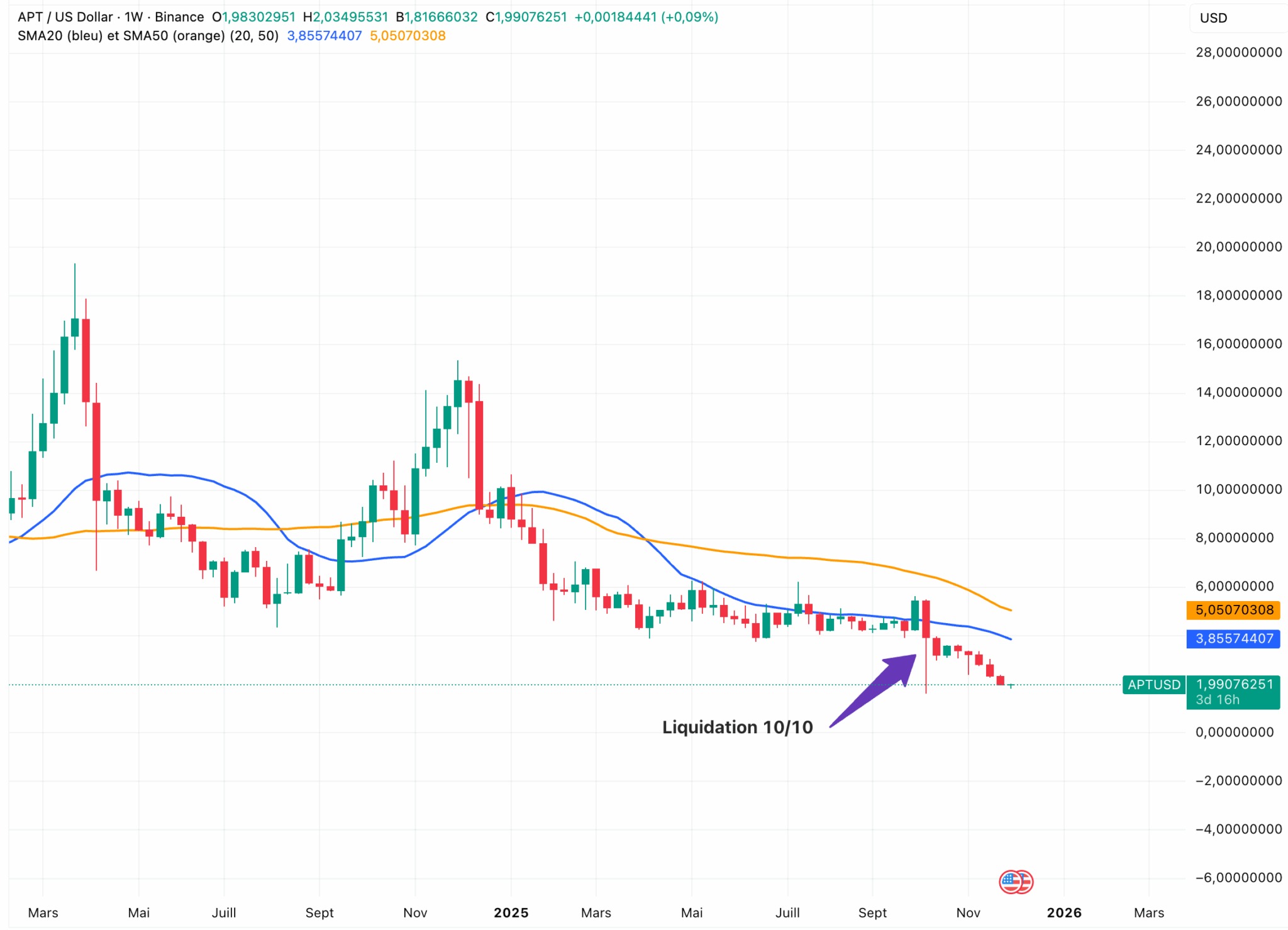
Chart showing the price of the APT token, weekly data
As shown in the chart above, the price of the APT token has never recovered from the crash on October 10. Over the past 30 days, its value has plummeted by nearly 37%. Since the week of October 10, the drop has even reached 63%, or nearly two-thirds of its market capitalization.
While we are discussing a technical aspect here, other fundamental and on-chain factors also help explain this plunge.
Aptos is often referred to as a “VC Chain” due to its massive venture capital funding. According to DropsTab, the project raised over $350 million across two funding rounds. Of the five rounds in total, three remain opaque in terms of their terms.
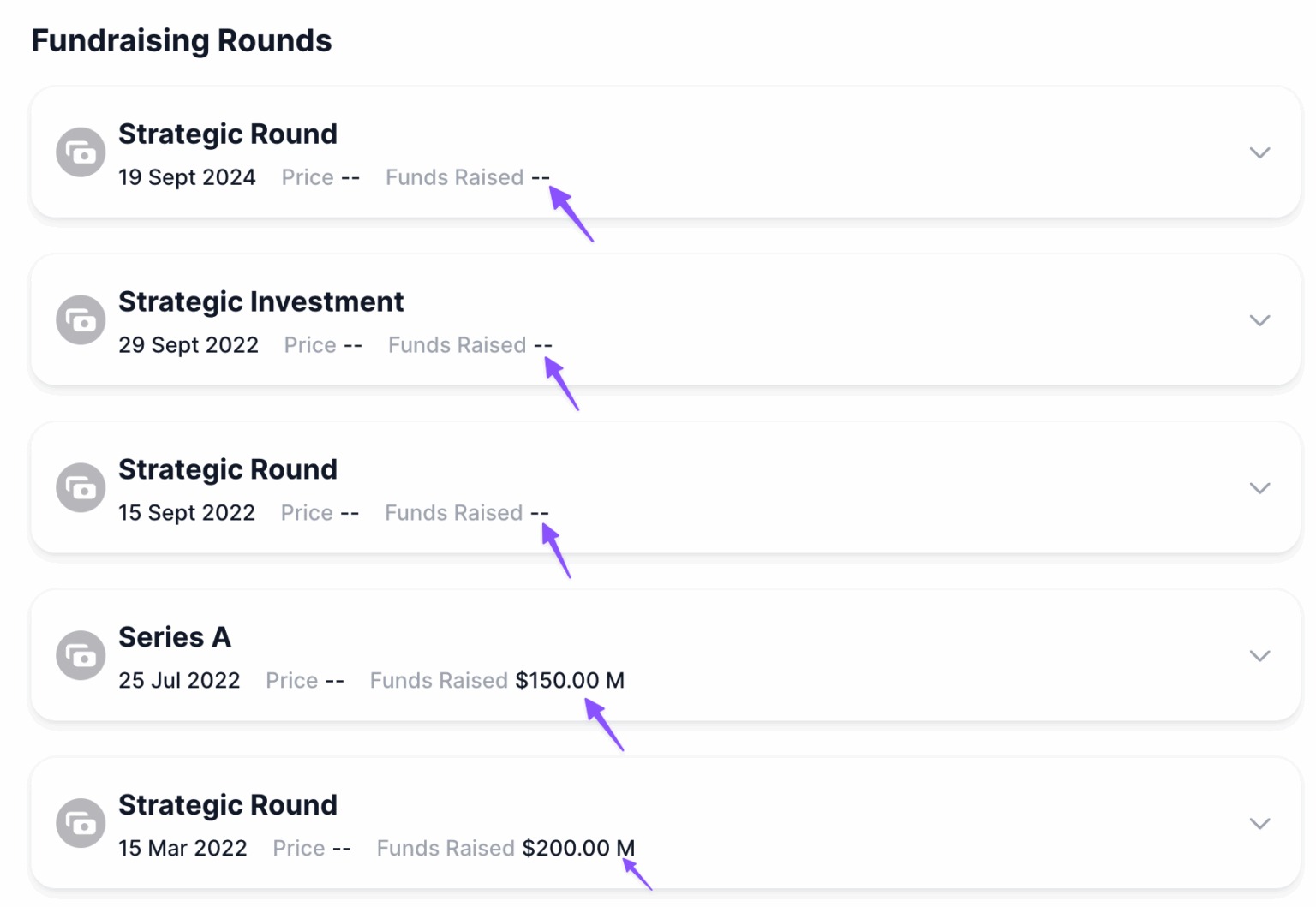
Information on the various funding rounds conducted by the Aptos project
These fundraising rounds come with a trade-off: institutional investors gradually recoup their investment by selling their tokens, with the aim of making a profit (or limiting their losses).
This process, known as token unlocks, acts as a drag on the token. If demand does not offset the increase in supply caused by the unlocks, the price automatically drops.
Each month, 11.31 million APT tokens are released, further exacerbating this imbalance between supply and demand.
Furthermore, on-chain data from the Aptos blockchain does not bode well:
- From October to November, fees generated by the blockchain fell by 32.4%;
- Over the same period, trading volume for the APT token fell by more than 33.5%.
In summary, Aptos is navigating a period of significant turbulence. The token has broken through its technical support levels, and neither the tokenomics nor on-chain activity appear capable of reversing the trend.
Bittensor (TAO): -40.2%
Launched in November 2021, Bittensor is a project that combines artificial intelligence (AI) and blockchain. Every Bittensor participant (individuals, software, or hardware) freely contributes to the system by providing AI models, data, or computing power.
Paradoxically, the price of the TAO token held up well against the shock of October 10, even beginning a recovery the very next day. However, in November, its value plummeted by more than 40%. Currently, it is testing a major technical support level on the weekly chart—the last line of defense before a potential drop toward $215.
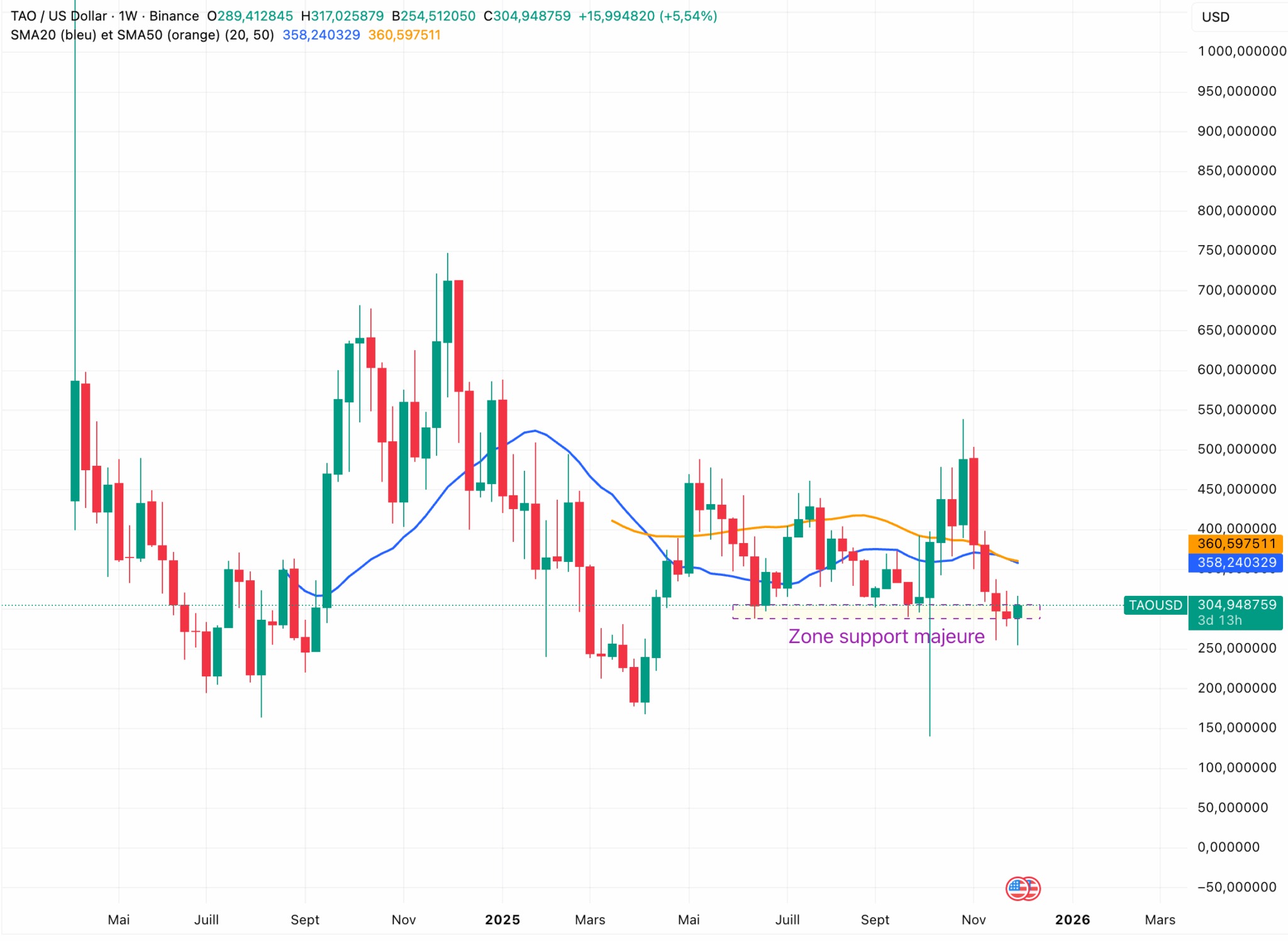
Chart showing the TAO price, weekly data
It is important to provide context for this drop: the entire crypto market posted lackluster performance in November, with BTC down 13% and ETH down 17%. These are particularly difficult conditions, with few altcoins showing positive performance.
However, this is not the only possible explanation for TAO’s drop. Indeed, Bittensor is reaching a crucial moment in its history. On December 12, Bittensor will undergo its first halving.
In other words, the number of TAO issued each day will be cut in half, from 7,200 to 3,600. Although this type of event is generally considered beneficial in the long term for a cryptocurrency’s appreciation (less supply), it may also slow the growth of the Bittensor ecosystem.
Indeed, network participants (miners, validators, etc.) will see their incentives (financial rewards) cut in half. Echoing this issue, data from the Token Terminal platform suggests that the number of core developers has drastically fallen over the summer, dropping from 70 people to a reduced team of fewer than 20:
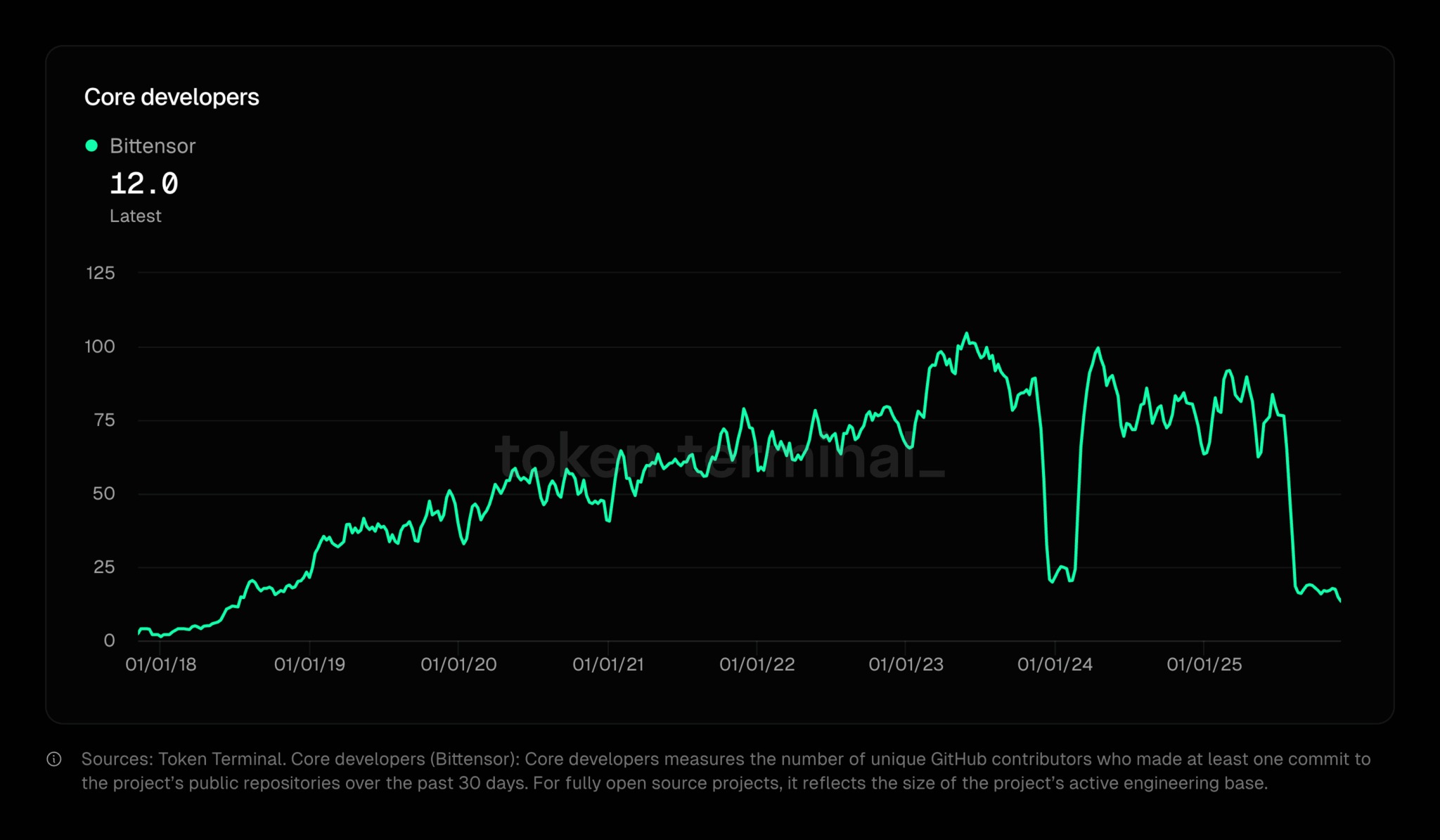
Graph showing the number of active core developers on the Bittensor blockchain
Another worrying sign: TAO trading volume has plummeted in recent weeks. It fell from $3.56 billion (week of October 13) to $1.01 billion by the end of November, a 72% drop. This decline reflects a clear disengagement among traders.
In summary, Bittensor is at a pivotal moment in its history. Between maintaining its technical support and adjusting its post-halving business model, the coming weeks will be crucial for the project’s future.