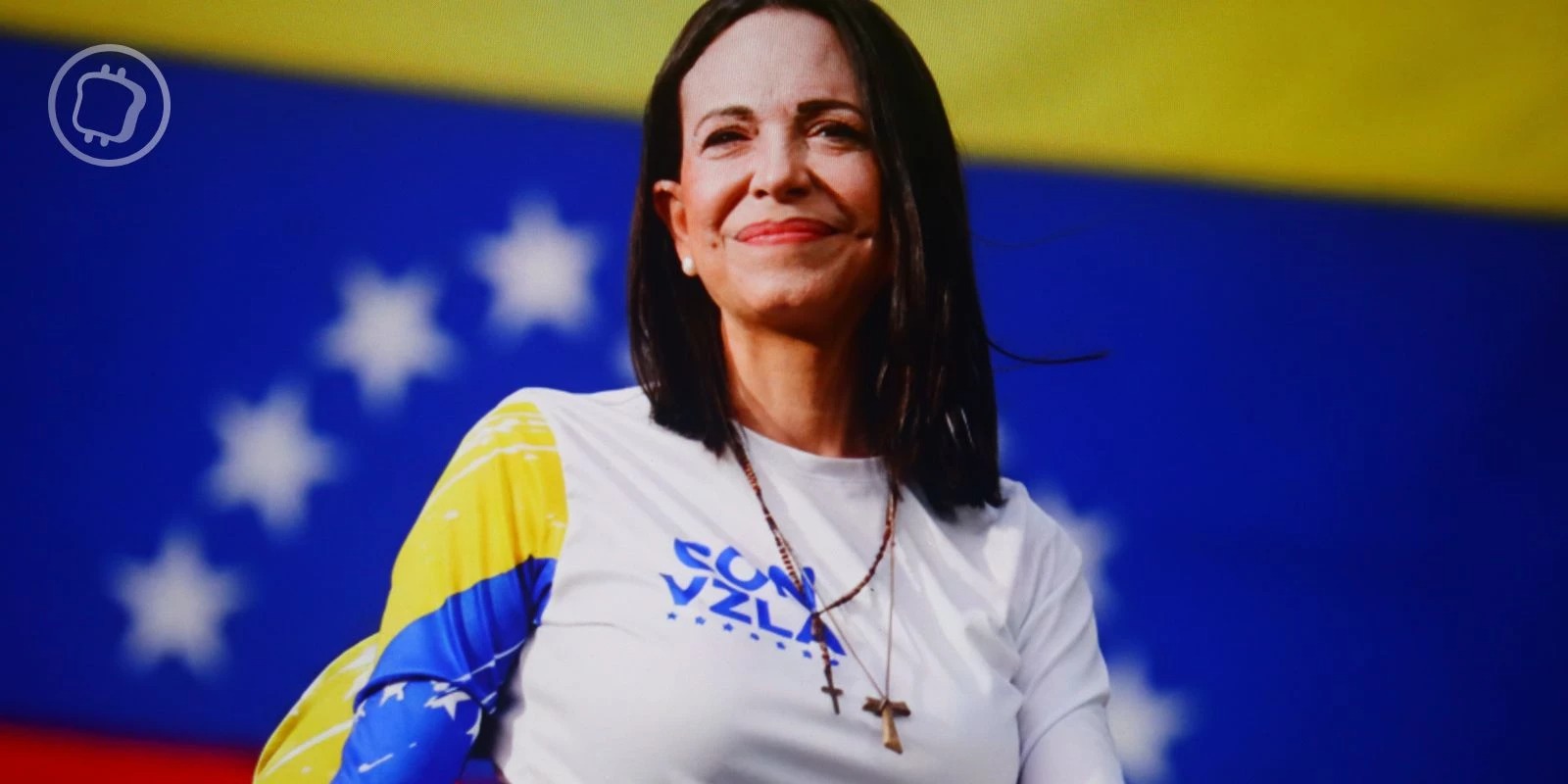
After years of authoritarian rule, Venezuela faces a historic turning point with Maduro’s arrest. In this uncertain climate, opposition leader María Corina Machado is returning to the forefront. Winner of the 2025 Nobel Prize, she embodies a new vision and is notably an advocate for the adoption of Bitcoin.
Can María Corina Machado succeed Maduro?
The dramatic arrest of Nicolás Maduro last Friday, followed by his extradition to the United States to stand trial, marks a historic turning point for Venezuela. The country, exhausted by years of economic crisis, hyperinflation, shortages, and repression, finds itself without true leadership, awaiting a U.S. decision regarding its political transition.
Amid this economic chaos, Bitcoin has emerged as a lifeline for thousands, if not millions, of Venezuelans. Used to circumvent the devaluation of the bolivar and transfer funds from abroad, it has become a pillar of the informal economy and a vital tool for daily resilience.
Faced with this power vacuum, eyes are now turning to the opposition, long silenced by the regime. María Corina Machado, an iconic figure of the resistance against Maduro, is returning to the center of the political arena.
Although barred from running in the 2024 presidential election—a decision widely denounced as arbitrary—she had designated Edmundo González Urrutia to represent her. According to international observers, he won the election, but the Maduro government blocked the transition, triggering a crisis of legitimacy that further weakened its power.
Machado, who received the Nobel Peace Prize in 2025 for her peaceful advocacy for civil rights and democratic change, now embodies the hope for renewal. Her popularity remains strong, and with Maduro’s sudden downfall, she could once again be poised to play a decisive role in the country’s future.
According to the Polymarket prediction market, Machado now has a 57% chance of returning to Venezuela, but only an 18% chance of coming to power, compared to 23% for Edmundo González and 40% for Delcy Rodríguez, the current interim president and Maduro’s former vice president.
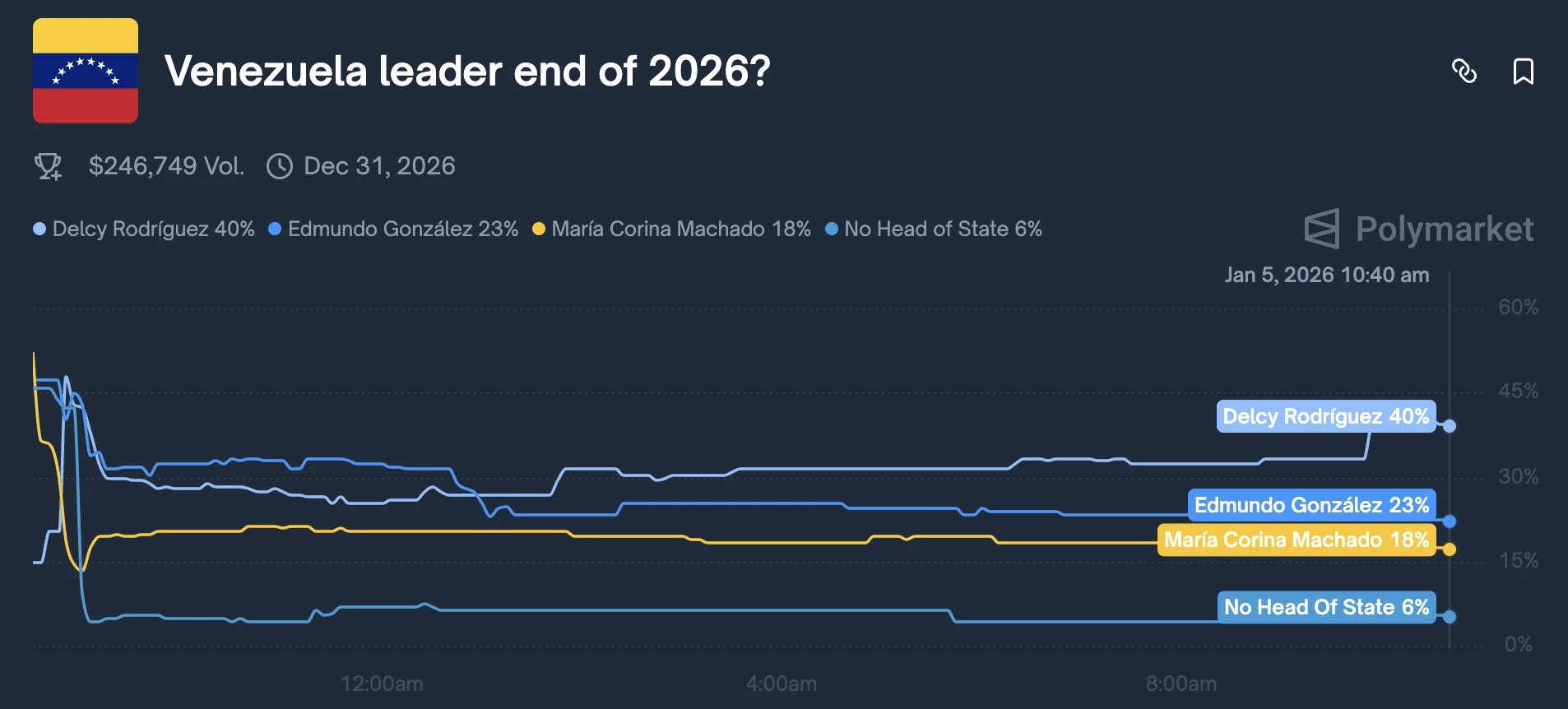
Prediction of Venezuela’s next leader
Economically, she advocates for a clear break with the centralized models of the past. For her, Bitcoin represents much more than a technical tool: it is an instrument of individual sovereignty.
Machado: 2025 Nobel Peace Prize and pro-Bitcoin policy
Unlike her predecessors, Machado aims to adopt a more liberal policy. And among her flagship proposals is the integration of Bitcoin into the national economy.
For her, BTC is not just a technical tool, but a symbol of resistance against authoritarianism and hyperinflation.
She views Bitcoin as a strategic reserve asset for the central bank and an alternative monetary infrastructure, allowing citizens to protect their savings and circumvent state controls.
In 2024, during an interview with the Human Rights Foundation, Machado stated:
“Bitcoin has evolved from a humanitarian tool into a vital means of resistance. We are grateful for the lifeline it represents and look forward to fully adopting it in a new, democratic Venezuela.”
This vision stands in direct opposition to that of the outgoing regime, which has persecuted Bitcoin miners and shut down cryptocurrency-related infrastructure. If she comes to power, Venezuela could become one of the first countries to embrace Bitcoin, following El Salvador’s lead—not out of technological ideology, but as a concrete response to the collapse of its monetary system.
Her election would thus pave the way for economic reconstruction, where the resilience offered by Bitcoin would play a central role in restoring stability and sovereignty to the Venezuelan economy.