Jeffrey Epstein, the financier who died in 2019, has resurfaced at the center of Bitcoin news. New emails, released this weekend, reveal exchanges dating from 2011 to 2017 involving MIT, Blockstream, and influential figures in the Bitcoin community. These documents raise questions about the criminal’s actual influence on the protocol’s early days.
From Adam Back to Michael Saylor, Epstein at the Heart of the Crypto Industry
Jeffrey Epstein was an American financier accused of running a vast sex trafficking ring involving minors, with alleged ties to several public and political figures, such as Bill Clinton, Donald Trump, and Woody Allen.
Arrested in 2019, he was found dead in prison; the official conclusion was suicide. Subsequently, the “Epstein files” made headlines, comprising thousands of court documents, photos, videos, emails, and messages retrieved from his properties. Most are limited to everyday exchanges, but some reveal the topics that particularly interested him during his life, among them: Bitcoin.
This weekend, new documents from the case were released, revealing the timeline of events: Epstein had been interested in Bitcoin as early as 2011. At the time, he described the technology as a “brilliant idea,” while pointing out to an anonymous correspondent that it had serious flaws.
The connections extend to influential figures in the ecosystem. In 2017, Austin Hill, co-founder of Blockstream, reportedly discussed with Epstein the creation of a “Sharia Coin,” a cryptocurrency compliant with Islamic finance, designed for Saudi Arabia.
In another message from 2016 discussing this new cryptocurrency, Epstein claims to have spoken with the founders of Bitcoin, without specifying exactly who they were.
I’ve spoken with some of the Bitcoin founders, who are very enthusiastic.
Given that Satoshi disappeared in 2011, it is more likely that he confused the Bitcoin founders with developers or members of the Bitcoin Foundation, an organization that funded Bitcoin’s development until 2015.
Three years earlier, in 2014, Blockstream reportedly met with Epstein and representatives from the MIT Media Lab during their fundraising efforts. Adam Back, CEO of Blockstream and a key figure cited in the Bitcoin white paper, responded by stating that Epstein’s investment had been rejected due to a potential conflict of interest.
Back’s defense has not convinced the entire community; it is worth noting that in 2014, Epstein had already served 13 months in prison after pleading guilty in 2008 to soliciting prostitution from a minor.
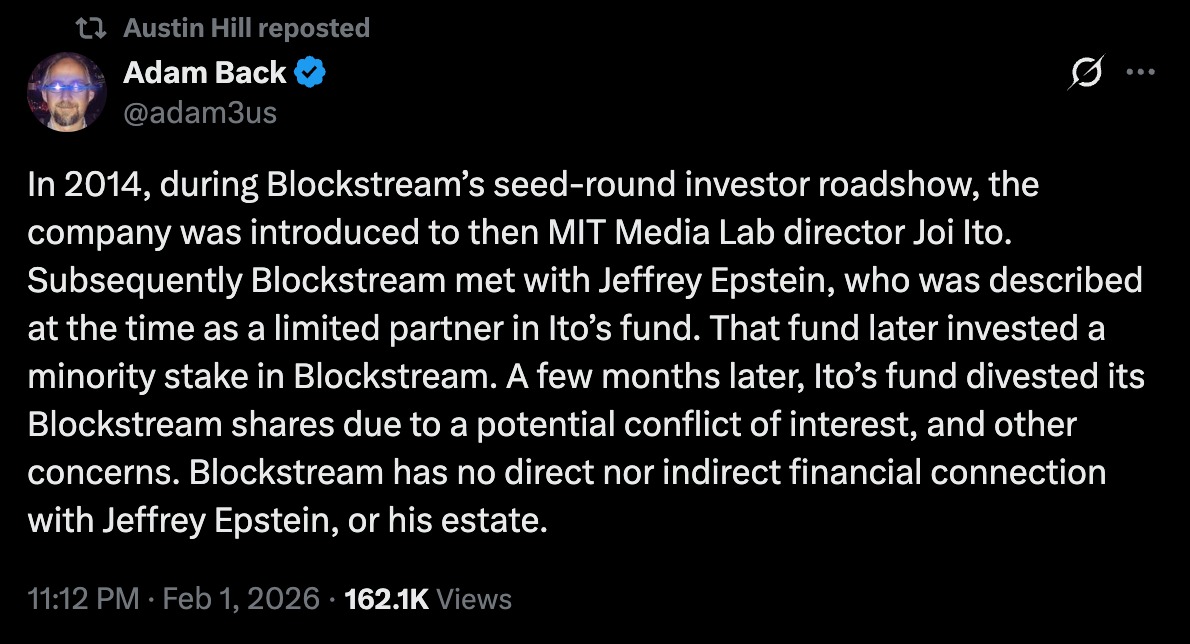
Adam Back’s response
The exchanges also include Peter Thiel, co-founder of PayPal and an investor in Ethereum. In 2014, he asked Epstein whether they should apply “anti-BTC pressure.” Epstein replied that Bitcoin first needed to resolve its own contradictions, citing in particular the ambiguity between its anonymity and its transparency.
Finally, Michael Saylor also appears in this correspondence, well before his high-profile conversion to Bitcoin. In a message, press secretary Peggy Siegal describes him as “a shady guy” who “has no personality, a bit like a zombie on drugs.”
Did Epstein and MIT take control of Bitcoin Core in 2015?
In 2015, the bankruptcy of the Bitcoin Foundation left Bitcoin Core developers without a secure source of funding. Email exchanges between Joichi Ito, then director of the MIT Media Lab, and Epstein reveal discussions about attempts by certain organizations to “take control” of Bitcoin Core’s development by recruiting its key contributors: Gavin Andresen, Wladimir van der Laan, and Cory Fields.
Ito was delighted at the time that the three developers had joined the MIT Media Lab, an entity partially funded by Epstein.
However, this claim warrants some clarification. While Gavin Andresen did indeed lead the MIT Media Lab’s Digital Currency Initiative (DCI), Wladimir van der Laan and Cory Fields were merely external contributors with no direct affiliation.
It is precisely this ambiguity in Joichi Ito’s statements that fuels speculation today. Some internet users suggest that Bitcoin Core could have been “captured” by Epstein, or even indirectly by intelligence agencies such as the CIA and the Mossad.
These theories are based on real but often reinterpreted facts; the financial ties between Epstein and MIT have been known for several months now. Furthermore, Gavin Andresen is also known to have met with the CIA as early as 2011 to present Bitcoin; some even say that it was this meeting that ultimately prompted Satoshi Nakamoto to disappear.
To date, there is no evidence demonstrating a direct influence by these organizations on Bitcoin’s development. It is essential to remember that, even if such influence had been exerted, since Bitcoin’s code is open-source and auditable, the community would most likely have detected it. Any malicious modification or questionable direction would have been identified, debated, and rejected.