
Stablecoins are becoming increasingly prevalent in the global monetary landscape, to the point where they are now a widely popular payment option for both businesses and individuals. Here’s an overview of the situation…
Stablecoins: B2B payments surge by 300%
Since last June, the United States has had a regulatory framework, the GENIUS Act, tailored to support the development of dollar-backed stablecoins, which account for more than 99% of the currently available supply of these tokens.
However, this theoretical opening needs to be tested in practice in order to assess the actual evolution of this sector over the past year. This exercise was carried out by the Artemis analysis organization, with an initial assessment that will come as no surprise: “In 2025, Tether’s USDT supply recorded a larger increase than the next five issuers combined, with $48.2 billion.”
With this dominance once again confirmed, the Artemis report takes a closer look at the use of stablecoins in the payment sector, where the most significant increase is in B2B (business-to-business) transactions, with “an annual growth rate of $76.8 billion, up approximately 300% from the previous year.”
Ethereum: P2B payments show the fastest growth
From a more technical perspective, the vast majority of transactions carried out on the Ethereum blockchain—which accounts for 55% of the sector’s supply—are peer-to-peer (P2P), at 67%, while this represents only 24% of volumes.
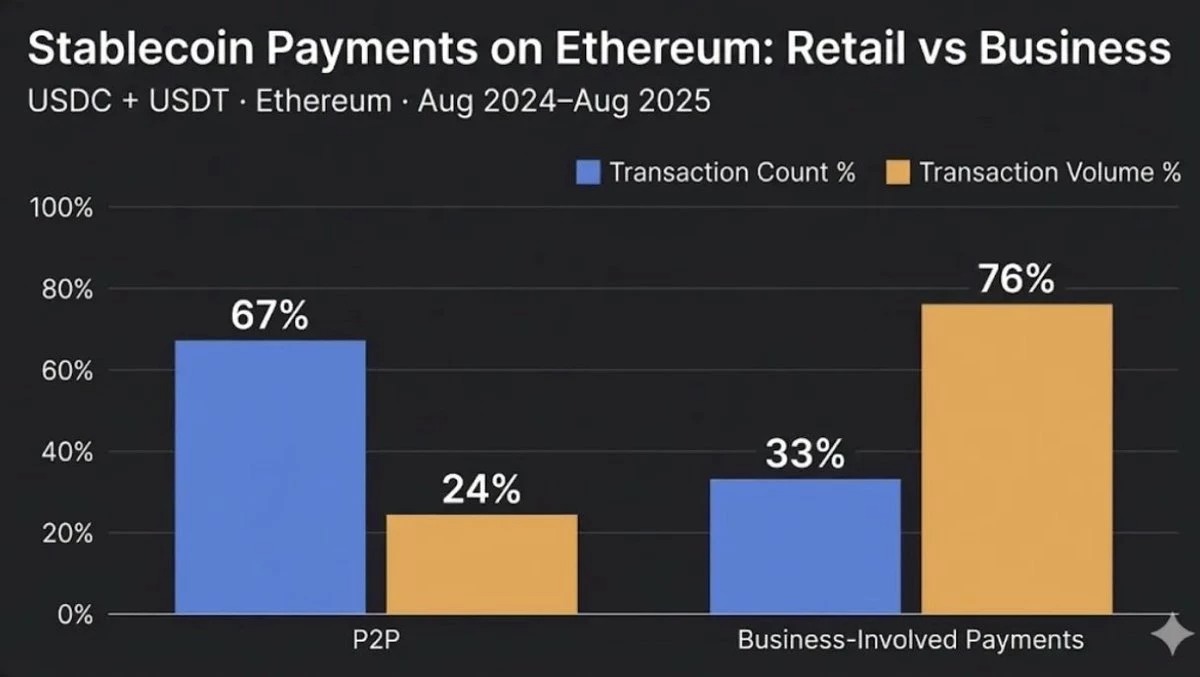
Insights into Ethereum provided on the X network by the Ethereum Foundation’s ecosystem manager, responding under the pseudonym Snapcrackle, show that over the last 12 months:
- B2B volume has increased by 156%;
- The average transaction amount has increased by 45%;
- The P2B (private to business) sector showing the fastest growth, up 167%.
Institutions aren’t sending more payments: they’re sending larger payments.
Snapcrackle
Flagship use case of the year: on-chain payment cards
From a decentralized application (dApp) perspective, the Polymarket platform recorded “the highest number of stablecoin transactions (30d),” establishing Polygon as the leading ecosystem in this field.
As for euro stablecoins, their previously almost non-existent availability has enabled them to grow by 97% to a total of $580 million, far ahead of other non-USD stablecoins in terms of supply and volume. Circle’s EURC is well ahead with growth of $260 million.
According to Artemis analysts, the flagship use case for 2025 is on-chain payment cards. Their volumes have exploded over the last 12 months, recording an increase of more than 400%.
This sharp rise in adoption has led Artemis analysts to predict that “2026 will be the year of stablecoins.” This is especially true given Coinbase’s recent launch of a stablecoin creation protocol tailored to businesses.