
Prediction market platforms recorded record activity estimated at $2 billion over the past week. This rise in volume is accompanied by fierce competition, particularly with the arrival of the challenger Limitless. Here’s an update.
Predictive markets: $2 billion in volume
In late 2024, the Polymarket platform propelled predictive markets into the crypto spotlight with record volumes recorded during the U.S. presidential campaign. However, its services were banned in the United States following a regulatory decision in 2022.
The situation is quite different today, since the platform announced last September that it would resume nationwide operations amid regulatory easing implemented by the Trump administration. This is good news, especially considering the record volume of $2 billion recorded in this market over the past week.
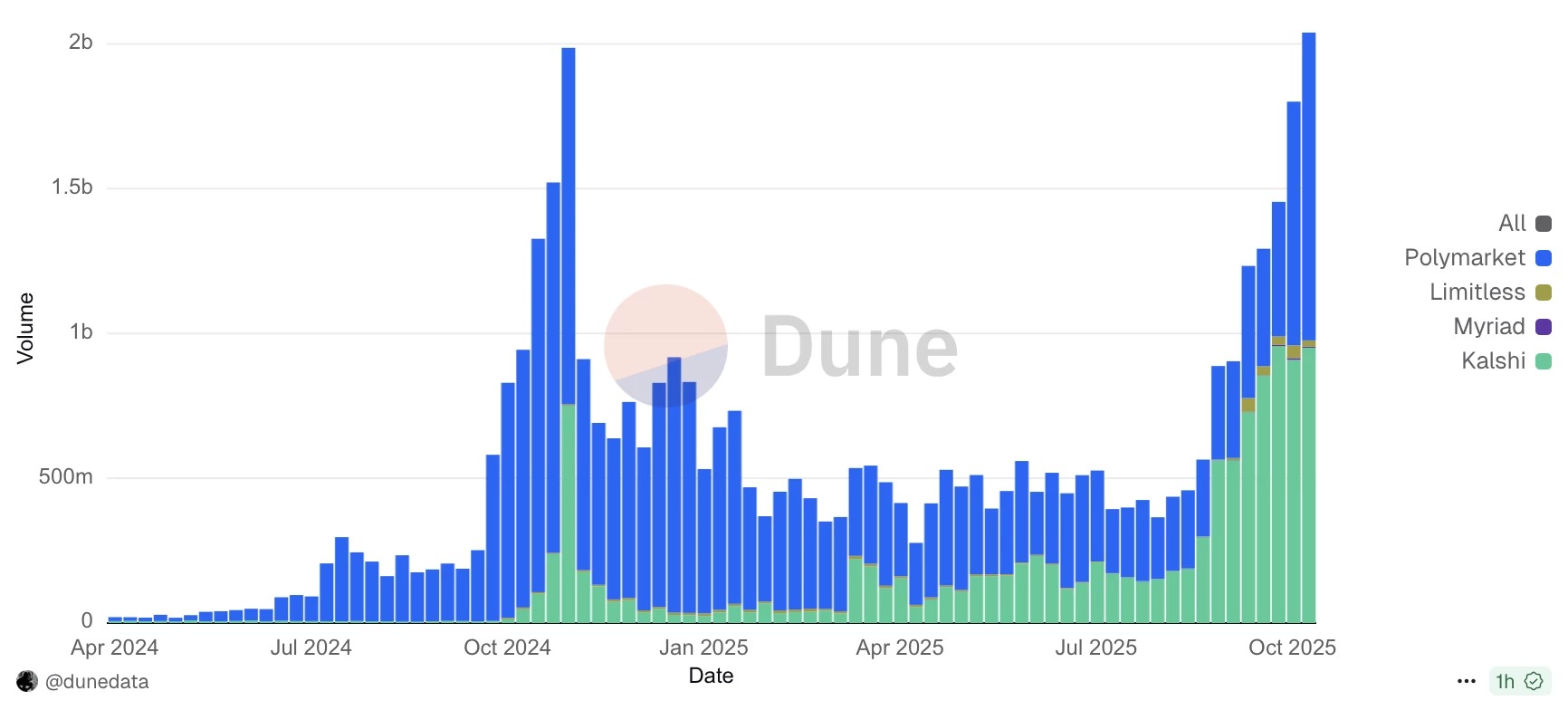
Prediction markets reach $2 billion in volume
This activity is largely driven by the ongoing election for New York’s next mayor, which is set to conclude next month, as well as by speculation about which team will win the Super Bowl in February of next year.
This surge in activity demonstrates the significant potential of prediction markets, particularly since the parent company of the New York Stock Exchange (NYSE), Intercontinental Exchange, decided to invest a record $2 billion in Polymarket. This move also made its CEO the youngest billionaire on the Bloomberg Billionaires Index.
Fierce Competition
This surge in popularity is currently at the center of fierce competition to capture market share. This is especially true since the Kalshi platform can finally operate under the same regulatory framework as Polymarket—to the point that it surpassed Polymarket last September in trading volume.
What explains this new momentum? Quite simply because Kalshi recently added sports betting to its prediction markets. This was a strategy “patiently developed over several months before launching markets dedicated to the National Football League (NFL) and college football,” according to sports betting consultant and prediction market analyst Dustin Gouker. As a result, these markets now account for more than 70% of its business.
Now, the two platforms are neck and neck, with nearly equivalent volume estimated at around $1 billion per week. At the same time, a new competitor built on the Base Layer 2 network, called Limitless, has just closed a $10 million seed funding round, with a Token Generation Event (TGE) for its LMTS cryptocurrency announced as imminent.
In light of this situation, new offerings are emerging with the goal of “building new financial primitives for trading,” according to Kalshi’s crypto lead, John Wang. For its part, Polymarket now offers “up/down” prediction markets based on Bitcoin’s price over a 15-minute period.