The well-known privacy-focused blockchain Monero (XMR) is facing a significant economic threat: a rival project, Qubic, plans to launch a 51% attack on its network on August 2, 2025.
Monero blockchain threatened by competitor
This weekend, Sergey Ivancheglo, aka CFB, founder of Qubic and former co-founder of IOTA, announced that he and his blockchain plan to launch a 51% attack against the Monero blockchain on August 2.
According to Ivancheglo, the stated goal is not to destroy Monero, but to test its robustness against coordinated pressure, while demonstrating the effectiveness of the “Useful Proof of Work” (uPoW) technology developed by Qubic.
Qubic’s uPoW system allows its “AI miners” to secure their own blockchain while mining Monero (XMR) during their idle cycles, i.e., when their computing power is not required on the Qubic network.
This mechanism maximizes the profitability of these miners: during their downtime, they use their surplus power to mine XMR. The Monero thus extracted is then sold for USDT and used to purchase QUBIC tokens, which are then burned (i.e., permanently destroyed).
This model has a double bullish effect on the price of QUBIC: the massive purchase of tokens fuels demand and their destruction reduces the supply in circulation, which in theory should increase the price of the token.
However, this system also has a bearish effect on the price of Monero: the automatic sale of XMR to obtain USDT puts downward pressure on the market, which could reduce the profitability of other Monero miners.
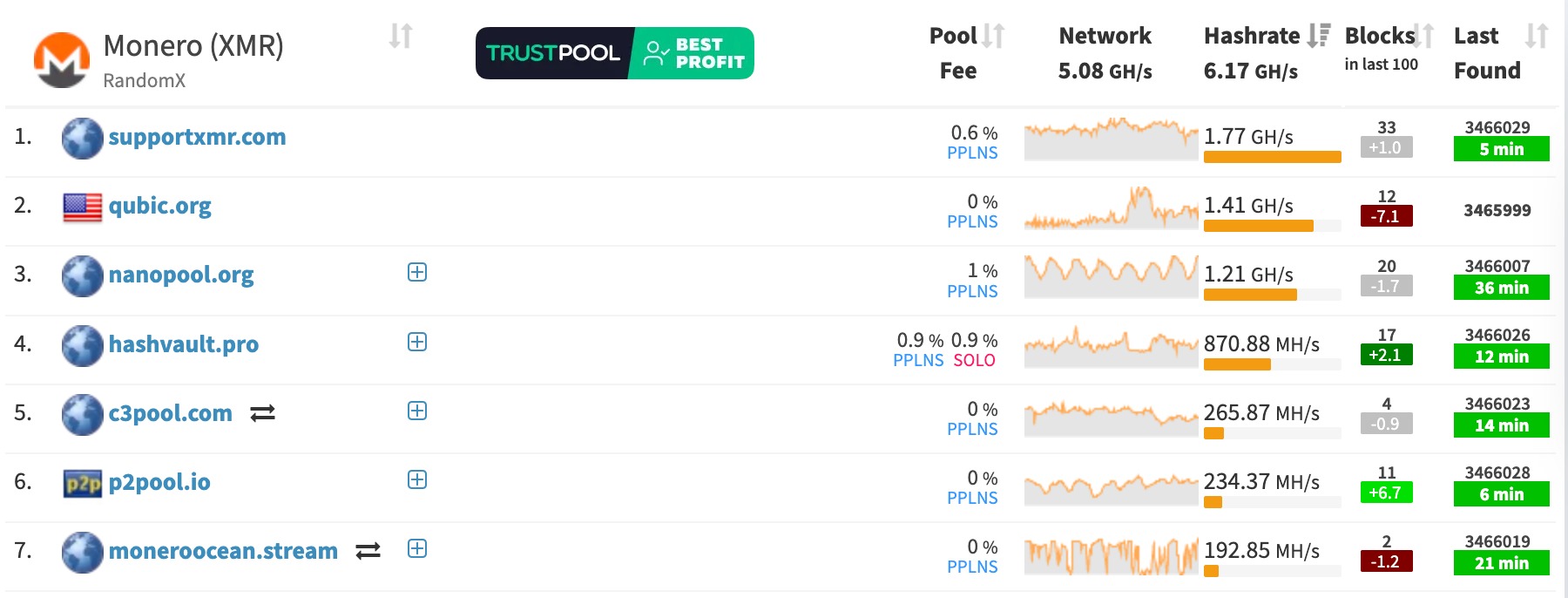
By combining these economic dynamics with a concentration of hashrate in a pool controlled by Qubic, the project could weaken the security of the Monero network. If some independent miners become unprofitable and disconnect, this leaves more room for attackers to achieve a majority of the hashrate.
Currently, the mining pool associated with Qubic controls approximately 23% of Monero’s total hashrate, estimated at 6.17 gigahash per second (GH/s).
However, Monero advocates question the accuracy of these figures. They accuse Qubic of artificially inflating its self-reported hashrate (a practice known as “spoofing”) and parasitizing the network without contributing fairly.
Does the Monero blockchain have a chance of surviving such an attack?
It is difficult to determine with certainty whether Qubic’s threats will have a real impact on the Monero network.
In theory, the attack appears well thought out from a technical and strategic standpoint. In practice, it seems more like a publicity stunt designed to generate buzz about Qubic in opposition to Monero.
But if this attack turns out to be nothing more than a publicity stunt with no real consequences, the opposite effect could occur: Qubic and Sergey Ivancheglo could lose credibility, especially since the latter is already known for his aggressive communication campaigns around IOTA.
Monero could emerge stronger from this episode, consolidating its community’s confidence in the robustness and resilience of its network. While Qubic’s operation is expected to continue until August 31, debate is raging within the Monero community. Some users are calling for a rapid migration to decentralized pools such as P2Pool in order to reduce concentration of power. Others are arguing for protocol changes to make this type of attack more difficult to carry out in the future. By way of comparison, the threat posed by MineXMR in 2022 briefly exceeded 40% of the hashrate, but the situation was quickly contained thanks to collective action. This episode had already demonstrated Monero’s resilience, as well as its users’ willingness to prioritize decentralization and anonymity over short-term profits.