The use of cryptocurrencies skyrocketed last year in Iran amid a bloody crackdown on popular unrest. According to a report by Chainalysis, both the Iranian government and the population have turned to cryptocurrencies en masse.
Iranians rush to cryptocurrencies
Iran has been cut off from the world since last week, when the authoritarian regime shut down internet access for its population. However, observation of financial flows on the blockchain over the past year shows that cryptocurrencies were one of the pillars of the changes underway in the country.
A recent report by Chainalysis indicates that Iranians have turned to cryptocurrencies in the face of a catastrophic economic situation: the rial has fallen 90% since 2018 and the country is facing an inflation rate of 40 to 50%. Notably, it is not only the civilian population that is using cryptocurrencies: half of the observable volume comes from the Islamic Revolutionary Guard Corps (IRGC), the regime’s paramilitary organization:
The IRGC has extensively exploited digital assets to finance its malicious activities, both domestically and through its network of proxy forces across the Middle East.
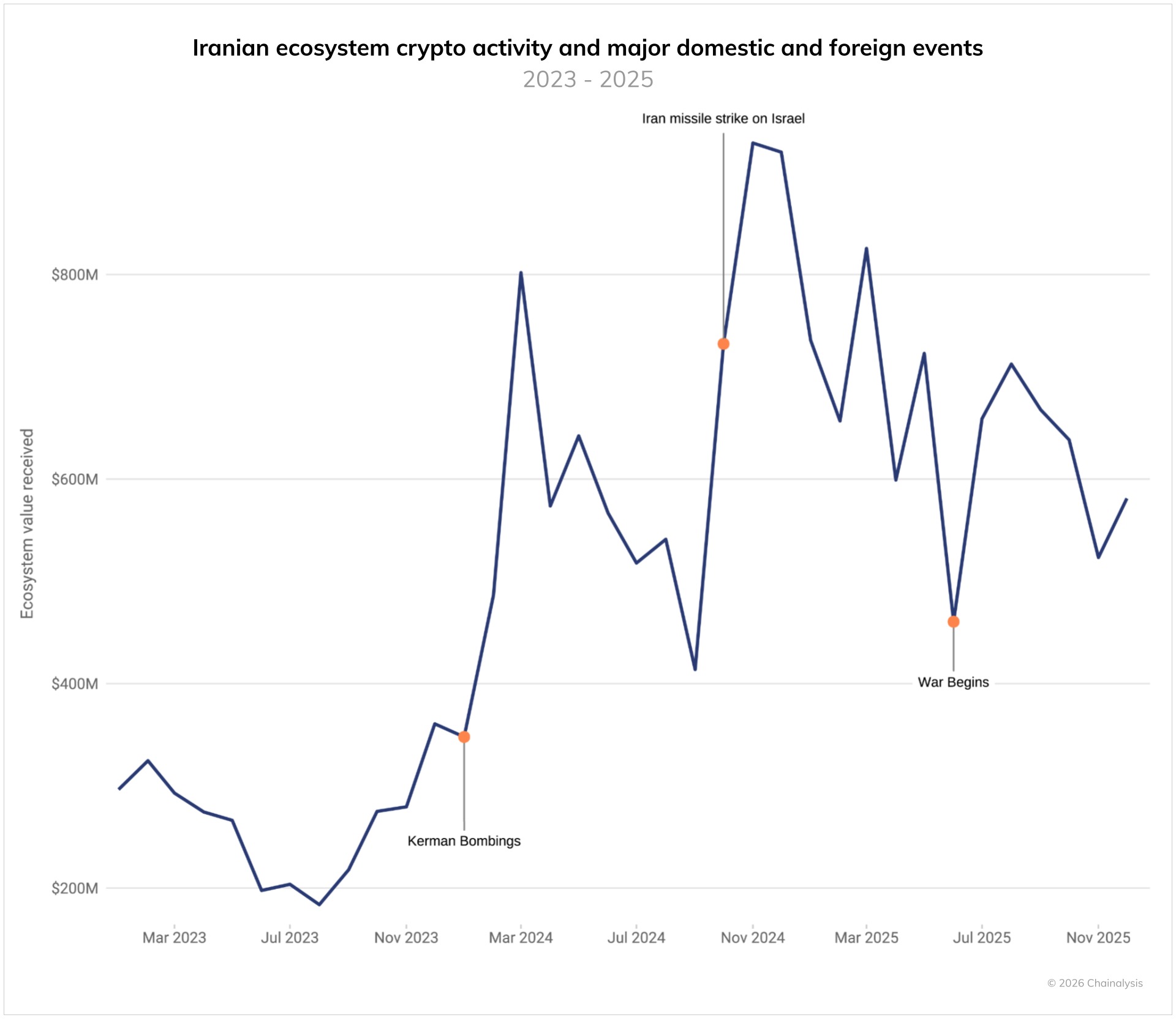
The crypto ecosystem exploded in 2025 in Iran, reaching $7.7 billion in volume. The report also notes that peaks in activity correspond to peaks in geopolitical tension:
The Revolutionary Guards make cryptocurrencies a major tool
According to Chainalysis, the increase in volume linked to the Revolutionary Guards has mirrored their growing control over the Iranian economy and its political institutions:
In 2024, the volume of funds received on-chain by addresses associated with the IRGC exceeded $2 billion, before climbing to over $3 billion in 2025. It is worth noting that even these exceptional figures are a minimum estimate, as they only take into account a limited number of addresses identified from sanctions designations targeting IRGC wallets by the US OFAC.
The report points out that unaccounted-for volumes exist and that the financial network as a whole appears to be much larger, with shell companies and discreet financiers:
We expect this figure to increase as […] larger segments of their laundering network are uncovered.
Iranians withdraw their cryptocurrencies in times of crisis
The report also notes that withdrawals skyrocketed in the days leading up to the internet shutdowns. The civilian population massively withdrew Bitcoins to individual addresses. Both the number of transfers and the amounts involved increased, against a backdrop of escalating tensions.
This increase suggests that Iranians are acquiring Bitcoin at a significantly higher rate during periods of protest than before. This behavior is a rational response to the collapse of the Iranian rial, which has lost almost all of its value.
The report also points out that Bitcoin is not only used to preserve Iranians’ capital. Its resistance to censorship and liquidity allow for greater flexibility in terms of payment. This is also a trend that can be observed in other countries experiencing economic tensions or collapses.
The situation in Iran remains critical, with humanitarian organizations reporting several hundred or even several thousand deaths carried out by the regime. But the country continues to be subject to a blackout, making the flow of information difficult. According to Le Nouvel Obs, all digital communications now pass through a single exit point, controlled by the Revolutionary Guards.