EDF warns of the effects of increasing nuclear power modulation; as certain reactors are forced to slow down or shut down, technical risks are rising, as are costs. Bitcoin could be the solution to this electricity overproduction and improve the integration of renewable energy into the grid.
EDF Warns of Risks to Nuclear Fleet
As the publication of the 3rd Multi-Year Energy Plan (PPE 3) approaches, the government is facing pressure from two sectors. On one hand, the solar and wind sectors are calling for further acceleration of their development; on the other, the nuclear sector is seeking to finance new reactors.
However, this situation poses a problem: in 2025, France was already in a state of overproduction with approximately 130 TWh of surplus electricity. This energy is an opportunity when it can be consumed, stored, or exported. But when that is not possible, power plants are forced to resort to a risky practice: power curtailment.
With the proliferation of renewable energy plants, whose electricity production is unstable, EDF is increasingly reducing the output of its reactors to make room for them. In 2024, modulation is estimated to have reached 29 TWh, then 35 TWh in 2025.
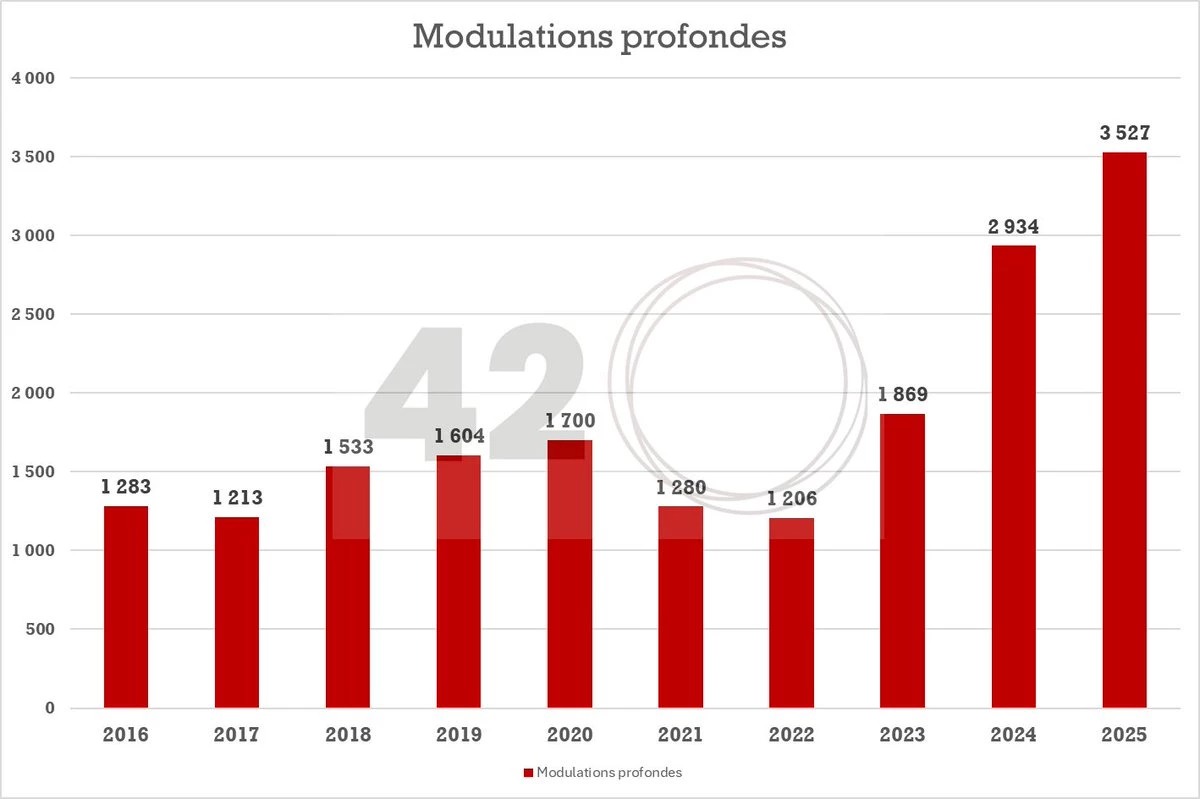
Trends in nuclear power plant modulation in France
EDF’s recent report warns of the risks associated with the modulation of nuclear power plants; this practice accelerates reactor wear and tear, leads to more frequent and extensive maintenance needs, and contributes to increasing the cost of producing this energy.
How can Bitcoin mining become a solution to the problem of power plant modulation?
Bitcoin mining can play a key role thanks to its flexibility in terms of electricity consumption. Unlike a factory or a data center, a mining farm can increase, reduce, or completely cut off its demand in a matter of seconds, simply by shutting down its machines.
During consumption peaks, miners can thus “step back” on demand, instantly freeing up electricity for households and industry. Used in this way, mining becomes a form of energy reserve, capable of absorbing surpluses and continuously utilizing them, while generating revenue.
This approach is already being implemented in several countries, notably Japan, Texas, and Bhutan. Today, a majority of experts recognize the benefits of mining, which was once criticized for its energy consumption—a practice often misunderstood.
Using Bitcoin mining to consume surplus energy offers a twofold advantage: it recovers energy that would otherwise be lost, and it also limits premature wear and tear on reactors. This helps reduce maintenance costs, ultimately lowering electricity bills for households.