
In 2025, cryptocurrencies broke new records in terms of adoption. In its latest report, a16z reviews developments in various sectors of the ecosystem. We take stock of the situation.
Crypto adoption explodes in 2025
There are two ways to judge the adoption of cryptocurrencies: prices and the development of use cases. While prices have risen sharply in recent years, we have also seen a breakthrough of blockchain technologies in traditional finance.
This is what analysts at a16z sought to highlight in their latest report, “State of Crypto 2025.”
First, it is interesting to note that while the number of cryptocurrency holders is estimated at 716 million, the number of monthly active users is only between 40 and 70 million people. This offers growth potential for developers looking to target users who already hold crypto.
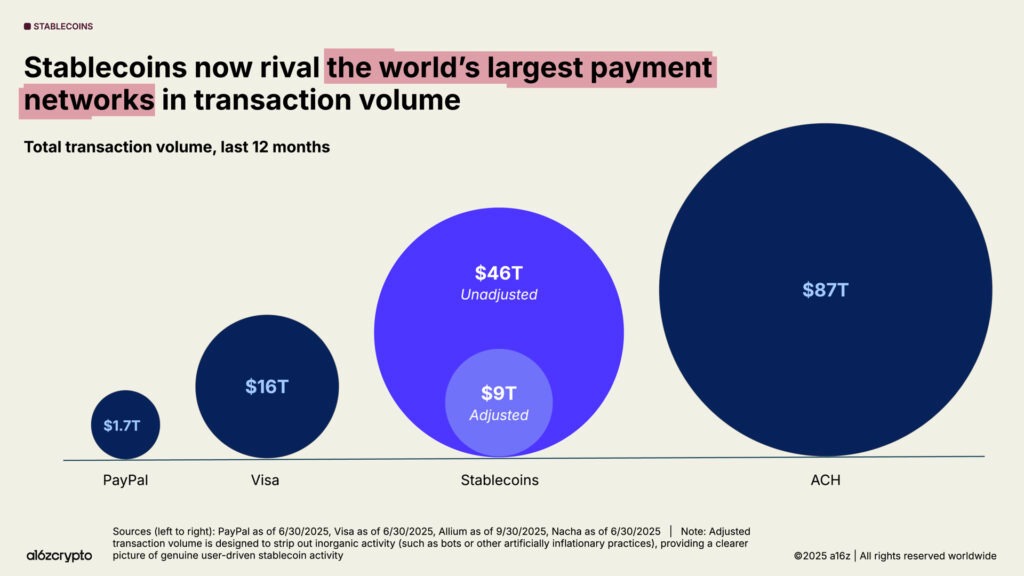
Among the various sectors discussed, stablecoins also feature prominently. Over the past 12 months, this asset class has achieved $46 billion in volume, more than Visa and PayPal combined, and could rival Automated Clearing House (ACH), the payment system used by US financial institutions.
However, a counting model that focuses on organic transactions and seeks to exclude bots and artificial activity brings this volume down to $9 billion. While this is still much lower than the first figure announced, it is nonetheless significant:
Beyond volume, this adoption is also reflected in the mention of the term “stablecoin” in filings with the Securities and Exchange Commission (SEC). With around 20 mentions in January, this statistic exceeded 300 in September.
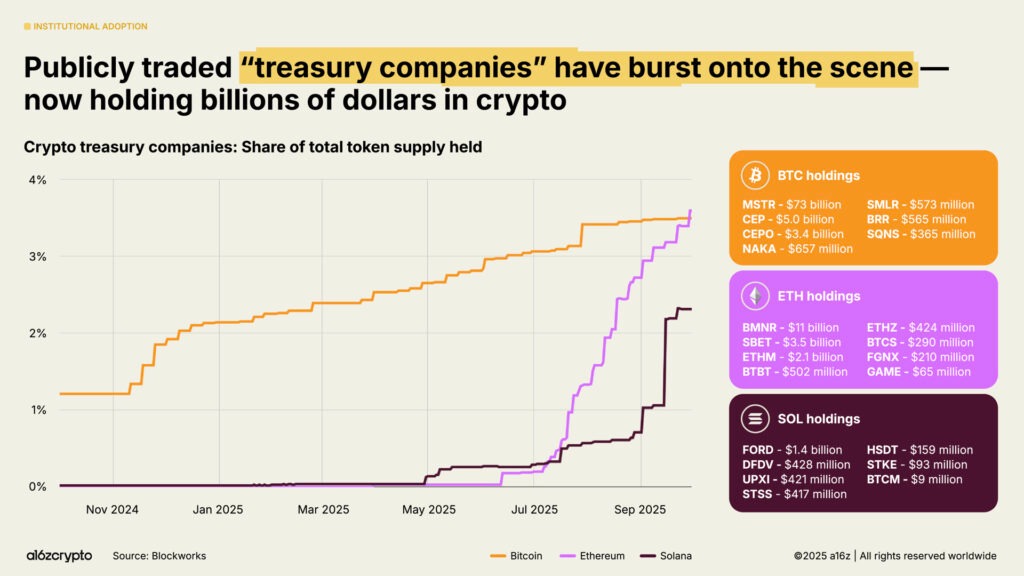
Another hot topic in recent months has been the famous publicly traded “crypto treasuries.” Regardless of how serious the various companies are, it should be noted that they now hold approximately 3.5% of BTC and ETH and 2.2% of SOL:
A number of other statistics can also be highlighted. In terms of real-world assets (RWA), for example, the value of tokenized assets has now exceeded $30 billion, compared to $9 billion in 2024.
In terms of decentralized finance (DeFi), Solana (SOL) and Hyperliquid (HYPE) seem to stand out as the big winners, capturing 53% of revenue-generating economic activity.
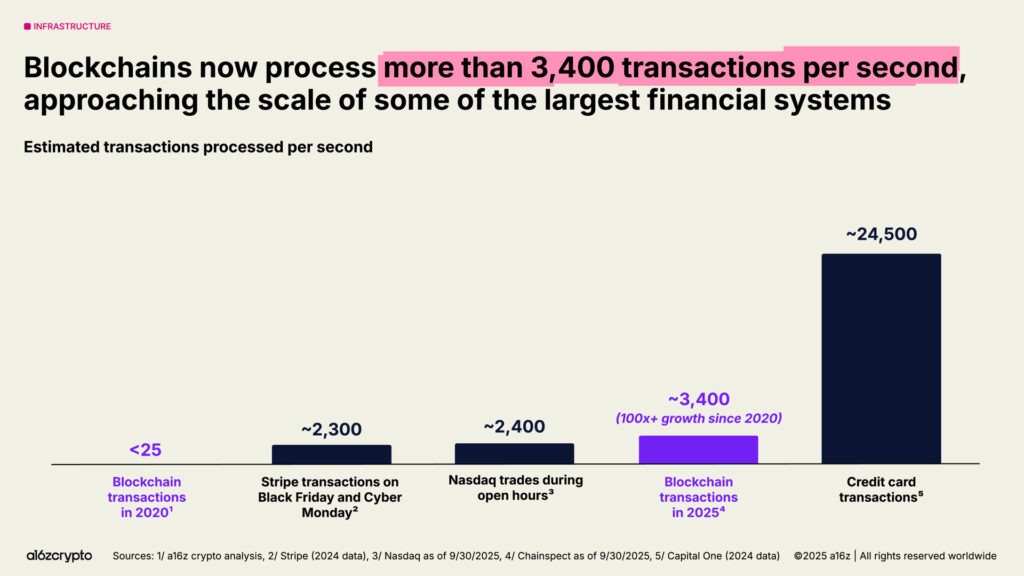
Finally, more generally, the various blockchains now total around 3,400 transactions per second, which is now more than the number of trades executed on the Nasdaq during trading hours:
Over the years, all these statistics can be regularly compared to assess their evolution over time, both during bear markets and bull markets.