After several weeks of hesitation around its lows, Bitcoin is beginning a solid technical rebound.
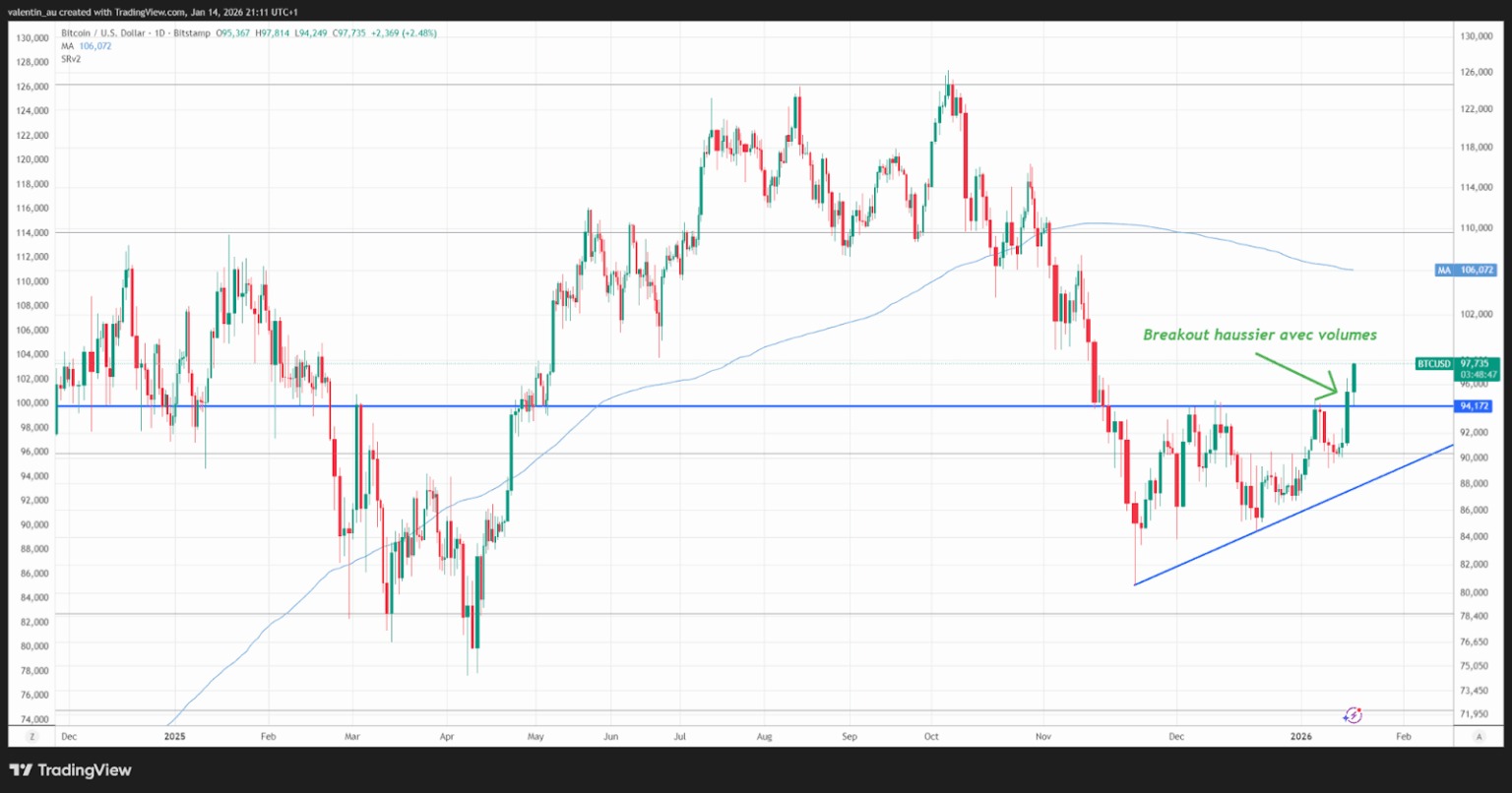
Beyond the chart signals, the imminent review of the CLARITY Act in the US Senate is an underestimated catalyst that could change institutional investor behavior and market asymmetry in the short term. Since its November lows around $83,000, the price of Bitcoin seems to be looking to regain its upward momentum this week. The BTC/USD pair rebounded strongly by around 7% in two sessions (Tuesday and Wednesday), with a notable increase in volume, and exceeded a key short-term pivot point around $94,000 to reach a two-month high.
Bitcoin breaks out of an ascending triangle with volume
From a chart perspective, breaking through this threshold, which has been an active resistance level since early December, confirms the breakout from the top of an ascending triangle. The theoretical target for this pattern is around $107,000, representing a potential gain of around 10% from the $97,000 zone. Such a move would bring Bitcoin back into contact with long-term benchmarks, notably the 200-day moving average, which is closely followed by many managers with automated strategies. The signal is all the more interesting as it comes after a sharp correction from October’s peak above $126,000, a level that continues to serve as a reference for profit-taking.
A regulatory catalyst that could change the risk for institutional investors
This surge in Bitcoin also fits into a political calendar that could act as a catalyst. The US Senate Banking Committee postponed the executive session (closed-door meeting) that was to be held on Thursday, January 15, to consider the Digital Asset Market Clarity Act of 2025 (“CLARITY Act”), which was already passed by the House of Representatives on July 17, 2025, and then sent to the Senate in September.
The main objective of the bill is to propose an operational framework for distinguishing between assets that fall under the financial securities regime and assets that are considered “digital commodities,” in line with the position of the Commodity Futures Trading Commission, which considers Bitcoin to be a commodity, just like gold or oil. The majority of the committee emphasizes its desire to clarify the separation of roles between the CFTC and the Securities and Exchange Commission, and to replace an approach perceived as excessively contentious with a more readable statutory framework. For the market, the issue goes beyond the simple adoption of the bill. As long as the rules of the game remain unclear, major institutional players such as banks, insurers, custodians, and funds have an incentive to move forward gradually and cautiously. Conversely, as soon as the likelihood of a stable framework increases, the option of positioning oneself earlier becomes more attractive, particularly through vehicles that are already integrated with regulatory constraints, such as spot Bitcoin ETFs.
A Bitcoin rebound to be handled with caution
Despite an asymmetry that has become more favorable to buyers in the short term, caution remains the order of the day. On the one hand, passage in committee is not the end goal: the bill must still pass the Senate, then be subject to political arbitration, with a real risk of being blocked or watered down in its final form. On the other hand, from a cyclical perspective, Bitcoin entered the historically most unfavorable phase of its four-year cycle last fall, which lasts on average about a year. In this context, the current rebound may be nothing more than an intermediate rally within a broader corrective phase.