
Bitcoin has broken through a new threshold, reaching $118,000. This performance is part of an upward trend fueled by an influx of institutional capital, a favorable monetary environment, and growing demand for BTC. We break down the factors behind this latest surge in price.
BTC surpasses $118,000, a new all-time high
In recent months, and even years, Bitcoin has enjoyed a particularly favorable economic environment. Institutional adoption has accelerated, driven by spot Bitcoin ETFs in the United States and massive investments by companies such as MicroStrategy.
Although inflation has been reduced over the past year, the return of accommodative monetary policies, notably marked by lower interest rates, is encouraging diversification. Added to this is a regulatory framework that has become more favorable for companies in the sector, particularly in the United States.
This economic environment has enabled the price of Bitcoin to appreciate by more than 100% over the past 12 months and to remain above $100,000 since the beginning of May. This morning, the price of Bitcoin confirmed its trend, reaching a new all-time high of $118,388.
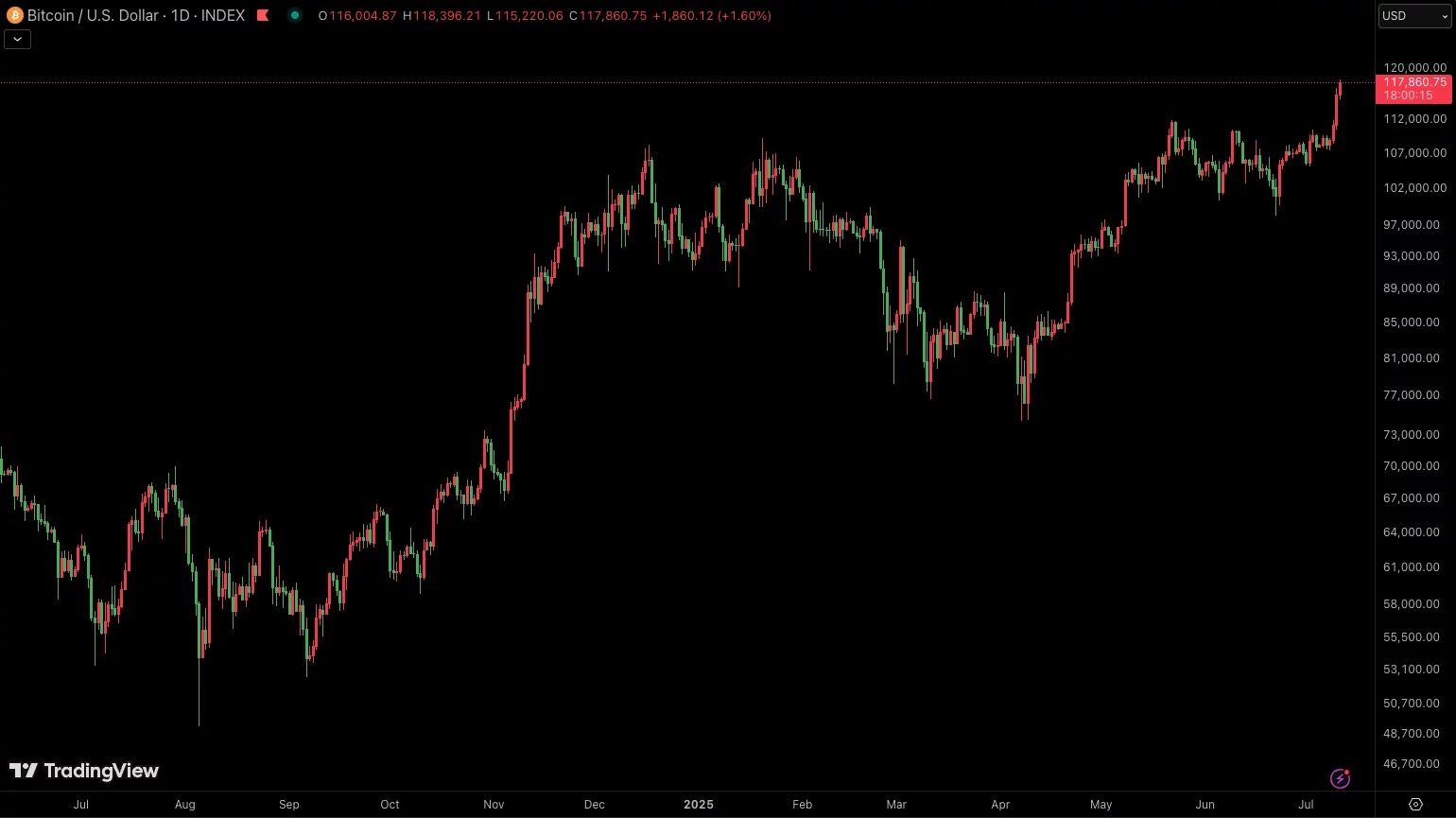
Although the performance is impressive, the price of Bitcoin has not yet returned to its highest level against the euro. It has exceeded $100,000, but remains around 5% below its previous peak reached in January 2025.
A similar situation can be observed with the price of gold: 1 Bitcoin is currently trading at 35.44 ounces, compared to 40.77 at its all-time high in December 2025 and 37.46 at its peak in 2021.
This situation can mainly be explained by the weakening of the dollar against the euro since Donald Trump’s inauguration in the White House, as well as by the rise in the price of gold against the dollar: +20% over one year and +105% since the end of 2021.
How can Bitcoin’s rise in the middle of summer be explained?
Several catalysts may explain Bitcoin’s current upward momentum. First, expectations of further interest rate cuts by the Federal Reserve (Fed) are fueling renewed appetite for assets considered “risky” by traditional markets.
Yesterday, Bitcoin spot ETFs recorded their second-best day ever with $1.18 billion in net inflows. BlackRock, through its iShares Bitcoin Trust (IBIT), absorbed $448 million, followed by $324 million for Fidelity Wise Origin (FBTC) and $268 million for the ARK 21Shares ETF (ARKB).
In addition, $640 million in short positions were liquidated on the derivatives markets in the last 24 hours. These liquidations contributed to a “short squeeze” phenomenon, accelerating the rise by forcing bearish traders to buy back their positions in a hurry.
But beyond market activity, a more profound change is taking place: more and more savers and investors are becoming aware of the limitations of the fiat currency system.
Faced with eroding purchasing power, geopolitical instability, and expansionary monetary policies, Bitcoin is gradually emerging as a credible alternative. This gradual monetary transition is generating structural buying pressure on BTC, which could well continue.