
According to a recent report by the Court of Auditors, tax oversight of cryptocurrencies appears to have some gaps in France. On the agenda: reporting of self-hosted wallets and targeted monitoring of social media. An obvious security risk given the increasing number of kidnappings of crypto figures.
The Court of Auditors highlights tax challenges related to cryptocurrencies
The Court of Auditors is the main French institution responsible for overseeing public funds. In this context, it has just published a report dated December on the corrections needed to address “distortions in wealth taxation.”
A document of over 200 pages that includes a chapter addressing the sensitive topic of cryptocurrencies, and more specifically “the challenge of detecting undeclared digital assets.” This applies particularly to gains realized “in the form of capital gains, income, and donations.”
These capital gains largely concern people in their thirties, with over 4,000 tax households referenced in this report. The problem? A gap described as “significant” between Chainalysis’ estimates of capital gains for French cryptocurrency holders in 2021—estimated at 3.5 billion euros—and figures from the DGFiP, which report a total of 400 million euros in declared gains involving 20,000 taxpayers over the same period.
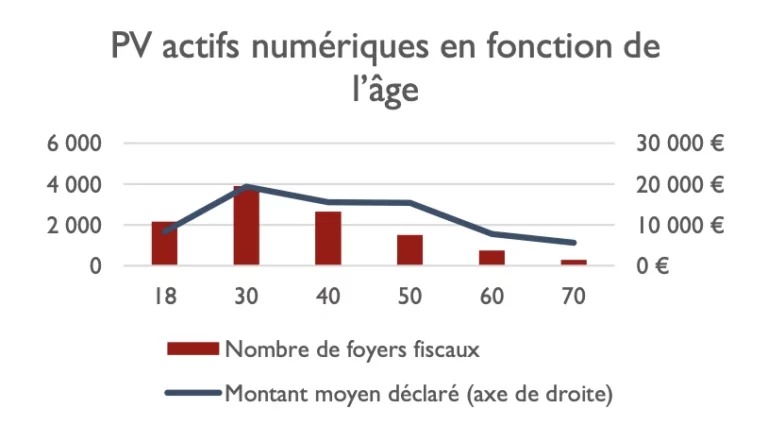
Capital gains on digital assets by age
As a result of this finding, the reporting obligations of cryptocurrency holders and crypto service providers (PSANs) have been gradually strengthened. However, there are still some gaps to be filled, according to certain points in this report highlighted by Henri Gauthier on the X network.
Some ideas for improving oversight of cryptocurrency holders
The first point highlighted in this report concerns the entry into force of the “DAC 8” directive, scheduled for 2026. This directive requires European PSANs to report certain information regarding transactions conducted through them to the tax authorities of the Member State in which they are based.
However, the Court of Auditors notes that this requirement “will not apply to PSANs hosted in France.” It therefore believes it would be necessary to remedy this situation by aligning the obligations of French PSANs in this area with those of their European counterparts.
The report also highlights what it calls regulatory “blind spots,” particularly due to a complete lack of response to requests from the tax authorities by certain non-European PSANs based in Singapore or Hong Kong.
At the same time, the Court of Auditors makes it very clear that French tax authorities lack the resources to carry out these audits, which are currently in the hands of “a handful of experts.” And for good reason: “digital assets do not yet constitute a specific focus of tax audits.”
On the agenda: reporting of self-hosted wallets and monitoring on social media
The main recommendation in this report involves the implementation of a “requirement to notify the tax authorities of the holding of self-hosted crypto-asset wallets above a defined value threshold.”
A procedure that, according to Henri Gauthier, could involve listing the relevant addresses on the Cerfa tax return.
Finally, the Court of Auditors notes that the tax investigation department is reportedly conducting “a pilot program allowing it to use non-public data from social media to detect unreported digital asset transactions.”
This increased surveillance raises numerous issues, particularly regarding security for cryptocurrency holders who are currently facing a surge in ransomware attacks. Indeed, their personal data could fall into the wrong hands, either through a hack or due to the complicity of certain government officials, as has recently been the case.