While a company from the United Arab Emirates has funded the Trump family’s World Liberty Financial cryptocurrency project, The Wall Street Journal reveals a significant conflict of interest. What are the ins and outs of this deal?
The Wall Street Journal reveals curious ties between Donald Trump and the United Arab Emirates
On Saturday, the Wall Street Journal published a major report implicating Donald Trump, his family, and his friends in connection with an investment by the United Arab Emirates in his company World Liberty Financial (WLFI).
In summary, the report suggests that a $500 million investment may have facilitated access to “highly secure artificial intelligence chips” for companies owned by Tahnoon bin Zayed Al Nahyan, the brother of the President of the United Arab Emirates.
Specifically, this same report identifies close ties between numerous parties, thereby echoing certain rumors and information that we have reported over the past 12 months.
First, let us clarify that Tahnoon bin Zayed Al Nahyan is one of the world’s leading private investors and that three of his companies recur frequently in this report: G42, MGX, and Aryam Investment 1.
According to the Wall Street Journal, four days before Donald Trump’s inauguration, Tahnoon bin Zayed Al Nahyan signed a $500 million deal to acquire a 49% stake in World Liberty Financial.
This notably followed a visit by Eric Trump to a crypto conference in Abu Dhabi in December 2024, as well as a visit by Steve Witkoff, a longtime friend of the U.S. president, co-founder of World Liberty Financial, and special envoy to the Middle East.
A week after this visit, two entities named Aryam Investment 1 were registered two days apart, in Abu Dhabi and Delaware. It is this company that reportedly provided the funds used to acquire 49% of the Trump family’s crypto firm, at least half of which was paid to various individuals.
This investment thus secured seats for G42 and MGX on the board of directors of World Liberty Financial.
However, as the chart below shows, MGX is also the company that invested $2 billion in Binance last year, using the USD1 stablecoin. At the time, MGX simply described the stablecoin as a “superior product,” without revealing the close ties between the various players:
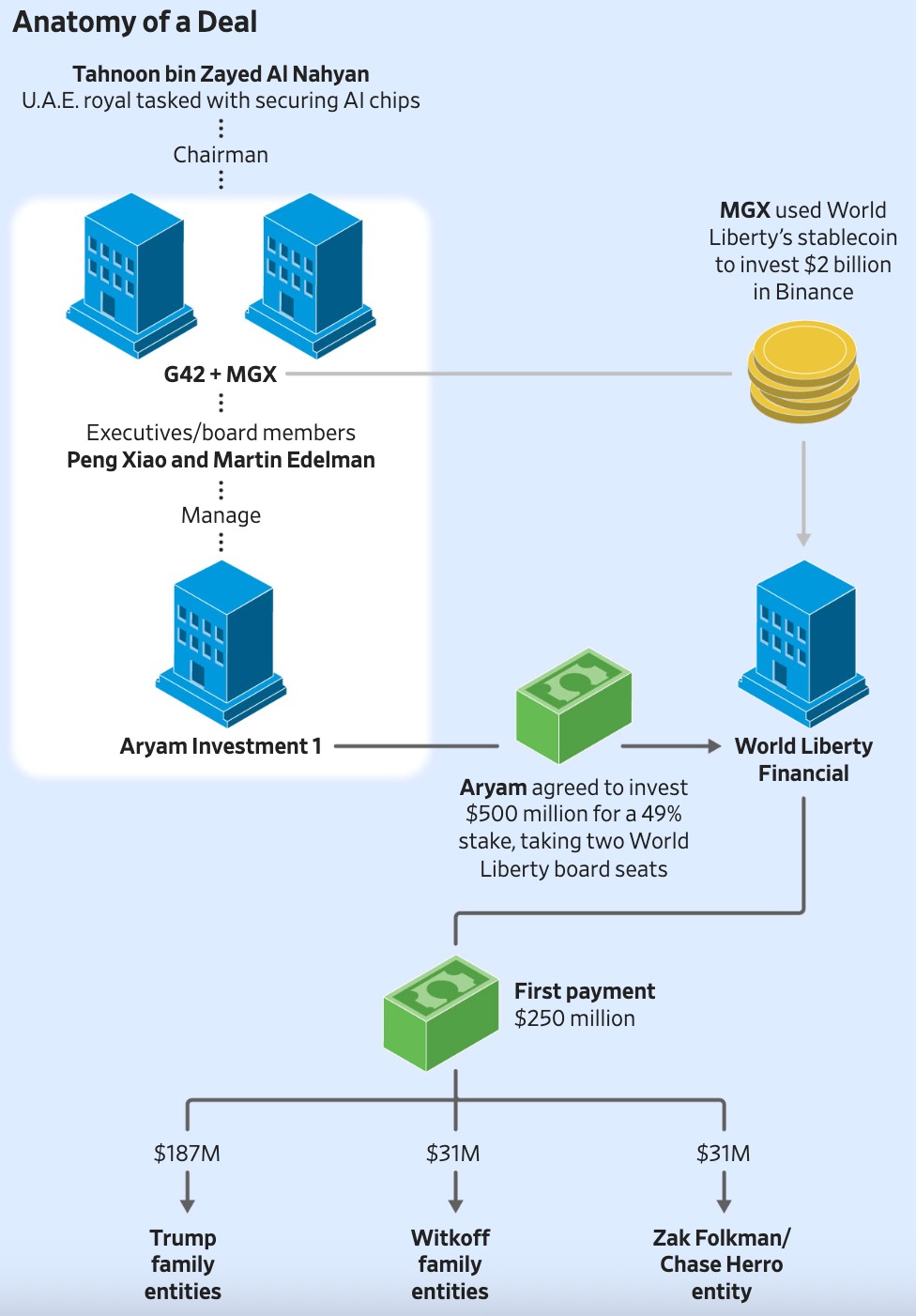
Summary diagram of the links between the various players mentioned in the report
Through this cross-referencing, the Wall Street Journal goes on to question the role Tahnoon bin Zayed Al Nahyan may have played in Changpeng Zhao’s (CZ) pardon. And for good reason: the founder of Binance lives in Abu Dhabi and also holds Emirati citizenship. Furthermore, this pardon reportedly facilitated the granting of a global license to Binance by the Abu Dhabi Global Market, with a view to establishing a global headquarters there.
Moreover, this pardon came in October, just one month after MGX invested 15% in TikTok’s U.S. entity, allowing the social media platform to continue operating on U.S. soil.
Furthermore, while Tahnoon bin Zayed Al Nahyan has long been interested in AI, the Biden administration had restricted his access to U.S. chips, fearing that this technology might benefit China due to his ties to Huawei.
However, two months after a meeting at the White House with the individual in question in March 2025, the Trump administration committed to supplying 500,000 AI chips to the United Arab Emirates, about one-fifth of which would be reserved for G42.
While caution is warranted in light of these revelations, it is clear that this raises questions about the ties that can sometimes be forged behind the scenes for various agreements.