What if Bitcoin mining were no longer a problem, but a solution? More and more experts are highlighting its growing role in supporting renewable energy, particularly by reducing energy waste and accelerating the development of new green infrastructure.
Bitcoin mining is becoming vital for renewable energy
For many years, media outlets and politicians around the world have consistently voiced negative criticism of Bitcoin, sometimes going so far as to make incoherent statements or share unverifiable data.
Alex De Vries, for example, a former official at the Dutch Central Bank, claimed in a report that a single Bitcoin transaction would consume the equivalent of a swimming pool of water. Beyond the absurdity of this statement, it was widely reported by numerous media outlets without any serious verification, nor were the many corrections provided by the Bitcoin community taken into account.
In fact, experts studying Bitcoin today are unanimous: Bitcoin mining is not an ecological disaster; on the contrary, it is becoming indispensable to the energy transition.
A recent article by Daniel Batten, an activist and energy expert who has been focusing on Bitcoin for several years, highlights that Bitcoin is even becoming a driving force behind the ongoing transition—a thesis supported by 14 of the last 16 scientific reports and by 90% of specialized media outlets.
According to estimates by the Digital Assets Research Institute and the University of Cambridge, between 52.4% and 56.7% of the energy used by Bitcoin mining now comes from sustainable sources. This is mainly because miners act as consumers of last resort—that is, consumers of energy that would otherwise go to waste.
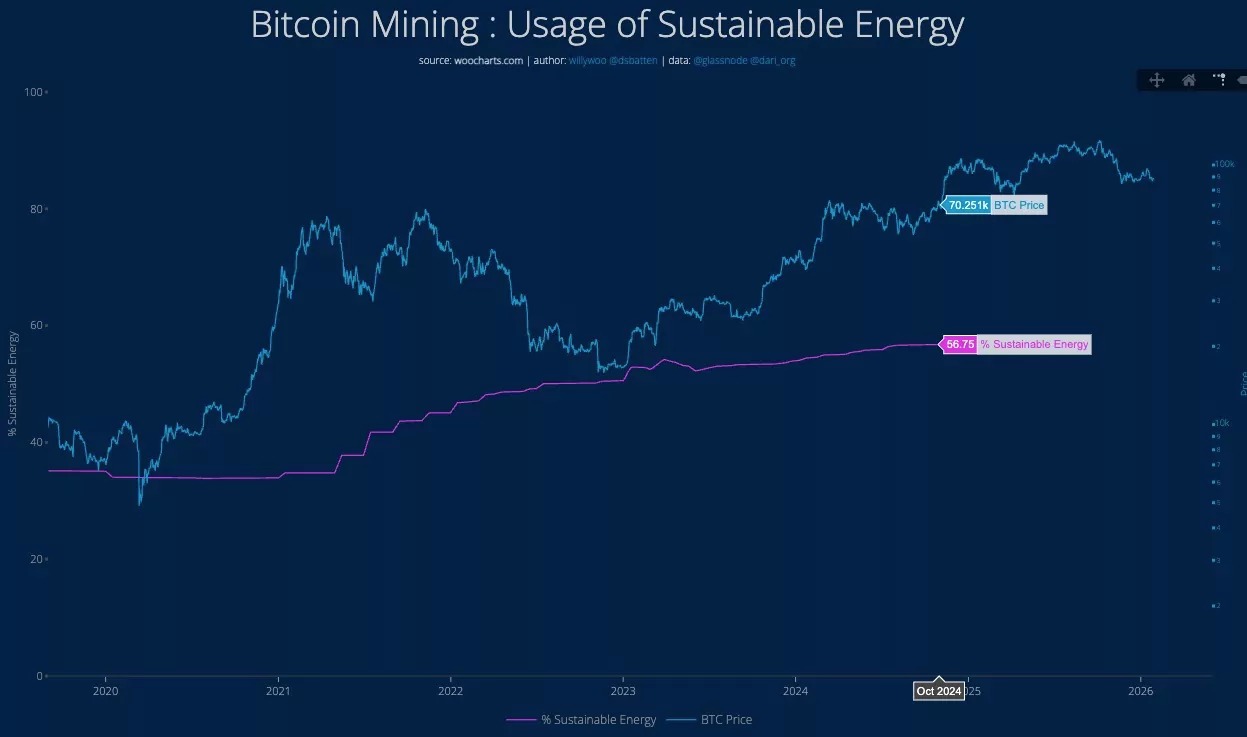
Trend in the share of green energy used by Bitcoin mining
By absorbing surplus electricity, miners enable the monetization of excess energy, supporting the profitability of power plants. Batten also highlights that by guaranteeing a buyer for energy produced during peak production periods, mining would reduce the payback period for solar and wind farms from 8 years to approximately 3.5 years.
In Texas, the integration of miners into the ERCOT grid is said to have reduced energy waste by 4% while increasing the profitability of renewable energy producers by 12%. In Ethiopia, the surplus from the GERD dam sold to miners is reported to have generated as much as $55 million.
Could France benefit from this?
The impact of Bitcoin mining goes beyond simply consuming surplus green energy. In fact, the industry is researching and developing solutions to reuse the “waste” heat generated by ASICs, the computers used for Bitcoin mining.
For example, in Finland, several miners supply district heating networks serving cities with tens of thousands of residents, while in the Netherlands, Bitcoin Brabant heats its agricultural greenhouses, thereby replacing their natural gas consumption.
While mining innovations are establishing themselves as industry standards around the world, France is turning its back on this opportunity.
The hot news surrounding Exaion, EDF’s cryptocurrency subsidiary, illustrates our leaders’ ideological capitulation. Despite a counteroffer led by a French consortium and supported by the National Bitcoin Institute (INBi), the Directorate General of the Treasury approved the sale of the company to the American giant Mara Holdings.
After stifling French miners for years, the government is finally handing over its capabilities to an entity subject to the Cloud Act, along with the sale of a non-compete clause prohibiting EDF from re-entering the sector for two years.