As fears of a major oil crisis mount, Iran continues to attack the Strait of Hormuz. In response, several organizations have announced the release of oil reserves, while in France calls for government-funded fuel subsidies are growing. An update this Thursday.
The Strait of Hormuz remains under attack, oil supplies reduced
This week, several ships were hit by Iranian strikes in the Strait of Hormuz, the key supply route for oil from the Middle East. Iran continues to target this area, notably deploying mine-laying vessels. As a reminder, 20% to 25% of global oil production passes through the Strait of Hormuz.
The world’s major economies are keeping a close eye on the strait, trying to reopen the passage. Donald Trump has reiterated his threats against Iranian forces that attempt to mine the strait, while Emmanuel Macron has called for the use of military escorts to restore the supply. For now, the situation remains deadlocked.
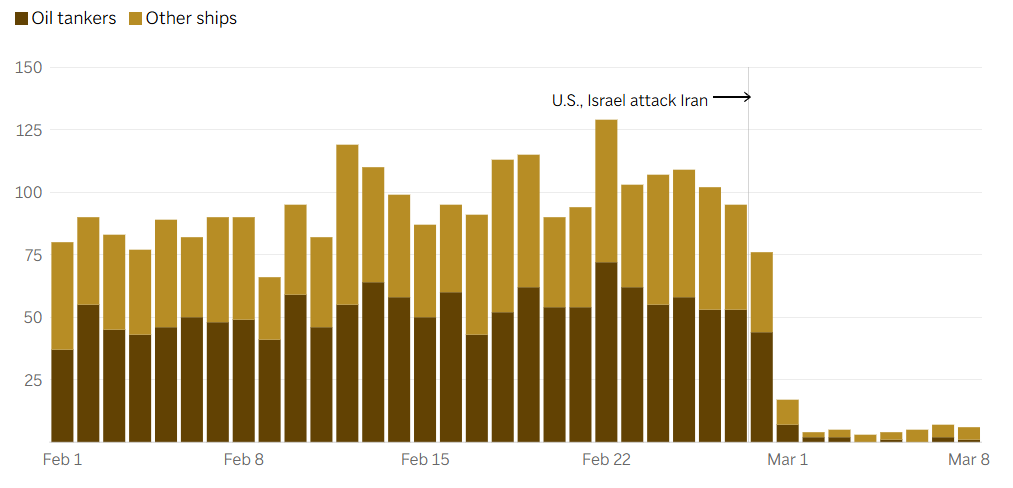
The number of ships passing through the Strait of Hormuz each day has plummeted
The war in the Middle East and the supply disruption have sent the price of Brent crude soaring. It reached $120 on Monday, March 9, and stands at $96 today. Prices at the pump have followed suit: a liter of diesel has exceeded €2 at many stations this week.
A temporary release of oil reserves
Faced with this critical situation, 32 member countries of the International Energy Agency (IEA) announced the release of 400 million barrels held in emergency reserves to address the supply shortage. For his part, the U.S. Secretary of Energy announced that the United States would release 172 million barrels starting next week.
The release of these reserves remains relatively symbolic: the world consumes more than 100 million barrels of oil per day. However, this corresponds to about twenty days’ worth of the volumes exported through the Strait of Hormuz. The hope is therefore that this timeframe will allow the war to end, as it faces a high risk of becoming bogged down.
Temporary Drop at the Pump and Calls for Funding
This Wednesday in France, managers at Leclerc and Coopérative U stores announced negotiations with refiners to lower prices at the pump. We should see price drops of 30 cents per liter by this weekend at gas stations. This is a temporary drop, but it should provide some relief for French consumers’ wallets.
In the face of soaring prices, new calls for financial aid for French citizens have been made.
But so far, the Ministry of Finance has strongly opposed the idea: the government is instead considering capping margins. François Villeroy de Galhau, Governor of the Bank of France, also stated that the country simply does not have the means to subsidize French citizens’ fuel purchases:
We have no money left. […] The real long-term solution is to achieve energy independence.
All eyes therefore remain fixed on the Middle East, on the 13th day of the war launched by the United States and Israel.