
With Bitcoin’s hashrate at its lowest since September, some on-chain data suggests that miners are capitulating. What is going on?
Bitcoin miners suffer from market decline
In the Bitcoin (BTC) mining industry, several parameters must be taken into account to determine whether or not an activity is profitable.
Among other things, we can mention the computing power available to a miner (their hashrate), the difficulty of mining, the value of which depends in part on the total hash deployed on the network, the cost of electricity, any additional income that may be generated by the resale of heat in particular, as well as the price of BTC and network activity, which generates more or less fees.
Due to all these variables, Bitcoin mining goes through cycles of profitability and others where cash flow is severely tested. On this last point, the least financially sound players will choose to unplug their machines or turn to other activities due to lack of profitability. When this reaches its peak, we refer to it as miner capitulation.
The market regulates itself in such a way that the fewer miners there are, the easier it becomes to mine, motivating players to restart their machines and creating cycles that can be observed with on-chain analysis.
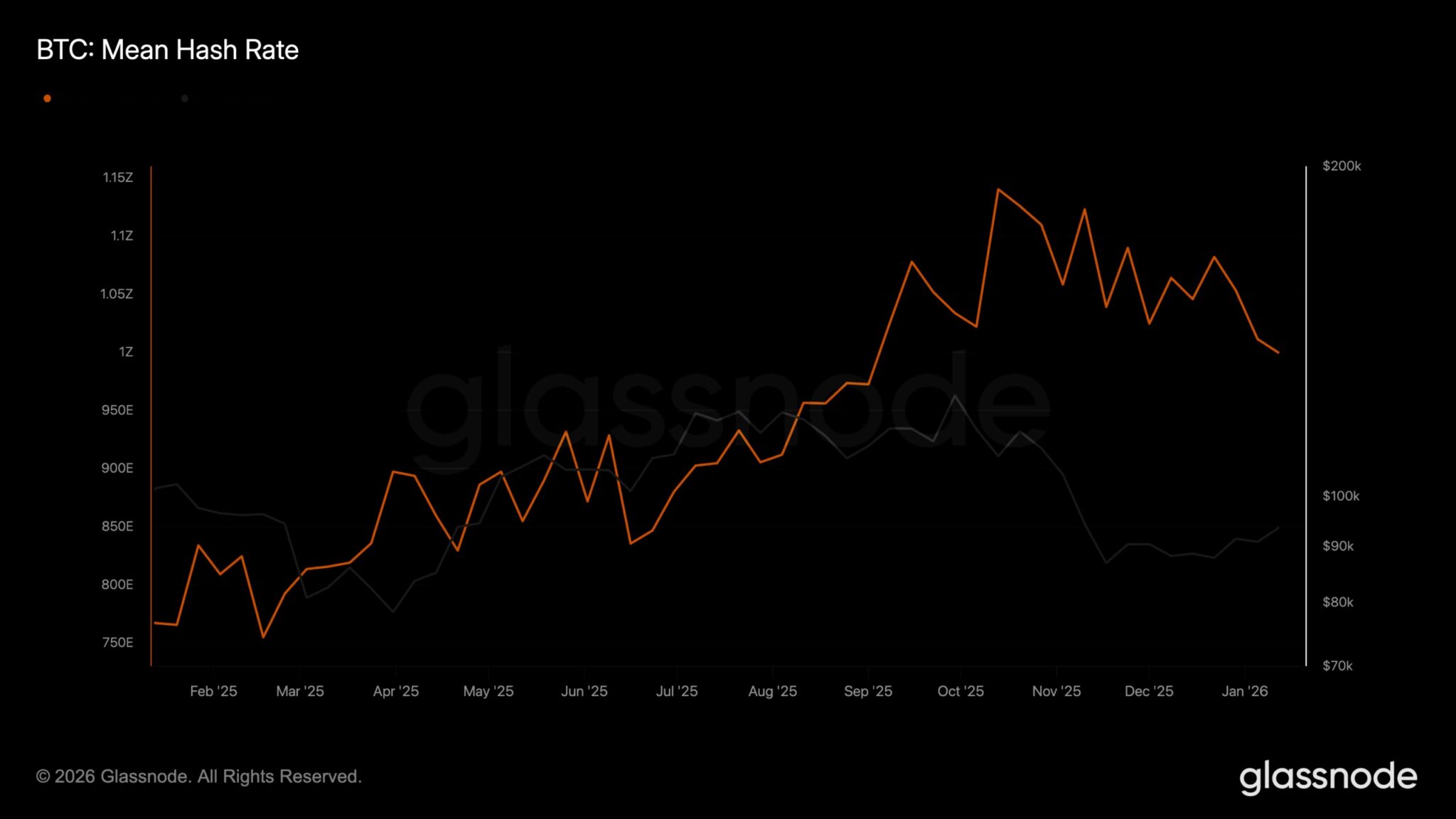
While the price of Bitcoin is down 28% from its all-time high (ATH) on October 6, mining difficulty has fallen 6% over the same period. This is because the price decline has undermined miners’ profitability, motivating some to leave the network. On a weekly basis, the computing power deployed on Bitcoin has thus fallen by 12.34% since its October ATH, from 1,140,060,419 TH/s to 999,375,511 TH/s:
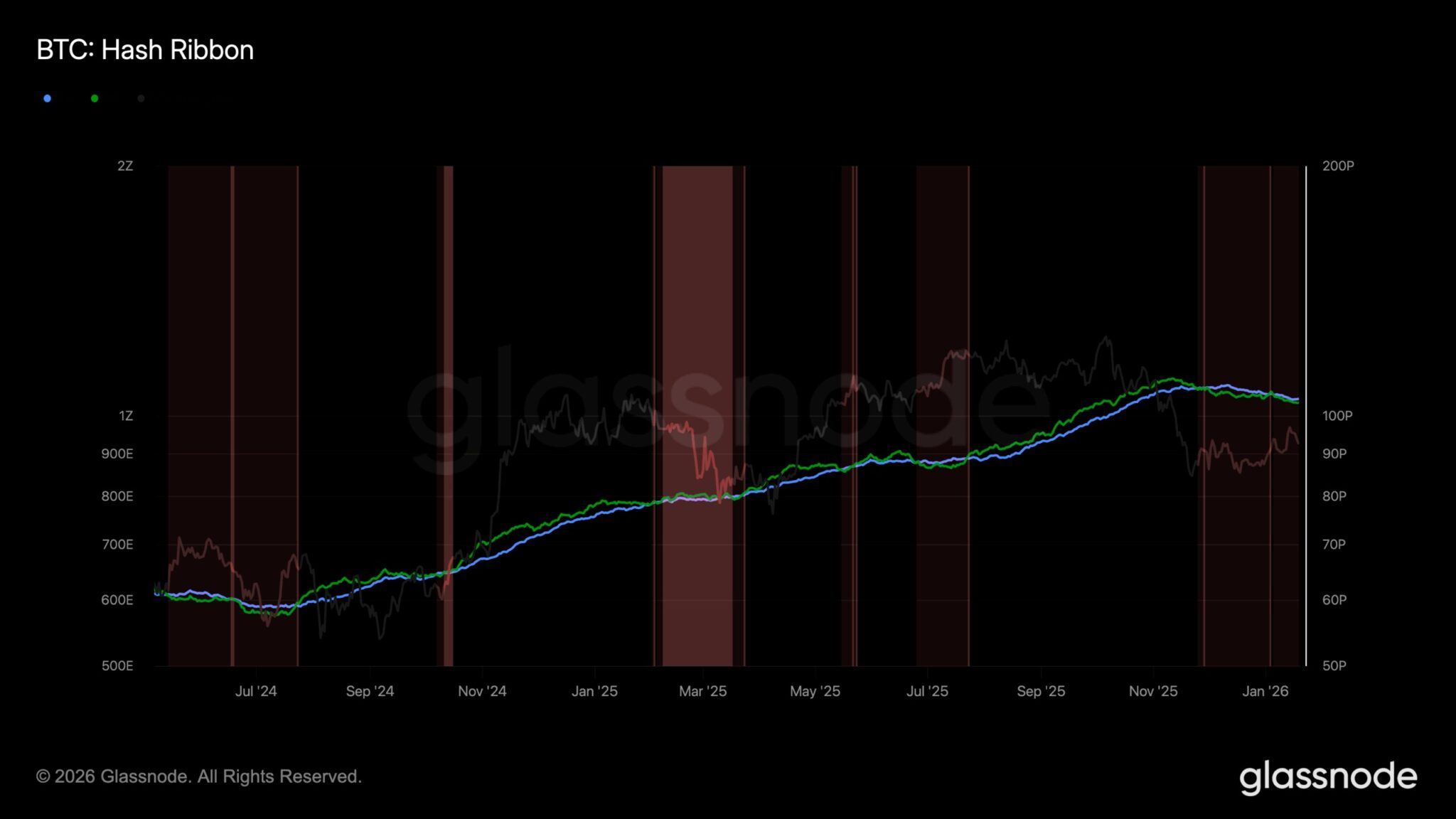
At the same time, the Hash Ribbon shows a period of capitulation that began at the end of November. The Hash Ribbon is calculated from the 30-day moving average (MA30) and the 60-day moving average (MA60) of the hashrate. When the MA30 falls below the MA60, the graph turns dark red, suggesting capitulation. Conversely, the chart turns light red when the MA30 rises above the MA60 again, suggesting a return of miners. Despite a few interruptions, the current period of capitulation appears to be the most significant since the summer of 2024:
On the stock market, Bitcoin miners are also feeling the pinch, with MARA and CleanSpark losing 44.85% and 23.29% respectively since October 6. Meanwhile, BTC is trading at $91,100 at the time of writing, down 2% over the last 24 hours.