
Despite its current decline, 2025 will remain the year in which Bitcoin set a new record, peaking at $126,000. But perhaps it didn’t even exceed $100,000, if we adjust its price for inflation since 2020. Let’s do the math…
Bitcoin: a peak of $126,000 not as obvious as it seems
Since its launch in 2009, the price of Bitcoin has continued to set new historical records, to the point of posting a return of 27,600% over the last decade, based on its peak of $126,000 last October.
This highly volatile journey has been measured primarily in US dollars in order to estimate the magnitude of its bullish momentum, but also the corrections—as is currently the case—that punctuate the BTC price.
However, Bitcoin’s high volatility could well clash with another measure of economic instability, according to calculations published at the end of the year on the X network by Galaxy Digital’s chief analyst, Alex Thorn, to the point of putting its historic $100,000 milestone into perspective.
Indeed, the dollar unit of measurement commonly used to calculate the price of cryptocurrencies—but also the “stability” of more than 99% of the stablecoins in circulation—has been facing chronic devaluation for many years due to inflation.
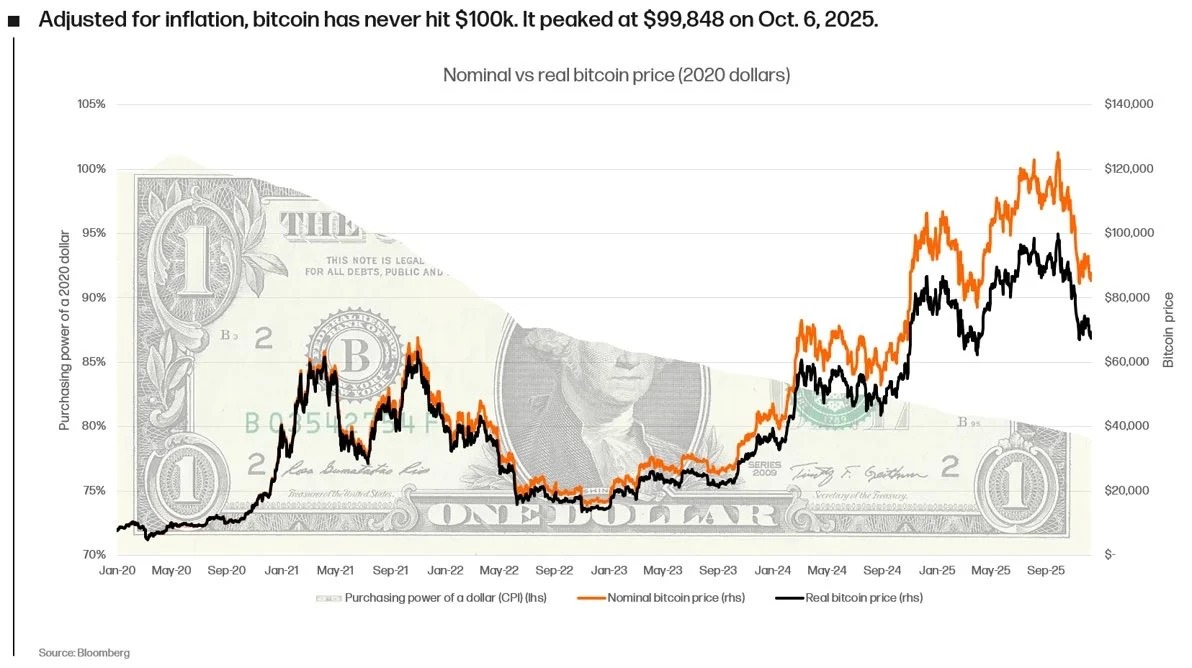
This situation is clearly illustrated by Alex Thorn in a graph whose conclusion is rather disturbing:
If we adjust the price of Bitcoin for inflation using 2020 dollars, BTC has never exceeded $100,000.
Alex Thorn
Faced with inflation, BTC would not even have exceeded $100,000
To fully understand this statement, we need to consider the price of the dollar at the beginning of 2020, or more precisely its effective value measured in terms of purchasing power. Because $1 is still worth $1, but over time, you need a little more to buy equivalent goods.
As a result, the price of Bitcoin has well exceeded $100,000 in nominal value, but things immediately become less clear if we recalculate the BTC price in “constant 2020 dollars,” i.e., without applying “the decline in purchasing power measured by the consumer price index (CPI)” over the last few years.
In reality, its high was $99,848 in 2020 dollars, surprising as that may seem. This adjustment takes into account the decline in purchasing power measured by the Consumer Price Index (CPI), incrementally, for each inflation release from 2020 to the present.
Alex Thorn
Why choose the January 2020 dollar as the benchmark, when according to the calculations of a commenter on this post, the price of Bitcoin based on its 2009 purchasing power would have caused its latest historic high to plummet to $83,000?
The answer is simple: this is the value of the dollar before the huge injections of liquidity made by central banks during and after Covid.