
It was a rough night for US stock markets, which were shaken by negative outlooks. Cryptocurrencies followed suit, with sharp declines in recent hours. What is going on?
Wall Street plummets overnight
Overnight, US stock markets were particularly shaken. The S&P 500 suffered a capitalization loss of $1.5 trillion in less than two hours. The index, which tracks major US companies, lost $15 billion per minute for around 100 minutes. The result: the S&P 500 closed down 1.56%, with the Nasdaq down 2.15%. Boosted by Nvidia’s results, the Dow Jones moderated its decline to 0.84%.
Investors appear to have been influenced by the release of a September employment report, which reinforces the scenario of the Federal Reserve maintaining interest rates in December.
Bloodbath for cryptocurrencies
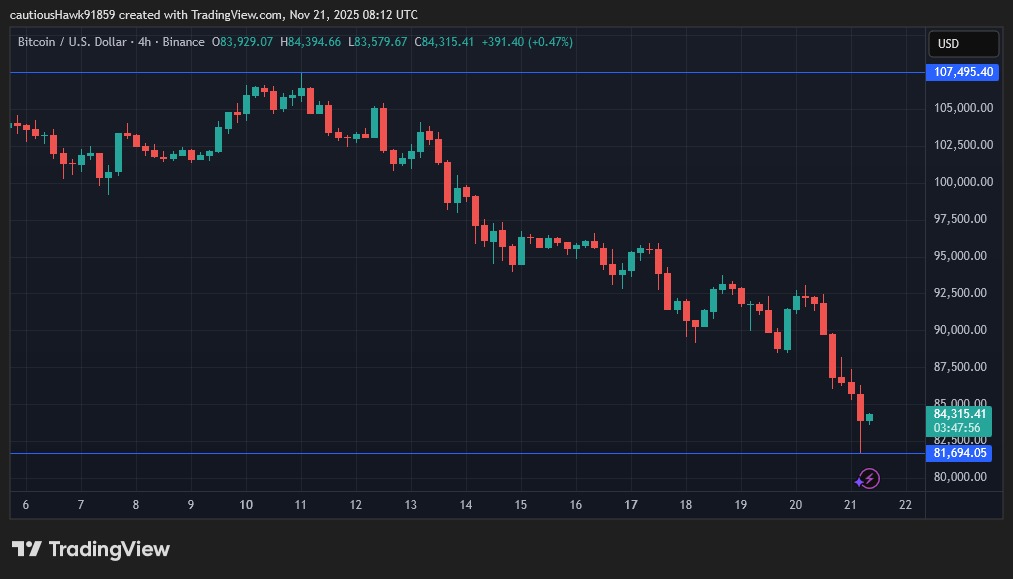
Investors’ withdrawal from “risky” assets was also seen in cryptocurrencies, which were unable to halt their decline overnight. The price of Bitcoin (BTC) has lost 8.8% over the last 24 hours, while Ethereum’s ETH has fallen 10.3%. The largest cryptocurrency is approaching the psychological threshold of $80,000, after crossing $90,000 three days ago:
In the top 10, the biggest losers are Solana’s SOL and Dogecoin (DOGE), both down 11%. The total capitalization of cryptocurrencies has fallen 8.4% since yesterday.
Among the top 50 cryptocurrencies, only one has seen an increase: Zcash (ZEC). The anonymous cryptocurrency, which has been in vogue in recent weeks, has gained 3.6% since yesterday.
Outlook and next steps
The evolution of cryptocurrencies in the coming days will depend on several signals from institutional investors. ETF movements have indeed been trending sharply downward this week. BlackRock’s Bitcoin ETF, for example, saw a record daily outflow two days ago, losing $523 million. This is part of a scenario in which investors are repositioning themselves toward assets perceived as less risky. This is especially true as the US Federal Reserve is sending out more and more signals of a slowdown.
It has indicated that the labor market is weakening, but without any rapid deterioration. In other words, a rapid cut in interest rates to support employment does not appear to be on the cards. Inflation remains above 2%, a key threshold above which the Federal Reserve does not envisage lowering rates. The context therefore seems to point to a continuation of a downward trend for cryptocurrencies, in a political and economic situation that remains tense in the United States.