The principle of decentralization is a cornerstone of the cryptocurrency sector, often highlighted in the management of its protocols and blockchains. This requirement can sometimes be fragile, as in the case of Scroll’s DAO, which has just put its governance on hold. What exactly is happening?
The decentralized organization of the Scroll blockchain puts its governance on hold
Since its inception, the cryptocurrency sector has been based on a few essential ideological fundamentals, such as the principle of decentralization. This logic involves the implementation of community decisions in the context of the evolution of its protocols and blockchains, managed by a decentralized autonomous organization (DAO).
However, this desire for decentralization sometimes clashes with conflicting ambitions, such as in the case of large token holders who are determined to steer community decisions to serve their own interests. In addition, some projects sometimes tout a relative decentralization that is more commercial than truly effective.
The recent announcement by the Scroll DAO has just thrown a new spanner in the works. Indeed, it seems that a major crisis is currently hitting this structure dedicated to the development of Scroll layer 2, supported by the Ethereum Foundation.
Important update regarding Scroll DAO: Although all accepted proposals will be implemented as planned, no new proposals will be processed until a new governance model is introduced.
Scroll DAO
Towards the adoption of a centralized approach?
Soon, new information published on the X network by people involved in the project community, such as Olimpio, shed light on the recent resignation of the DAO’s leader (Eugene). At the same time, a meeting of its delegates seems to reveal the discord that reigns in this matter, with questions being raised about a desire to “redesign governance.”
According to the information available, the situation within Scroll DAO appears complicated and without any clear direction. However, this “pause” in governance allows Olimpio to assume that the most likely path forward resembles “the adoption of a centralized approach.” And that raises many legitimate concerns.
The debate is still ongoing about what to do with the active proposals in this cycle. For example, there is a treasury management proposal, and they have to decide whether or not to honor it.
Olimpio
Faced with this situation, the reactions of the main protocols present on the Scroll layer 2 were not long in coming. The most significant concerns Aave, whose Aave Chan Initiative manager, Marc Zeller, states that in the event of a confirmed loss of decentralization, he will “propose to the Aave DAO to close shop there.”
Currently, the Aave protocol ranks third among the most important protocols on Scroll, with an estimated TVL of $25 million according to DeFiLlama. This amount represents nearly 10% of the total value locked on Scroll ($285 million).
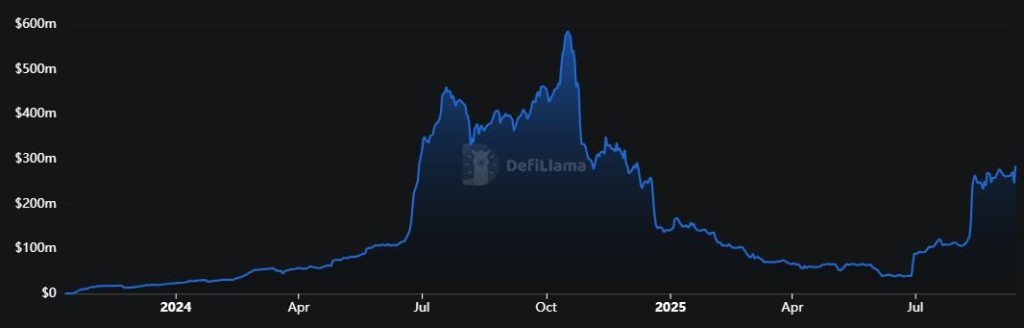
This crisis may have its origins in the glaring lack of adoption of Scroll’s layer 2. Indeed, the number of active addresses has plummeted by 85% over the last year. Could this be the beginning of the relentless digital selection that will undoubtedly thin out the ecosystem of these blockchains developed in parallel with Ethereum over the next few years? It’s a question worth asking…