
Hyperliquid wants to regain control of its ecosystem. Today, Circle benefits greatly from the DeFi protocol without putting in too much effort: this will soon be a thing of the past. Hyperliquid is launching a call for tenders, but with one condition: the company issuing Hyperliquid’s USDH stablecoin will only keep 5% of the fees. So why is Paxos so keen to win this position?
Paxos announces it is entering the race to become the issuer of Hyperliquid’s USDH stablecoin
Paxos announces it is entering the race to become the issuer of Hyperliquid’s stablecoin — USDH. A former partner of Binance — with BUSD — it is in the running to become the issuer of USDH, the future stablecoin of the Hyperliquid decentralized finance protocol.
As a reminder, Hyperliquid is the world’s number one DeFi protocol, with more than $700 million deposited by users (TVL). Recently, volumes have literally exploded on the platform, without causing any technical problems, providing the best validation of the DeFi model to date.
Paxos, for its part, is a company that issues various stablecoins, such as PaxGold. The company has provided Binance with its BUSD, a solid coin that has almost never lost its peg to the dollar—i.e., its price equivalence of 1 BUSD = 1 USD.
Founded in 2012 by Charles Cascarilla and Rich Teo, the company is registered in New York. It is also regulated under the GENIUS Act and MiCA. The company has been issuing stablecoins since 2018, with more than $160 billion in tokenized assets.
But why position yourself in a market where 95% of the profits go to Hyperliquid?
Becoming a leading player, even if it means losing 95% of the fees
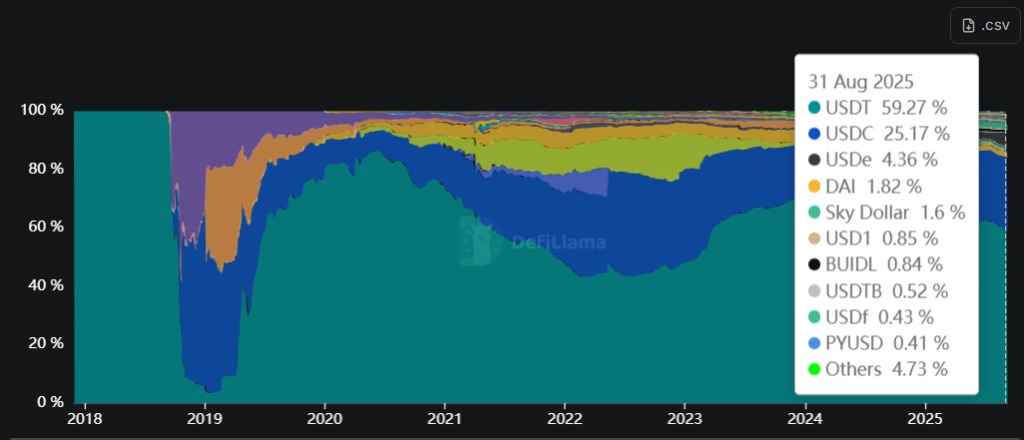
Today, the most widely used stablecoin on Hyperliquid is Circle’s USDC. Jeremy Allaire’s company is the second-largest stablecoin issuer in the world, with a 25% market share according to DefiLlama data.
With $5.5 billion in USDC on the Hyperliquid platform, Circle generates approximately $200 million in revenue from interest rates. That’s 10% of Circle’s annual revenue.
Losing this market would be a major blow to Circle and could potentially open the door to other players in the ultra-competitive stablecoin sector.
This is a boon for Paxos, especially since Hyperliquid has a stranglehold on the decentralized futures market with a 70% market share. The protocol generated $106 million in revenue last month on $400 billion in trading volume.
Paxos is not the only protocol in the running. Other major players in the sector include Agora — Moonpay, EtherFi, LayerZero, etc., Ethena Labs — which counts Blackrock among its partners, and Stripe with its Tempo stablecoin project, although the latter information has yet to be confirmed. But the most serious contender for the throne remains Paxos.
With USDH, Hyperliquid continues to break away from the pack
As a reminder, Hyperliquid recently announced its intention to launch a stablecoin, USDH, whose ticker has already been reserved by the world’s largest decentralized finance protocol.
The USDH would be issued directly on Hyperliquid, with the following conditions:
Anyone issuing USDH must share the returns with the ecosystem, remunerate validators, fund the assistance reserve, and buy back HYPE tokens.
Hyperliquid
The USDH stablecoin would also enable Hyperliquid to expand its ecosystem with new products and services:
The project aims to make Hyperliquid more attractive to institutions and consumer fintech platforms by connecting it to global banking networks and clarifying regulations.
Cointelegraph
By becoming the issuer of USDH, Paxos would gain a significant share of the blockchain-based payments market.
In addition, it would be an opportunity to strengthen the company’s presence among leading financial institutions and become a key player in the finance of tomorrow. The battle for the financial system of the future is underway.
Circle, whose CEO is often seen at the White House, has just taken a hit.