
As Google builds its own blockchain, the internet giant’s head of Web3 strategy has shared more information about the project. What do we know?
Google is working on its Google Cloud Universal Ledger (GCUL) blockchain
On Tuesday on LinkedIn, Rich Widmann, Google’s head of Web3 strategy, made a particularly interesting post about the internet giant building its own layer 1 blockchain. However, it should be noted that the news was not a secret, as we already had the opportunity to talk about Google’s work last spring in relation to a partnership with CME Group.
Nevertheless, all this is taking place in a particular context, as a new narrative seems to be emerging around layer 1 dedicated to stablecoins. In fact, Widmann shared a comparison table between Stripe’s Tempo blockchain, Circle’s Arc blockchain, and what will be Google Cloud’s Universal Ledger (GCUL):
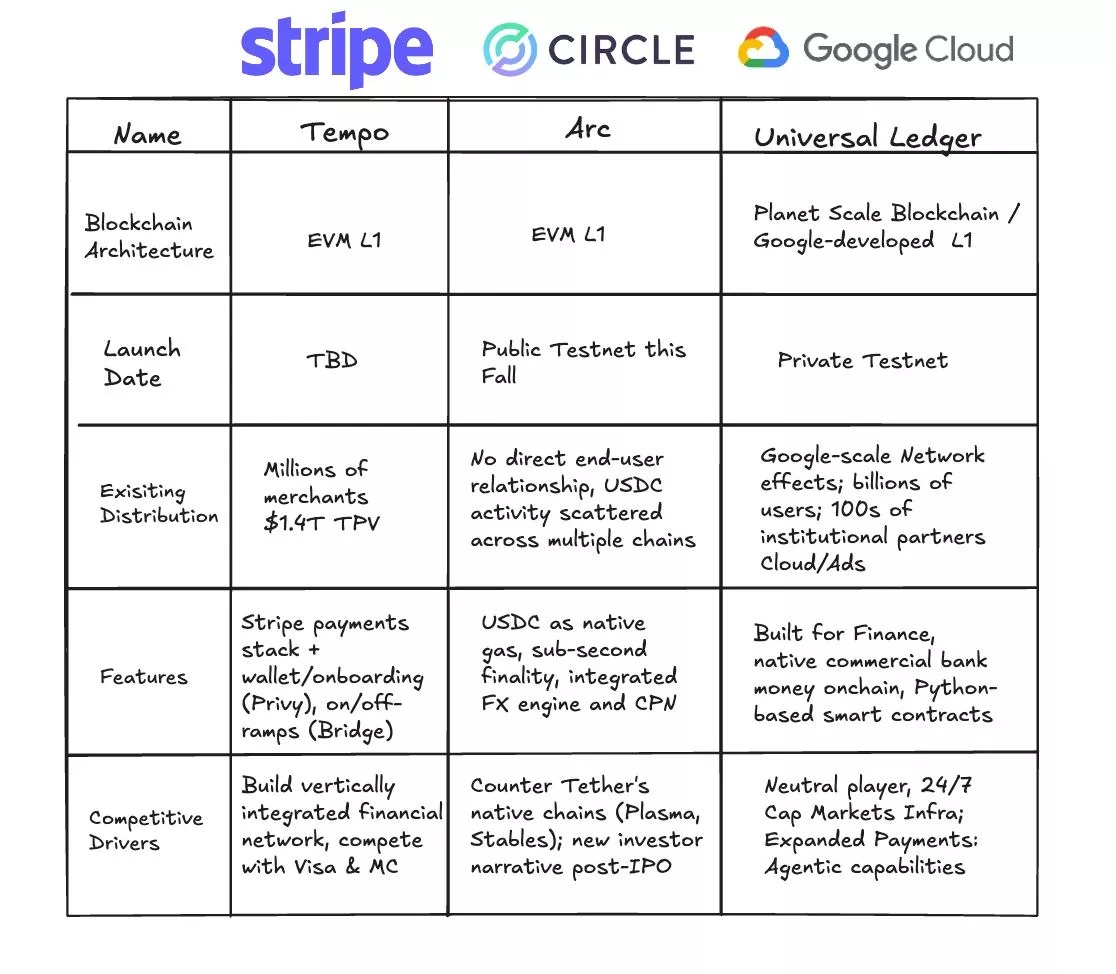
What is immediately apparent is that the network will not be built on the Ethereum Virtual Machine (EVM), but rather specially designed for the world of finance, notably with smart contracts written in Python. For the time being, the network is in private testnet, and more technical details will be revealed “in the coming months.”
Rich Widmann praised the qualities of the network, which he believes gives it a competitive advantage:
GCUL brings together years of R&D at Google to offer financial institutions a new, high-performance, truly neutral layer 1 blockchain that allows them to create smart contracts in Python. That’s why institutions like the CME Group have chosen Universal Ledger to explore tokenization and payments on one of the world’s largest commodity exchanges, relying on GCUL.”
Furthermore, he continues his reasoning by stating that while the various stablecoin issuers will logically stay away from their competitors’ networks, they will still be able to deploy on GCUL:
In addition to leveraging Google’s distribution, GCUL is a neutral infrastructure layer. Tether will not use Circle’s blockchain — and Adyen [Stripe’s competitor, ed.] will probably not use Stripe’s blockchain. But any financial institution can build with GCUL.
Now we must wait to learn more about the true characteristics of this blockchain, particularly with regard to its possible future decentralization and integration into the rest of the crypto ecosystem.