
With ETH having fallen more than 10% since its new all-time high (ATH) last weekend, will it manage to rebound? Let’s look for answers in various data sources.
Where will ETH go after its ATH?
Yesterday, we looked back at Ethereum’s long-awaited new all-time high (ATH) over the weekend. However, we noted that this record was broken only modestly. Since reaching this ATH, the price of Ether has fallen 10.65% and is trading at $4,422 at the time of writing, down 3.9% over 24 hours.
It therefore seems natural to wonder whether the asset will manage to break its record again with more vigor, or whether this was the high point of the recovery observed in recent months.
Firstly, it should be remembered that a pause seems logical, given that since its annual low of $1,384 on April 9, ETH has risen 258% to its new ATH. It is therefore normal for some investors to want to lighten their positions to take profits.
Furthermore, this pause should be viewed in the context of the summer, when markets are generally quieter in August due to the holiday season. This can also be seen in other assets such as BTC, which, after a new ATH of $124,000 on August 14, is now trading down 11.3% at $110,000.
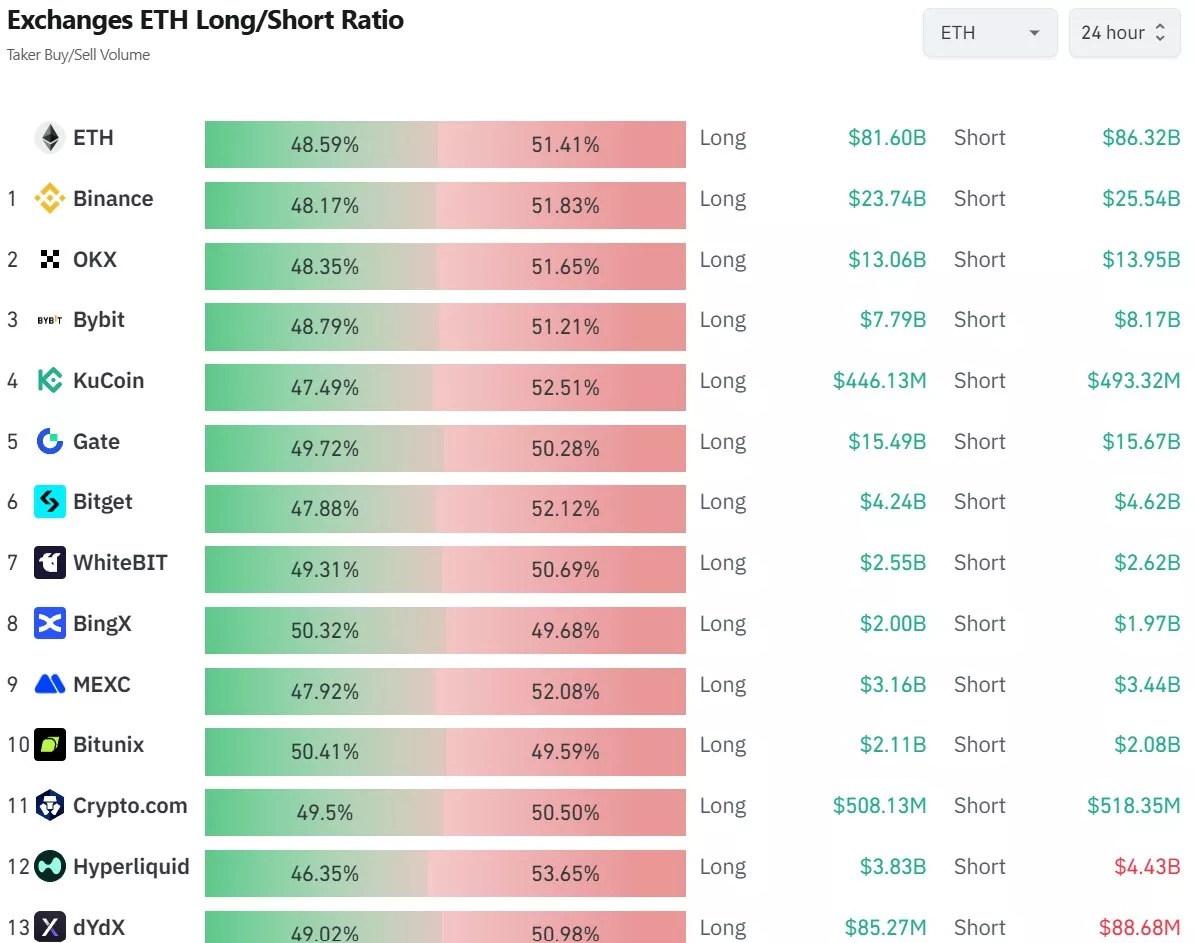
To try to determine market sentiment, we can take a look at the balance between long and short positions on the various crypto platforms. In this case, short positions slightly dominate, averaging 51.41% and a volume of $86.32 billion over 24 hours:
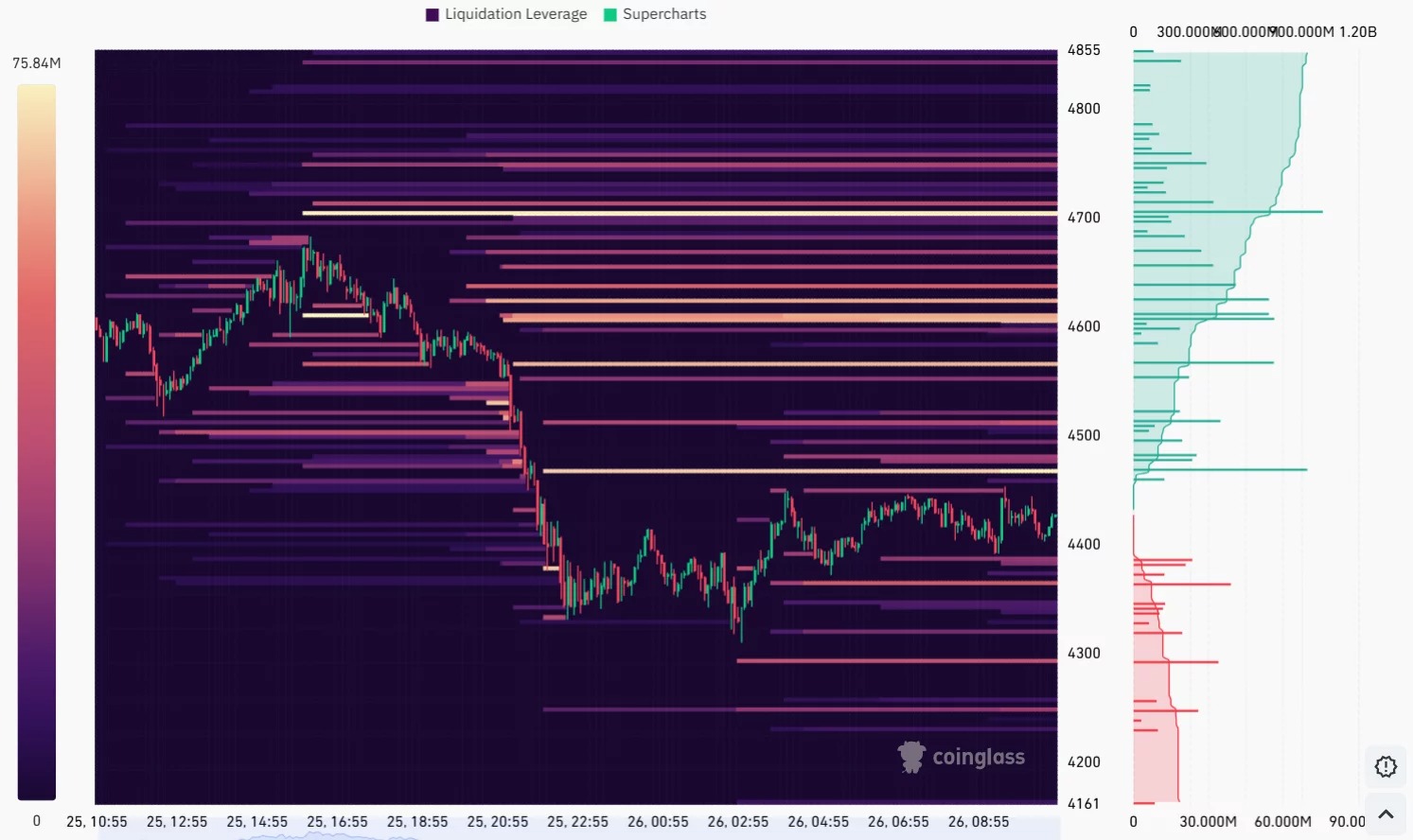
While this contributes to some selling pressure, the chart of liquidation levels on Binance shows that the upward acceleration would be greater in the event of a rebound than a possible downward acceleration if the decline continues. And for good reason: in the chart below, the more horizontal bars there are and the closer they are to yellow, the greater the liquidations of long or short positions will be if ETH reaches the relevant levels:
Regarding the spot market, we have already discussed staking outflows, but withdrawals are continuing and the queue is now nearly 16 days long, with more than 911,000 ETH in the queue. At the same time, however, it is worth noting that there is a nearly 11-day wait for 615,400 ETH to enter the market:
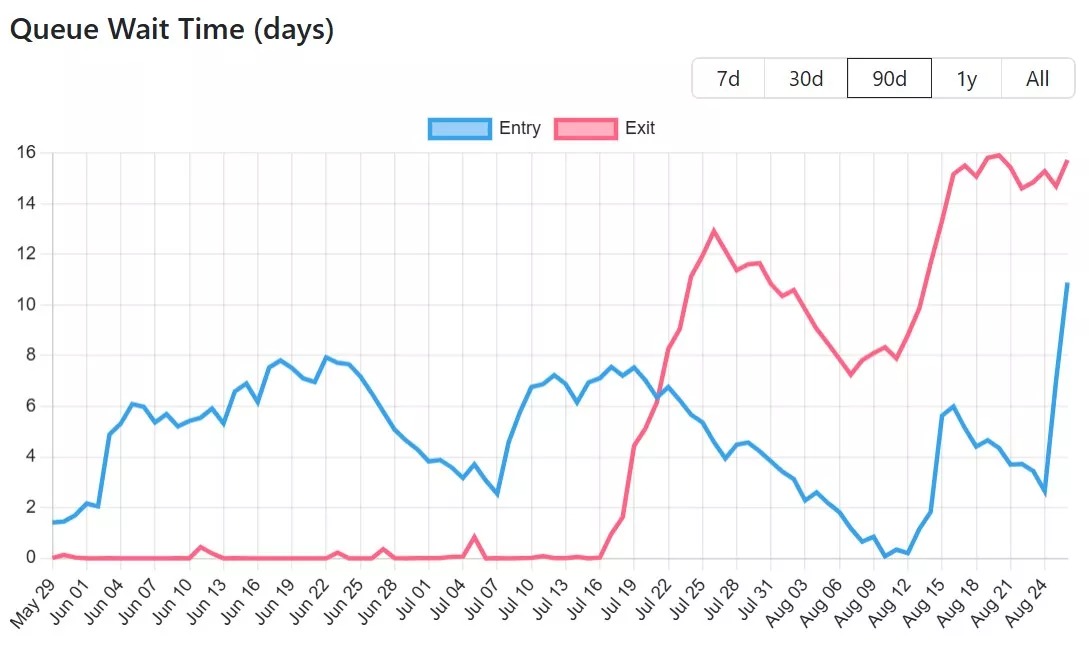
Of course, staking outflows do not necessarily mean sales, but they do reflect investors’ willingness to take profits.
On the ETF side, despite nearly $444 million in inflows on Monday, the total value of assets under management fell to $28.84 billion, after an ATH of $30.58 billion on Friday. Nevertheless, we can see an increase in these assets under management in ETH equivalent, as they currently stand at 6.62 million units, compared to 6.3 million on Friday.
Thus, uncertainty reigns as to the short-term direction of the ETH price, and patience will be required to see more clearly.