
On July 30, 2015, a smart contract was executed for the first time on a public blockchain: Ethereum was born. Ten years later, the project initiated by Vitalik Buterin has become much more than just a protocol—it is the foundation of a new digital economy based on the programmability of assets. To mark this decade, we look back at the major milestones that have shaped Ethereum, from its inception to its transition to proof-of-stake.
Ethereum celebrates its 10th birthday today
Today is a symbolic day for the Ethereum blockchain, which is celebrating its 10th anniversary. The most popular smart contract blockchain was launched on July 30, 2015, with the launch of its mainnet, the result of several years of work and collective contributions.
The conceptualization and development of the Ethereum blockchain was the brainchild of Vitalik Buterin, a young 19-year-old programmer of Russian-Canadian origin. Now famous, Vitalik Buterin was still unknown to the general public at the time. Passionate about Bitcoin and the philosophy behind cryptocurrency as conceived by Satoshi Nakamoto, he co-founded Bitcoin Magazine, which still exists today.
But Vitalik Buterin quickly wanted to push the boundaries of Bitcoin. In his opinion, despite its qualities, the Bitcoin blockchain was missing something: the ability to automate and execute complex programs beyond financial transactions.
So, in 2013, Vitalik published what would become the genesis of Ethereum: his white paper, which directly mentioned “smart contracts,” the programs that would earn Ethereum its nickname, “the decentralized global computer.”

It should be noted that smart contracts were not invented by Vitalik Buterin: the first work on the subject dates back to 1994, led by computer scientist Nick Szabo. However, smart contracts have well and truly moved from concept to reality thanks to Ethereum.
Vitalik was not alone in creating this revolutionary project, however. He was surrounded by notable figures such as Gavin Wood (who has since created Polkadot), Joseph Lubin, Mihai Alisie, Anthony Di Iorio, and Charles Hoskinson, who later created Cardano, one of the most capitalized blockchains with its own cryptocurrency, ADA.
From its launch to today, Ethereum has faced many challenges: sometimes defeats, sometimes victories. Either way, 10 years later, Ethereum is recognized as the second largest cryptocurrency in history behind Bitcoin, and the first blockchain for smart contracts.
Ether, its cryptocurrency used, among other things, to pay transaction fees on the network, is now capitalized at $459 billion. The Ethereum blockchain, meanwhile, now hosts more than $85 billion through its numerous decentralized finance (DeFi) protocols. And that doesn’t include the total value locked (TVL) of layer 2 blockchains, which act as overlays that leverage Ethereum’s security to provide greater scalability.
To mark the blockchain’s 10th anniversary, we take a look back at the important dates that have helped make Ethereum what it is today.
2014 – Historic crowdfunding
Ethereum’s crowdfunding in 2014 was one of the most iconic moments in the history of cryptocurrencies. It was not just a successful fundraiser, but an event that laid the economic, community, and ideological foundations for the future “world computer” that Ethereum would become, when everything was still to be done.
The fundraising campaign was launched on July 20, 2014, and ended on September 2, 2014. Organized as a pre-ICO (Initial Coin Offering), it allowed participants to purchase ETH in exchange for BTC, well before the Ethereum network was operational (the mainnet would not be launched until July 2015).
- Amount raised: approximately 31,591 BTC, or approximately $18 million at the time;
- Initial price of Ether: 1 BTC entitled the holder to 2,000 ETH at the start of the sale;
- Number of ETH generated for sale: approximately 60 million, out of the 72 million in the initial offering.
At the time, this was one of the largest public fundraisers in cryptocurrency, surpassed only by certain subsequent ICOs during the 2017 bubble.
July 30, 2015 – Launch of the Ethereum mainnet
After more than a year of intensive development, the Ethereum blockchain officially came into being on July 30, 2015, with the launch of its mainnet.
Called Frontier, this first public version finally allowed users to interact with the blockchain, deploy smart contracts, and start mining Ether, the protocol’s native cryptocurrency. This launch marked a turning point in the history of blockchains: for the first time, a public network allowed the creation of decentralized applications (dApps) without a central authority.
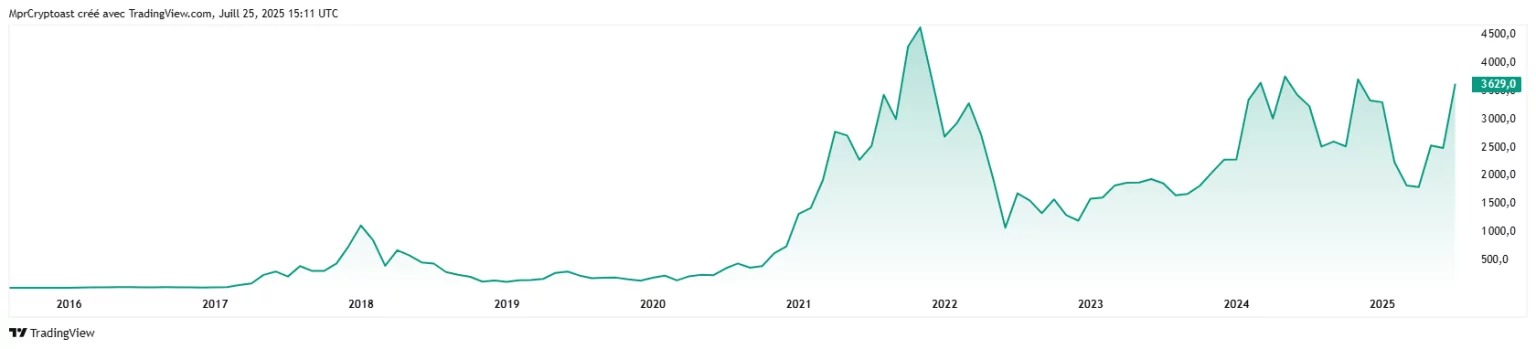
On that day, block number 0 was mined, launching the ecosystem that would revolutionize on-chain finance.
June 17, 2016 – Hack of “The DAO”
On June 17, 2016, Ethereum experienced its first major crisis with the hacking of “The DAO,” a decentralized autonomous organization that had raised more than $150 million in ETH just weeks earlier. Exploiting a flaw in the DAO’s smart contract, an attacker managed to siphon off approximately 3.6 million Ether, or nearly 15% of the funds raised. Although the flaw did not originate with Ethereum itself, the scale of the theft threatened the credibility of the young ecosystem. The community was faced with a difficult choice: respect the immutability of the blockchain or intervene to repair the irreparable.
July 20, 2016 – Hard Fork following the hack of “The DAO”
Less than a month after The DAO hack, the Ethereum community voted in favor of a radical decision: to perform a hard fork of the protocol in order to make the stolen funds recoverable.
On July 20, 2016, the split was implemented: a new version of the blockchain was created, “undoing” the effects of the hack. However, this controversial choice was not unanimously accepted. Part of the community refused to change the history of the chain and continued to support the original version under the name Ethereum Classic (ETC).
November 2017 – Ethereum grabs the spotlight with ICOs
In the fall of 2017, Ethereum established itself as the backbone of the emerging Initial Coin Offerings (ICO) market. Thanks to its open architecture and standardized smart contracts—notably through the ERC-20 standard—the blockchain enabled hundreds of projects to raise funds directly in cryptocurrencies, often without going through traditional financial intermediaries.
This phenomenon attracted billions of dollars in a matter of months and propelled Ethereum into the spotlight. But this excitement had a downside: while some projects were legitimate and innovative, others turned out to be scams or empty promises, leading to a gradual loss of confidence and increased scrutiny from regulators.
Nevertheless, this period has profoundly shaped Ethereum’s image as an incubator for decentralized innovation.
The beginning of 2020 marks an important transition for Ethereum with the launch of the Beacon Chain, the first building block of the project known as “Ethereum 2.0.” This new parallel blockchain introduces Proof of Stake (PoS), a more energy-efficient consensus mechanism intended to replace the Proof of Work (PoW) mechanism inherited from Bitcoin.
The Beacon Chain does not yet process transactions or smart contracts: it is used to coordinate validators and lay the foundations for the future network. This step marks the start of a profound transformation of the protocol, aimed at improving its scalability, security, and energy efficiency, with the goal of not compromising its decentralization.
August 5, 2021 – Ethereum may become deflationary with EIP-1559 (London)
With the London update, Ethereum introduces EIP-1559, a major reform of its transaction fee system. Until now, users had to propose a “gas price” to be adjusted manually, which created inefficiency and sometimes prohibitive fees.
EIP-1559 replaces this model with a more predictable mechanism: base fees are automatically calculated by the protocol based on demand and then burned (i.e., destroyed), thereby reducing the total supply of Ethers in circulation.

As the network is used, a portion of ETH disappears with each block, introducing unprecedented deflationary pressure. This reform reinforces the idea of a more economically “healthy” ether, while consolidating its place as a reserve asset for Web3.
September 15, 2022 – The Merge: Ethereum moves entirely to proof of stake and abandons mining
On September 15, 2022, Ethereum achieved what many considered a technological feat: the merger (The Merge) between the Beacon Chain and the historic main network.
Ethereum successfully abandons Proof of Work, an energy-intensive mechanism based on mining, in favor of Proof of Stake, which relies on validation through the staking of Ethers. In doing so, the network’s energy consumption drops by more than 99%, with no service interruption or data loss.
Beyond the environmental impact, this transition strengthens the security and sustainability of the protocol, while paving the way for future scalability-focused developments such as sharding and the development of layer 2 solutions.
April 12, 2023 – Shapella: ETH staked in the Beacon Chain can be withdrawn
On April 12, 2023, Ethereum will roll out the Shapella update — a contraction of “Shanghai” (execution side) and “Capella” (consensus side) — which introduces a highly anticipated new feature: the ability to withdraw Ethers staked in the Beacon Chain since December 2020.
Until now, validators participating in securing the network through Proof of Stake could neither touch their rewards nor recover their initial stake. Shapella removes this restriction, strengthening confidence in the PoS model and attracting new stakers, both individuals and institutions.
January 11, 2024 – Ethereum spot ETFs launch in the United States
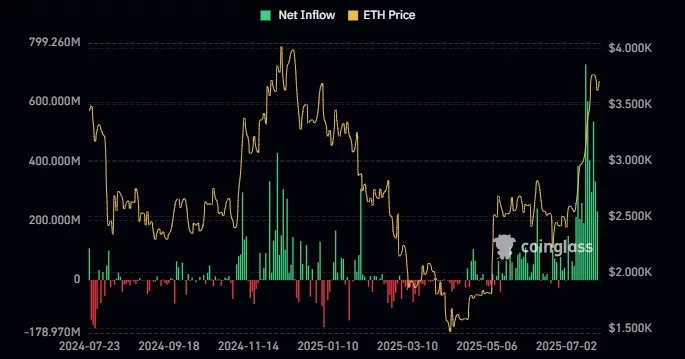
On July 23, 2024, Ethereum takes a significant step toward integration into the traditional financial system with the official launch of the first spot ETFs on Ether in the United States. After months of regulatory waiting, several asset management giants — including BlackRock, Fidelity, Grayscale, and Ark Invest — see their products listed on the stock exchange. These ETFs allow traditional investors to access Ether through securities accounts without having to directly hold the cryptocurrency. The event follows the approval of Bitcoin spot ETFs in January and reflects the growing institutionalization of digital assets. For Ethereum, this is a symbolic and strategic recognition of its status as an essential asset in the digital economy.
Unlike Bitcoin ETFs, those on Ether got off to a slow start, with the first few weeks in the red. But in July 2025, these investment vehicles gained new momentum, recording billions of dollars in net inflows over several consecutive weeks.
Ten years after the launch of its mainnet, Ethereum has established itself as one of the most influential pillars of the blockchain ecosystem. Through its major developments—from the transition to Proof of Stake to the emergence of layer 2, not to mention its central role in DeFi and tokenization—the protocol has demonstrated a rare capacity for adaptation and innovation.
But the future remains to be written. Faced with challenges such as scalability, governance, centralization, and growing competition, Ethereum will need to continue reinventing itself without compromising the principles that have made it strong: openness, decentralization, and resilience.