
On Wednesday evening, Paxos mistakenly printed a colossal $300 trillion in PayPal’s PYUSD stablecoin. Here’s a look back at this blunder, which was quickly corrected.
Paxos mistakenly issues a colossal amount of PYUSD
On Wednesday evening, a wallet belonging to stablecoin issuer Paxos surprised observers by issuing $300 trillion worth of PYUSD, PayPal’s stablecoin:
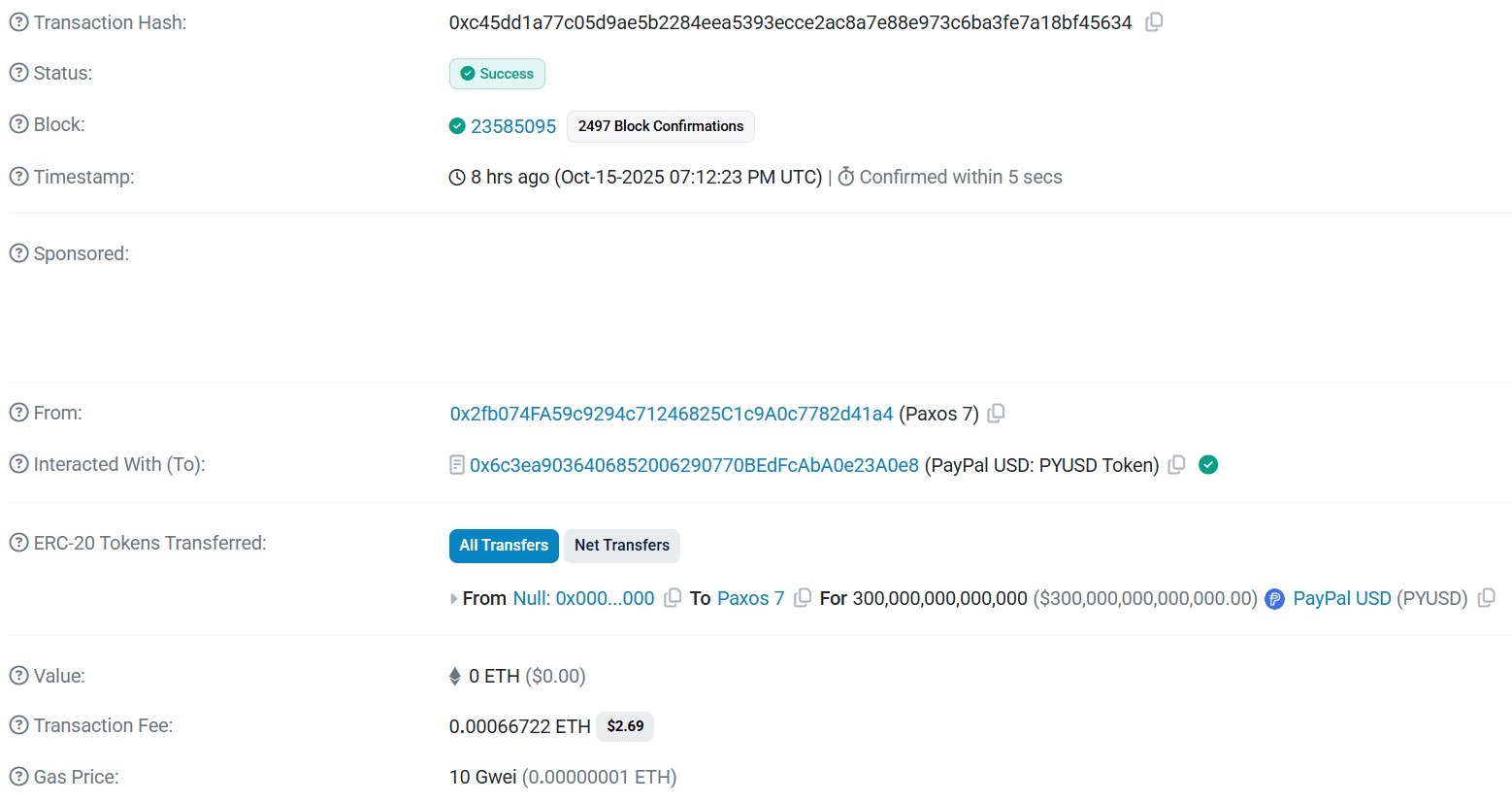
For comparison, this enormous amount is equivalent to eight times the US national debt, or more than 77 times the total market capitalization of cryptocurrencies.
Although there was reason to suspect a hack, this was not the case, and the Paxos team published a brief statement on the subject on X:
At 3:12 p.m. EST [7:12 p.m. Paris time, editor’s note], Paxos mistakenly issued excess PYUSD during an internal transfer. Paxos immediately identified the error and destroyed the excess PYUSD. This was an internal technical error. There was no security breach. Customer funds are safe. We have addressed the root cause.
Indeed, 22 minutes later, all of these PYUSD were sent to a burn address. Then, at 9:15 a.m., 300 million PYUSD were issued, which corresponds to the amount originally planned.
Of course, these PYUSD had no real value, given that they were not backed by any collateral.
However, while the error was quickly corrected and may seem amusing, it highlights the potential damage that such a hack could cause within decentralized finance (DeFi). And for good reason: smart contracts do not care whether or not Treasury bills are attached to the ERC-20 tokens they process in their lines of code.
In response to this incident, Zach Rynes, Chainlink’s (LINK) community liaison officer, highlighted his company’s Proof of Reserve (PoR) tool. He explains that this tool “prevents the issuance of additional tokens unless Chainlink PoR has first validated that there are sufficient off-chain reserves available to maintain a 100% guarantee.”
Meanwhile, PYUSD has a market capitalization of $2.64 billion, making it the seventh-largest stablecoin on the market.