
A report broadcast on France Info claims that 3 million Bitcoins were lost during a solar storm in 2015. This surprising statement is backed up by a scientific study. But what does this study actually say?
A solar storm could destroy Bitcoins, according to a France Info journalist
Last Saturday, a report broadcast on France Info surprised many cryptocurrency enthusiasts by claiming that nearly 3 million Bitcoins were lost in 2015 as a result of major solar storms.
Nicolas Arpagian, columnist for France Info and Les Échos, lecturer at the École nationale supérieure de la police (ENSP) and Sciences Po Saint-Germain, and author of books on cybersecurity, states:
The eruption on March 17, 2015 caused major disruptions to the electrical grid, resulting in the loss of some 3 million Bitcoins, or approximately $883 million.
However, when consulting the source cited by Nicolas Arpagian in his article published on the France Info website on the same subject, we find that the reality is significantly different from what he claims.
In fact, the Swiss Finance Institute report, written in English, makes no mention of a loss of Bitcoins, but rather a reduction in the frequency of exchanges on the blockchain, affecting approximately 3 million BTC.
Using daily data from September 2014 to January 2023, our multi-horizon analysis identifies statistically significant short-, medium-, and long-term effects, revealing that severe solar storms immediately destabilize networks, delay transaction confirmations, and reduce BTC activity. In addition, we quantify the economic impact of these disruptions. In 2015 alone, geomagnetic storms were associated with a cumulative reduction of nearly 3 million BTC in trading volume, which corresponded to an estimated value of approximately $883 million.
This is therefore likely to be an error of interpretation or understanding on the part of the France Info journalist.
Is it even possible for a solar storm to destroy Bitcoins?
In reality, it is impossible for a solar storm to “destroy” Bitcoins. BTCs are not physical objects stored on machines, but entries recorded in a distributed ledger, copied and synchronized across thousands of nodes around the world, known as the “blockchain.”
For a solar storm to truly erase BTC, it would have to either wipe out 100% of the nodes in the Bitcoin network simultaneously or destroy all traces of human civilization.
What solar storms can cause, however, are localized power outages, particularly in areas where mining farms are located. However, these disturbances caused by solar winds are very rare, and the Swiss Finance Institute’s study should also be taken with a grain of salt, as other factors occurring simultaneously could explain this.
Furthermore, no significant disruption to Bitcoin’s hashrate, its overall computing power, was observed during this period. Only a drop of about 3% was recorded, from 346 to 335 PH/s between March 12 and 21, a small decline compared to the much more pronounced drops observed earlier.
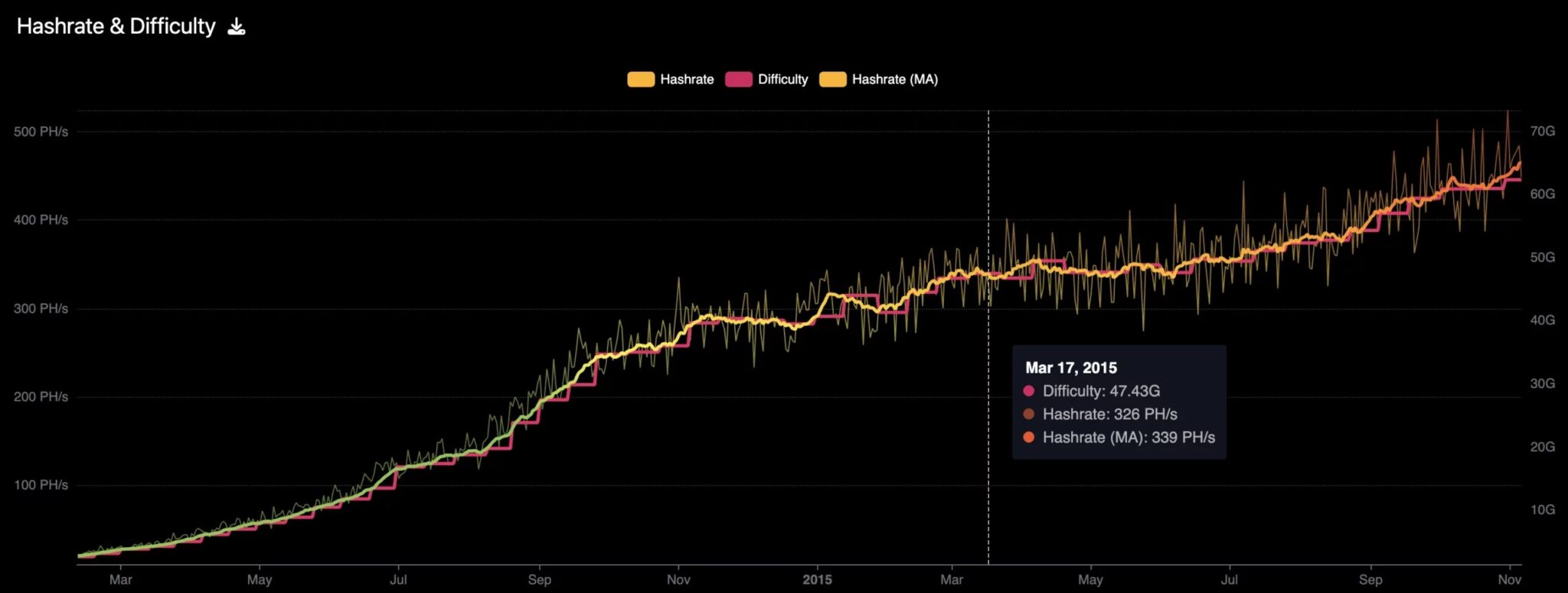
This could then lead to a temporary drop in the hashrate, i.e., the computing power available to secure the network and process transactions. During this period, block confirmation may slow down until the Bitcoin protocol automatically readjusts its difficulty (approximately every two weeks), as provided for by its algorithm.
The network then becomes slower, but no Bitcoin can be lost as long as at least one honest node manages to survive the solar winds.