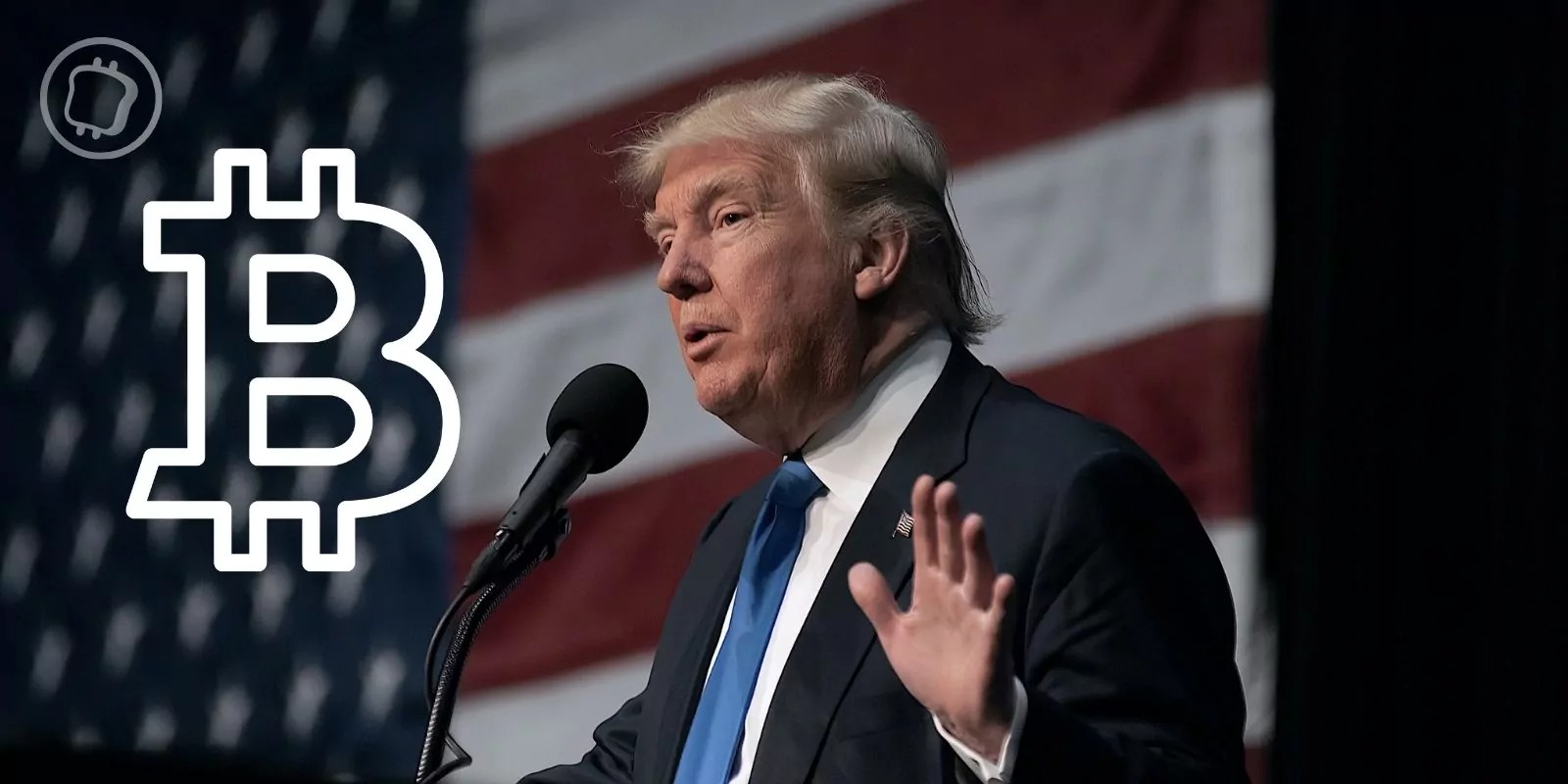
Donald Trump’s inauguration in January 2025 turned Bitcoin into a U.S. national priority. This led to the launch of the U.S. strategic cryptocurrency reserve, the regulation of stablecoins, and a huge leap forward in institutional adoption. The president laid the groundwork for a crypto-friendly ecosystem that spread to other countries, including France.
2025, the year Bitcoin went mainstream
Donald Trump’s inauguration on January 20, 2025, was a game-changer for the crypto sector. And not just in America! Immediately following the president’s inauguration, Bitcoin surged to $109,000, driven by Trump’s promises to make cryptocurrencies a “national priority.” Within twelve months, the Trump administration transformed the regulatory landscape, launching a series of pro-crypto measures.
It began quickly after his return to the White House: remember, in March 2025, Donald Trump signed a historic executive order establishing Bitcoin as a strategic reserve of the United States. He also included Ethereum, Solana, XRP, and Cardano in his reserve. At the state level, states like Texas have passed their own laws to establish strategic Bitcoin reserves. Gradually, other countries such as the Philippines and Taiwan announced over the course of the year that they would follow suit and launch their own strategic reserves.
Also this year, in July, President Trump signed the GENIUS Act, creating the first federal regulatory framework for stablecoins. This law imposes strict rules on reserves, including regular audits. Following this, crypto adoption has accelerated: we’ve gone from approximately 70 companies buying and holding Bitcoin (Bitcoin Treasury Companies) at the start of the year to over 130 by mid-2025, and it’s not over yet.
Once again, the president himself has been involved: Trump Media & Technology Group (TMTG), the parent company of Truth Social, made a massive investment by acquiring $2 billion in BTC via Bitcoin ETFs for its treasury in May. This strategy has positioned TMTG among the largest publicly traded institutional holders of the cryptocurrency.
And it’s not just the U.S. president, but his entire family, who have jumped into crypto: World Liberty Financial (WLFI), a DeFi project launched in late 2024 by the Trump family, has continued to grow this year, launching the USD1 stablecoin in March 2025. The eldest sons, Eric and Donald Trump Jr., co-founded American Bitcoin (ABTC) in March 2025 with Hut 8, a BTC mining giant. A mining company that was listed on the Nasdaq.
Democratization… and above all, the politicization of crypto
Huge strides this year have made Bitcoin more accessible than ever. In 2025, institutional investors increasingly poured money into Bitcoin ETFs, as Hubert de Vaplane, a partner at Morgan Lewis, highlighted on BFM Business.
2025 was a pivotal year in terms of price trends and market institutionalization.
But this goes beyond mere democratization. The crypto sector clearly became politicized in 2025, as Alexandre Stachtchenko, Chief Strategy Officer at Bitstack, states:
Once Donald Trump started talking about Bitcoin and won the election, most other political parties realized they had to talk about it to win.
The debate over Bitcoin has thus taken a political turn in France as well: Sarah Knafo, a Reconquête MP, was the first to publicly advocate for the creation of strategic Bitcoin reserves for Europe in December, quickly joined by the National Rally, which incorporated the crypto topic into its platform.
In October, Eric Ciotti’s group introduced a largely pro-crypto bill, proposing a national strategic reserve, crypto in the PEA, tax payments in BTC, and the development of French mining. Alexandre Stachtchenko summarizes, again on BFM:
In 2024, talking about Bitcoin was taboo. By late 2025, nearly the entire political spectrum had taken a stance on Bitcoin.
A complete break from previous years. Will 2026 continue this momentum? Yet, all these promising institutional advances were not enough to keep Bitcoin near its highs as the year came to a close.
After an ATH of $126,000 in early October, Bitcoin suffered a 15% flash crash on October 10. The correction continued in November, hitting a low of $80,600—the lowest point of the year. Today, Bitcoin’s price remains around $87,000, down 4 to 5% for the year despite October’s peak.