Paying with Bitcoin at any street vendor in Bangkok is now a reality, without the merchant having to change their routine. While global merchant adoption often faces technical challenges, an ingenious solution circumvents these obstacles by leveraging a peer-to-peer app.
The Lightning Network and peer-to-peer integrated into the Thai banking network
In Thailand, the PlebQR app has successfully made Bitcoin compatible with PromptPay, the national Thai payment standard available at nearly all points of sale.
In practice, with PlebQR, the user scans the merchant’s PromptPay QR code via the app. Instead of debiting baht (the local currency), they send satoshis (via the Lightning Network, for example) to a local intermediary, a “pleb.” The pleb, acting as a liquidity provider, instantly pays the merchant in baht from their own bank account.
This way, the merchant sees no difference—they receive baht without ever handling Bitcoin or being exposed to its volatility.
Since its launch in December 2024, PlebQR has facilitated 1,192 payments, totaling 604,304.17 THB, or more than 16,500 euros. The app has proven reliable with a success rate of over 75%, and it’s also quite fast: it takes an average of 30 to 45 seconds to find a peer willing to accept the offer, followed by an additional 45 to 60 seconds for the payment to be finalized.
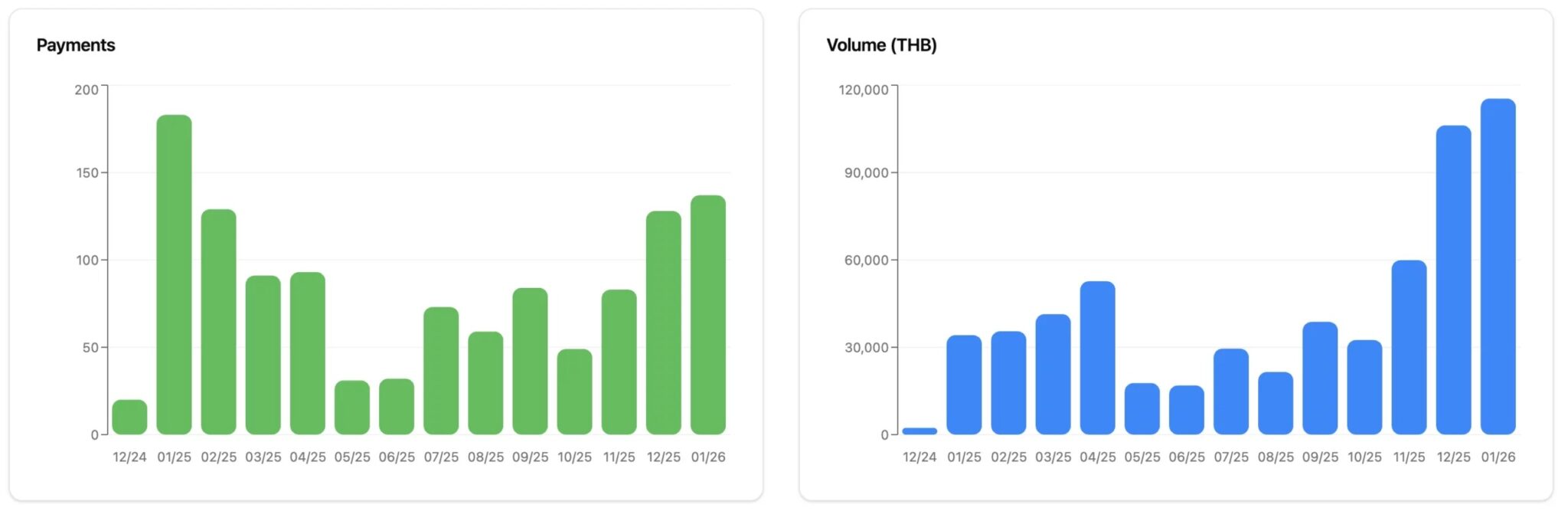
Volumes and number of transactions made with PlebQR
PlebQR operates as a peer-to-peer (P2P) marketplace, connecting those who want to spend BTC with those looking to accumulate it.
Calle, a developer of Bitcoin, Cashu, and BitChat, attests to the system’s effectiveness after testing it in the field:
I’ve been living almost entirely on Bitcoin for the past few weeks, buying food, drinks, clothes, and tickets with the sats I earn by posting nonsense on Nostr. […] In Thailand, as in many other parts of the world—especially in Asia—the most common digital payment methods aren’t credit cards, but QR codes. […] That’s where PlebQR comes in. I’d describe PlebQR as a “Let me pay for you” app. It connects you—someone who wants to buy a drink with Bitcoin—with a stranger online who wants your Bitcoin and pays the bill in fiat currency via a QR code on your behalf!
The tax headache: a major obstacle to Bitcoin’s adoption as currency
While PlebQR removes technical barriers, using Bitcoin as everyday currency still faces tax and regulatory complexities that vary depending on the user’s tax residency.
For a European, every coffee paid for in Bitcoin technically constitutes a taxable asset sale. In France, a 30% flat tax applies to capital gains as soon as total sales exceed 305 euros per year, requiring complex calculations for each micro-transaction.
The situation is different in neighboring countries; Germany, for example, exempts gains if the assets are held for more than one year (or if the profit is less than 600 euros), while Switzerland applies a 0% rate for individuals classified as private investors.
Before Bitcoin can be considered for adoption as a daily currency in France, tax restrictions will first need to be relaxed to allow Bitcoin to become a genuine alternative to fiat currencies.