
Cap is establishing itself as a next-generation stablecoin protocol, guaranteeing yield security through a financial instrument used in institutional lending. Want to receive the upcoming Cap protocol airdrop? Discover the different methods for earning Cap points and maximizing your allocation.
What Is Cap?
Deployed on the Ethereum blockchain, Cap is a stablecoin protocol that aims to provide credible and verifiable financial guarantees.
It stands out by functioning as a neutral and open aggregation layer, addressing the current fragmentation of stablecoins and yield opportunities.
To achieve this, Cap offers two main products:
- cUSD: A stablecoin backed 1:1 by other top-tier stablecoins such as USDC and USDT, as well as by tokenized money market funds like those from WisdomTree and Franklin Templeton;
- stcUSD: An interest-bearing savings product accessible by staking cUSD. The key innovation is that the risk associated with generating returns is hedged, offering users protection against losses. It allows holders to generate effortless passive income (8.60% per year as of December 1, 2025).
Cap marks the emergence of a new category of stablecoins. Unlike traditional models (Type I and II), where the team manages the collateral and the risk is ultimately borne by the user, Cap adopts a Type III approach.
In fact, the Cap protocol decentralizes yield allocation to market dynamics rather than human discretion. This both protects users and ensures true scalability. Here’s how Cap achieves this
- Decentralized allocation: The markets decide where yield is generated and allocate the collateral, not a central team. Allocations are reserved exclusively for institutions;
- Risk borne by decision-makers: The risk of loss is borne by delegators and yield generators;
- User protection: Users of cUSD and stcUSD are protected against losses, as funds liquidated in the event of an undercollateralized loan are redistributed to maintain the cUSD’s 1:1 peg.
This design, centered on credible financial guarantees and decentralized risk, has enabled Cap to offer a stablecoin that institutions can truly adopt.
As a result, major investors such as Franklin Templeton, WisdomTree, IMC, and Susquehanna are not only investing but also actively using the protocol. For example, WisdomTree has approved Cap’s smart contracts to integrate its money market fund as collateral, marking the first interaction of this scale between a regulated asset manager and a DeFi protocol.
How to participate in the Cap airdrop?
Since October 13, Cap has entered the third phase of Frontier, its points-earning program. This program allows users to accumulate points called “Caps,” which could be a sign that an airdrop is in the works.
The goal is clear: accumulate as many Caps as possible to climb the user rankings and become eligible for the future distribution of the protocol’s token. Caps are earned by interacting with Cap’s flagship products (cUSD and stcUSD):

The simplest method: holding cUSD (10x Caps)
If you want to start farming with minimal effort, the simplest strategy is to acquire and hold cUSD over time.
You can obtain cUSD directly via the swap feature on the Cap app (at https://cap.app/swap). To do this, you’ll need USDC in your wallet:
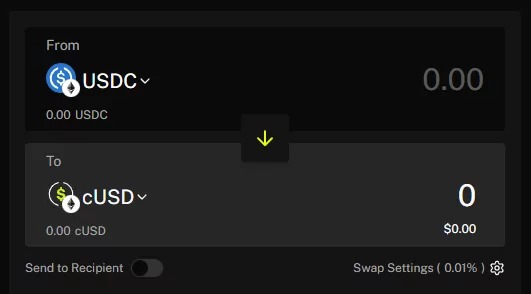
Simply holding cUSD allows you to accumulate Caps with a 10x multiplier.
Advanced strategies on Pendle and other platforms (up to 20x Caps)
To maximize your rewards, Cap encourages the use of structured products via platforms like Pendle, Morpho, or Yield Optimizers (Beefy, etc.). These strategies offer the highest multipliers for earning Caps.
For users looking to take it further, two strategies on Pendle are particularly lucrative:
- Deposit YT-stcUSD or provide liquidity to the pool for a x5 multiplier on Caps (accessible at this address);
- Deposit YT-cUSD or provide liquidity to the pool for a x20 multiplier on Caps (accessible at this address).
These options on Pendle allow you to isolate your exposure to future returns (PT and YT), significantly increasing the efficiency of your farming.
Advanced farming strategies on platforms like Pendle use structured products that may seem complex at first glance. Understanding PT and YT tokens is crucial to mastering Caps multipliers.
The PT, or Principal Token, represents the initial capital locked on Pendle. By purchasing a PT, a fixed yield is guaranteed on that capital until maturity.
The YT, or Yield Token, represents the future yield stream (interest and rewards) generated by the underlying capital until maturity. By purchasing a YT, you gain leveraged exposure to the asset’s variable yield, allowing you to speculate on a rise in the interest rate or the accumulation of airdrop points, but it becomes worthless at maturity.
Now, here’s how this works for cUSD and stcUSD:
- PT-stcUSD: A token representing capital in stcUSD; it offers a fixed yield and can be exchanged 1:1 for 1 stcUSD at maturity;
- YT-stcUSD: A token that captures the yield of stcUSD: it accumulates stcUSD and Caps points as long as the position is open, then it is worth 0 at maturity;
- PT-cUSD: A token representing the principal in cUSD: it provides access to a fixed yield and can be exchanged for 1 stcUSD at maturity;
- YT-cUSD: A token that tracks the return on cUSD: it allows you to earn Caps points as long as the position remains open, but its value drops to 0 at maturity.
The idea is simple: the more you interact with and lock up value in the Cap ecosystem, the more Caps you accumulate for the airdrop.