
Ethereum’s latest upgrade appears to have won over users of this iconic blockchain, with daily transactions reaching a new all-time high. This has prompted Vitalik Buterin to set a key challenge: building a “world computer” capable of revolutionizing the Internet.
Ethereum Sets a New Record for Daily Transactions
When discussing Ethereum, it is now necessary to specify whether one is referring solely to its Layer 1 blockchain or to its entire ecosystem, which consists of a multitude of associated Layer 2 solutions designed to provide enhanced scalability within a unified “Interop Layer” environment.
This evolution involves several key milestones, such as its latest Fusaka upgrade, validated in early December, which led to an increase in activity on its blockchain alongside a significant drop in fees.
This momentum is expected to continue into the new year, particularly given the recent all-time high of over 2.2 million daily transactions recorded on December 29, which has definitively surpassed the previous peaks from the 2021 bull market and the NFT craze.
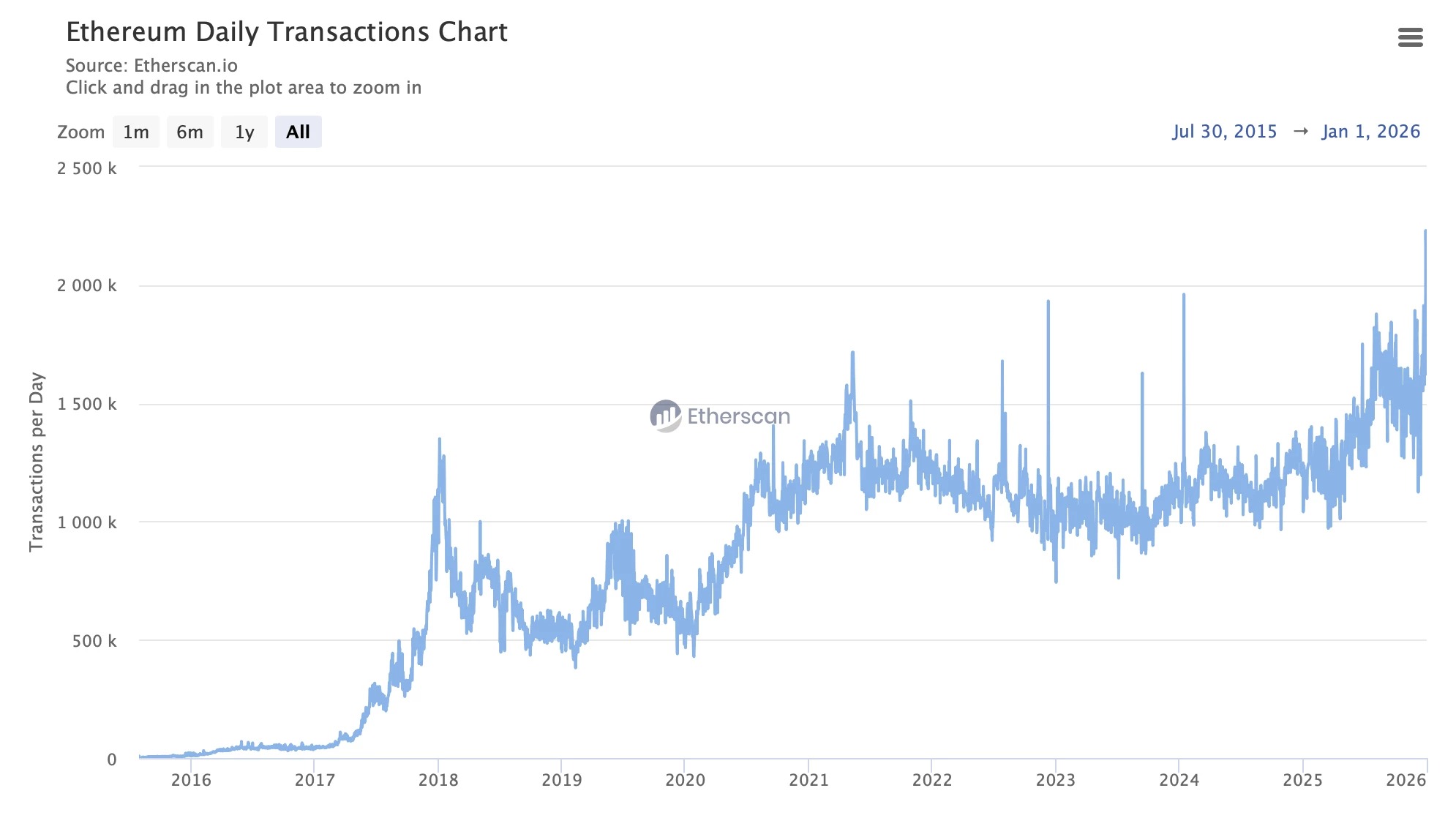
Daily transactions on Ethereum hit a new record
At the same time, the number of active addresses on the Ethereum blockchain has also reached its highest level since 2021—nearly 730,000—while the number of new addresses created simply skyrocketed on December 31, posting the sharpest daily increase recorded since early 2018.
The recent surge has been driven primarily by network upgrades that have drastically reduced fees, improved scalability, and attracted institutional participation through ETFs and the tokenization of real-world assets.
Nick Ruck, Director of Research at LVRG Research
Building the global computer that serves as the infrastructure for a freer and more open Internet
A surge in activity on Ethereum coincides with a post by its iconic co-founder, Vitalik Buterin, in the form of New Year’s greetings.
This is an opportunity to recall that this blockchain is designed to enable the creation of decentralized applications (dApps) “that operate without fraud, censorship, or third-party interference (…) for finance, but also for identity, governance, and any other civilizational infrastructure that people wish to build.”
This is not about the quest to “win the next meta”—whether it involves tokenized dollars or political memecoins—nor is it about arbitrarily convincing people to fill up blockspace to make ETH “ultrasound” again. Rather, it is about the following mission: building the global computer that serves as the central infrastructure for a freer and more open Internet.
Vitalik Buterin
Because the development of a Layer 2 ecosystem, however powerful and useful it may be, must not overshadow the importance of the Layer 1 blockchain on which it rests.